The Halal Product Assurance Organizing Agency (Badan Penyelenggara Jaminan Produk Halal – BPJPH) has issued BPJPH Regulation No. 3 of 2026 on the Form and Procedures for Displaying Non-Halal Information, establishing standardized requirements for determining whether a product must carry a non-halal statement and how such information must be formatted and displayed.
The regulation was issued on July 13, 2026 and became effective upon promulgation, with a 12-month transition period for products already circulating in Indonesia.
As Indonesia continues implementing its mandatory halal certification framework, the government has introduced this new regulation to standardize how products that are not halal must be identified in the Indonesian market. The regulation also represents the formal implementation of the WTO-notified draft regulation on Non-Halal Information Labelling, published in February 2026, which proposed standardized non-halal labels for products that cannot obtain halal certification or are manufactured using non-halal ingredients or production processes.
Highlight of BPJPH Regulation No. 3 of 2026
The regulation introduces three key changes that overseas manufacturers and local businesses should understand before placing products on the Indonesian market.
Businesses determine whether a product requires a non-halal label
Unlike halal certification, which requires assessment through the halal certification process, the determination of whether a product requires a Non-Halal Information statement is made independently by the business operator based on the criteria specified in the regulation.
The determination may be based on:
the characteristics of the product's ingredients; and/or
the production process that does not comply with Indonesia's Halal Product Assurance System (SJPH).
This means businesses are expected to assess their own products before placing them on the Indonesian market and ensure the appropriate non-halal information is displayed where required.
Detailed Criteria for Determining Non-Halal Products
To provide greater regulatory certainty, BPJPH Regulation No. 3 of 2026 sets out detailed criteria for determining when a product must be classified as non-halal. The assessment is based on two key aspects: the ingredients used and the production process.
Ingredient-Based Criteria
A product may be required to display Non-Halal Information if it contains ingredients derived from prohibited sources, including:
animal sources;
plant sources;
contain alcohol;
microorganisms;
materials produced through chemical, biological, or genetic engineering processes;
human body parts; or
najis (impure) or mutanajis (contaminated) materials.
The regulation further provides detailed classifications under each category. For example, ingredients derived from the carcass of an otherwise halal animal are still considered non-halal if the animal dies without being slaughtered in accordance with Islamic requirements. This includes animals that die due to strangulation (al-munkhaniqah), blunt force (al-mawquzah), falling (al-mutaraddiyah), or goring (al-nathihah). These provisions also apply to animals that are generally considered halal, such as cattle, buffalo, camels, goats, horses, chickens, ducks, etc.
Production Process Criteria
A product may also be classified as non-halal if its production process does not comply with the Halal Product Assurance System (SJPH). This includes situations where production facilities, equipment, storage areas, packaging, distribution, or serving processes come into contact with or are contaminated by prohibited, impure (najis), or contaminated (mutanajis) materials.
For example, a product may be classified as non-halal if production facilities or equipment used for halal products come into contact with prohibited, impure (najis), or contaminated (mutanajis) materials and are not subsequently cleansed in accordance with the requirements of the Halal Product Assurance System (SJPH). The non-compliance may occur during processing, storage, packaging, distribution, sale, or serving, where contact or cross-contamination with prohibited materials is not properly prevented.
By establishing comprehensive criteria covering both ingredients and production processes, the regulation provides businesses with a clearer framework for determining whether their products are required to display Non-Halal Information before being marketed in Indonesia.
Standardized Non-Halal Labels
One of the regulation's key developments is the introduction of standardized non-halal labels that must be used throughout Indonesia. The regulation distinguishes between products containing pork and products that are non-halal for other reasons.
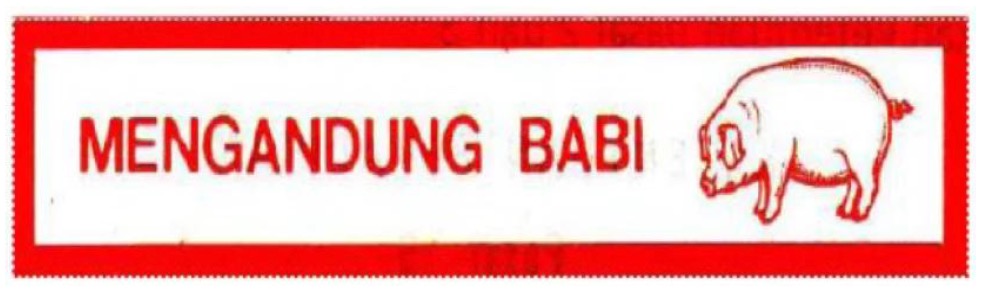
Products containing pork or pork-derived ingredients must display the statement "MENGANDUNG BABI" (Contains Pork) together with a pig symbol inside a red rectangular box with a white background.
Products containing other prohibited ingredients or produced through non-compliant production processes must display the statement "NON HALAL" in a standardized red rectangular box with a white background.

The regulation also specifies technical design requirements, including typography, colour codes, and visual appearance, to ensure consistency across all products marketed in Indonesia.
Requirements for Label Placement
In addition to specifying the label format, BPJPH Regulation No. 3 of 2026 establishes detailed rules on where and how the non-halal information must be displayed.
The label may be placed on:
the product packaging;
a specific part of the product; or
another designated location on the product.
Where packaging is used, the information must appear on the outermost packaging received by consumers.
The regulation further requires that the label:
be proportionally displayed;
be placed in a clearly visible and easily readable location;
remain unobstructed by graphics or packaging design; and
be permanent and not easily removed or damaged.
For products with limited packaging space, such as small-sized consumer products, businesses may use alternative methods permitted under the regulation to ensure the required information remains visible to consumers.
Additional Requirements for Bulk Products
The regulation also introduces specific requirements for products sold in bulk rather than retail packaging.
In such cases, businesses must display the required non-halal information on containers, dispensers, or other visible signage. In addition, they must maintain supporting documentation issued by the material manufacturer, such as production flowcharts, product composition, Certificates of Analysis (CoA), declarations, or equivalent documents demonstrating that the product contains prohibited materials or is produced through a non-compliant production process. Businesses are responsible for ensuring the authenticity and validity of these supporting documents.
What Should Businesses Do?
With the new non-halal labelling requirements now in force, overseas manufacturers exporting products to Indonesia, as well as businesses already marketing products in Indonesia that meet the non-halal criteria, should begin assessing whether their products are subject to the new requirements and take the necessary steps to ensure compliance.
Businesses are advised to:
assess whether their products contain prohibited ingredients or are manufactured using production processes that do not comply with the Halal Product Assurance System (SJPH);
determine whether their products are exempt from mandatory halal certification but are required to display Non-Halal Information;
review product packaging to ensure the prescribed non-halal statement, design, colour, and placement comply with BPJPH Regulation No. 3 of 2026;
prepare supporting technical documentation for products supplied in bulk, including production flowcharts, product composition, Certificates of Analysis (CoA), or equivalent documents where required;
take advantage of the 12-month transition period to update packaging and internal compliance procedures for products already circulating in Indonesia;
Conclusion
BPJPH Regulation No. 3 of 2026 marks another significant milestone in the implementation of Indonesia's Halal Product Assurance framework. Rather than expanding the scope of mandatory halal certification, the regulation establishes standardized criteria and technical requirements for determining and displaying Non-Halal Information, providing greater legal certainty for businesses and improving transparency for consumers.
For overseas manufacturers and businesses already marketing products in Indonesia, compliance now extends beyond determining whether a product is halal or non-halal. Companies should assess whether their products fall within the scope of the regulation, ensure that non-halal products are correctly labelled and supported by the required documentation, and update product packaging within the applicable transition period.
Although the regulation is already legally effective, BPJPH is expected to conduct socialization as further guidance and reach broader public outreach. Businesses should therefore continue monitoring regulatory developments while taking proactive steps to comply with the new requirements. Early preparation will help minimize compliance risks, avoid potential administrative sanctions, and ensure continued access to the Indonesian market.
Need Professional Halal & Food Compliance Support?
Our Indonesia food compliance experts are ready to help you assess whether your products require non-halal labelling under BPJPH Regulation No. 3 of 2026, update your packaging, and maintain full compliance with Indonesia's product assurance requirements.
Email: customer@reach24h.com