Introduction
Mexico is a key market for agrochemicals, but its pesticide registration system is complex, requiring joint technical approval from COFEPRIS, SEMARNAT, and SENASICA pursuant to of the General Health Law (LGS), RPLAFEST, and relevant NOMs.
This guide provides a clear and practical overview of Mexico’s pesticide regulations, including definitions, classification criteria, key authorities, registration process, and timelines.
Whether you are a multinational manufacturer or a local distributor, this resource is designed to help you understand the registration process, mitigate common pitfalls, and develop an efficient market entry strategy in Mexico.
Definition of Pesticides in Mexico
In Mexico, a pesticide is defined as any substance or mixture intended to control pests, including vectors of human or animal diseases, species detrimental to agriculture or forestry, as well as defoliants and desiccants.
Classification of Pesticides by Origin and Intended Use
Under the Mexico's regulationframework, pesticide are categorized by their origin and intended use:
By Origin
Mexico classifies pesticides primarily based on the source and nature of their active ingredients, resulting in several distinct regulatory categories.
Chemical pesticides: Products with chemically synthesized substances, representing the traditional and most extensively regulated class of pesticides.
Biochemical pesticides: Products based on semiochemicals, which act by modulating the behavior or communication of target organisms rather than through direct toxicity. This category includes pheromones as well as allelochemicals, such as allomones and kairomones.
Microbial pesticides: Derived from living microorganisms and include products based on bacteria, fungi, viruses, nematodes, or protozoa. These products are typically evaluated with special attention to biological characteristics and environmental behavior.
Botanical pesticides: Formulated from plant-extracted active substances and are generally distinguished by their natural origin.
Other pesticides: Products that do not exhibit conventional physicochemical or toxicological pesticide properties but still achieve pest control through alternative mechanisms. Examples include physical barrier products and behavior-modifying technologies.
By Intended Use
In addition to origin-based classification, pesticides are also categorized according to their intended use:
Agricultural Use: Products applied directly to plants to prevent, repel, control, or eliminate harmful organisms.
Household Use: Products used in residences, buildings, and non-industrial facilities.
Forestry Use: Products intended to protect forest resources from harmful organisms.
- Industrial Use: Products used in:
Manufacturing of non-food products (e.g., paints, varnishes, shellac, paper, cellulose, cardboard)
The treatment of recirculating water in industrial processes
Horticultural Use: Formulated pesticides intended to prevent, repel, control, or eradicate organisms harmful to horticultural or managed plant resources.
Livestock Use: Products used to control pests affecting animals, excluding orally administered or injectable products.
Urban Use: Products specifically intended for use in urban environments, including vacant land and railway lines.
Mexico’s Key Regulatory Framework for Pesticide Registration: LGS, RPLAFEST, and NOMs
Mexico's regulatory framework for pesticides is hierarchical, ranging from overarching statutes to specific technical standards.
General Health Law (Ley General de Salud, LGS)
The General Health Law (LGS) serves as the foundational legal instrument for pesticide regulation in Mexico. It establishes the statutory authority and overarching principles governing substances that may pose risks to human health, including pesticides.
RPLAFEST Regulation
The Regulation for Registration, Export and Import Permits and Certificates for Export of Pesticides, Fertilizers and Toxic and Hazardous Substances (Reglamento en Materia de Registros, Autorizaciones de Importación y Exportación y Certificados de Exportación de Plaguicidas, Nutrientes Vegetales y Sustancias y Materiales Tóxicos o Peligrosos commonly referred to as RPLAFEST) operationalizes the requirements of the General Health Law into actionable rules. It defines detailed procedures and technical requirements covering pesticide registration, data submission, import and export authorization, and lifecycle compliance obligations.
Official Mexican Standards (Normas Oficiales Mexicanas, NOMs)
The Official Mexican Standards (NOMs) establish binding technical specifications for implementation. Key pesticide-related standards include:
NOM-232-SSA1-2009, which sets requirements for pesticide packaging, labeling, and hazard classification
NOM-082-SAG-FITO/SSA1-2017, which establishes Maximum Residue Limits (MRLs) in food
NOM-033-FITO-1995, which regulates pesticide commercialization and mandatory training for sales personnel
NOM-034-FITO-1995, which specifies requirements for pesticide manufacturing and formulation facilities
Regulatory Authorities for Pesticide Registration in Mexico
Unlike many jurisdictions with a single lead agency, Mexico requires technical consensus from three federal bodies. A rejection from any one of these can halt a registration process.
COFEPRIS (Federal Commission for Protection against Sanitary Risks)
Operating under the Ministry of Health (SALUD), COFEPRIS coordinates the overall pesticide registration process and is responsible for issuing the final registration certificate. Its technical assessment focuses on human health risks, including acute and chronic toxicology as well as overall product safety.
SEMARNAT (Ministry of Environment and Natural Resources)
The Ministry of Environment and Natural Resources (SEMARNAT) evaluates the environmental risks associated with pesticide use. Its review encompasses ecotoxicology, environmental fate, and the potential environmental impacts of pesticide products.
SENASICA (National Service for Agro-Food Health, Safety and Quality)
SENASICA, operating under the Ministry of Agriculture and Rural Development (SADER), conducts the agricultural evaluation of pesticides. Its evaluation focuses on biological efficacy, crop safety, and Maximum Residue Limits (MRLs).
Who Is Eligible to Apply for Pesticide Registration in Mexico?
Applicants for pesticide registration must be individuals or legal entities legally established in Mexico. Foreign manufacturers are therefore required to appoint a local Mexican registration holder or establish a local subsidiary in order to submit registration applications.
Pesticide Registration Process
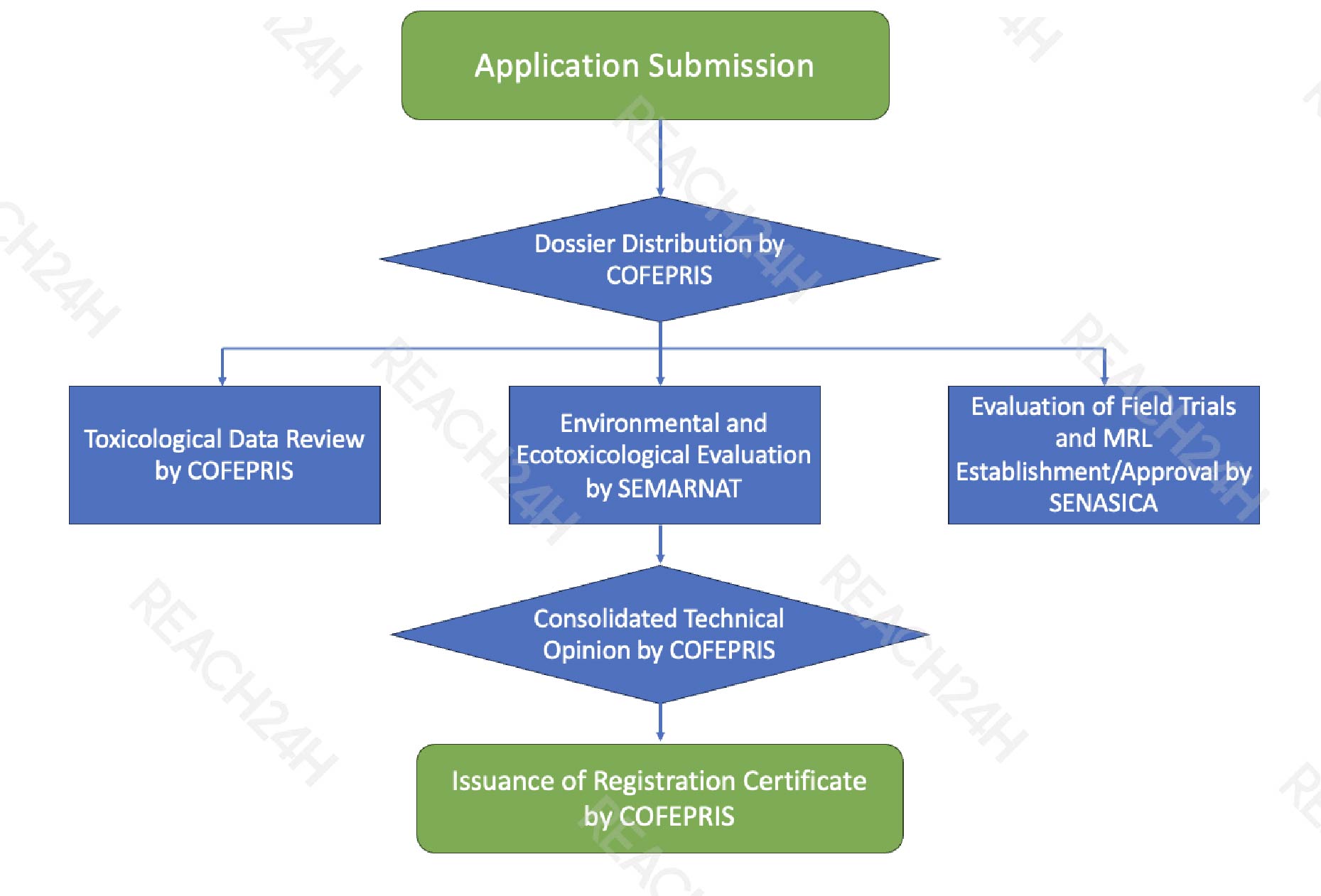
The Mexican registration system is defined by a Three-Party Parallel Review Mechanism. While COFEPRIS serves as the administrative lead and issues the official registration certificate. For a registration application to be approved, favorable technical evaluations from all three federal agencies are a mandatory requirement.
Step 1: Centralized Submission and Distribution
The process is initiated when a legally incorporated Mexican entity submits the registration dossier to COFEPRIS. As the central coordinator, COFEPRIS performs an initial administrative check and then handles the Dossier Distribution, transmitting the relevant technical sections to SEMARNAT and SENASICA for concurrent review.
Step 2: Specialized Technical Evaluation: The Three Pillars
The technical review phase occurs in parallel across three apartments:
COFEPRIS: Affiliated to the Ministry of Health (SALUD). It focuses primarily on the human health risk section of pesticide dossiers and reviews acute/chronic toxicology studies, safety assessments, and related content.
SEMARNAT: It is responsible for evaluating the environmental impact of pesticides, and conducts reviews on ecotoxicology, environmental fate, environmental impacts as well as relevant content.
SENASICA: Affiliated to the Ministry of Agriculture and Rural Development (SADER/SAGARPA). It takes primary charge of the agricultural application of pesticides, and reviews such aspects in dossiers as product efficacy (bioavailability), Maximum Residue Limits (MRLs), and crop safety.
Step 3: Consensus Integration and Final Issuance
The final phase of the registration is dependent on technical consensus:
Consolidated Technical Opinion: COFEPRIS integrates the independent technical opinions from SEMARNAT and SENASICA with its own opinion.
Final Decision: A favorable outcome from all three departments is mandatory; an objection from any single agency will stall the registration.
Certification: Upon achieving consensus, COFEPRIS issues the final Registration Certificate.
Key Timelines
Mexico applies standardized statutory review timelines for different registration scenarios:
Validity Period: Registration certificates are valid for five years. Renewals should ideally be initiated six months prior to expiry to ensure business continuity.
Strategic Support by REACH24H
Navigating the complexities of RPLAFEST and coordinating between three federal agencies requires high-level technical expertise. REACH24H Consulting Group provides a one-stop compliance solution for the Mexican market:
Technical active ingredient registration in Mexico
Formulated product registration in Mexico
Registration of equivalent active ingredients in Mexico
Plant nutrient registration in Mexico, including plant growth regulators, biostimulants, and fertilizers
Local registration holder services in Mexico
Support for establishing Mexican subsidiaries
Data evaluation, gap analysis, and waiver strategies
Development of Mexican registration strategies
Comprehensive regulatory consulting and professional training
Why Choose REACH24H?
Global Regulatory Experience
REACH24H has over a decade of experience tracking pesticide regulations across China, the EU, the US, Canada, Australia, Brazil, Argentina, and other regions. The company has extensive experience managing complex projects and resolving challenging regulatory issues, ensuring smooth pesticide registration in Mexico.
Strong Technical Expertise and Expert Team
Our agrochemical technical team includes experts in analytical chemistry, chemical engineering, biology, toxicology, and environmental science, supported by internationally trained professionals. This expertise provides solid technical support for high-complexity registration projects.
One-Stop Premium Service
REACH24H helps clients maximize dossier quality and reliability and provides technical support to defend submissions before authorities. We also develop tailored global market access and registration strategies, helping companies reduce costs, shorten timelines, and overcome regulatory barriers efficiently.
Extensive QSAR Project Experience
With multiple globally certified toxicologists, our team provides reliable support for QSAR reports and toxicology data required for Mexican pesticide registration. We have prepared thousands of QSAR reports for regions including the EU, Brazil, Mexico, Argentina, Australia, and Russia, achieving a consistently high acceptance rate.
Contact Us
If you are planning to register pesticides in Mexico or facing regulatory challenges under LGS and RPLAFEST and relevant NOMs, our experts are here to help. Contact us at customer@reach24h.com today for tailored regulatory solutions and end-to-end compliance support.