U.S. EPA Pesticidal Device Compliance and Establishment Registration Services
UV antimicrobial lamps, ozone generators, mosquito killer lamps, ultrasonic pest repellers, hypochlorous acid generators, air purifiers, water purifiers, and other products may be regulated by the U.S. Environmental Protection Agency (EPA) under the Federal Insecticide, Fungicide, and Rodenticide Act (FIFRA) when entering the U.S. market.
Unlike pesticide products that require U.S. EPA pesticide registration, products that meet the definition of a pesticidal device (Pesticide Device) generally do not require federal pesticide product registration. However, companies still need to fulfill obligations related to U.S. EPA company and establishment registration, initial and annual production reporting, product labeling, packaging and efficacy claim compliance, Notice of Arrival (NOA) for imports, and registration requirements imposed by certain states on device products.
Therefore, before exporting products to the United States, listing them on cross-border e-commerce platforms, or expanding sales into new states, companies should first determine: whether the product falls within the scope of FIFRA, whether it meets the requirements applicable to pesticidal devices, and which compliance obligations actually apply.
REACH24H provides U.S. EPA regulatory compliance support for manufacturers, brand owners, and exporters of pesticidal devices planning to enter the U.S. market. Based on the specific circumstances of each company and product, REACH24H can support U.S. EPA company number and establishment registration, initial and annual production reporting, label and efficacy claim review, Notice of Arrival filings, state-level registration, and related compliance work.
What Is a Pesticidal Device Regulated by the U.S. EPA?
Under FIFRA, a pesticidal device (Pesticide Device) is any instrument or contrivance, other than a firearm, intended for trapping, destroying, repelling, or mitigating pests, including insects, rodents, fungi, bacteria, viruses, and other microorganisms, and that primarily works through purely physical or mechanical means. For microorganisms, this does not include bacteria, viruses, or other microorganisms on or in living humans or other living animals. Pesticidal devices that meet the definition generally do not require U.S. EPA pesticide registration, meaning they do not receive an EPA Registration Number. However, this does not mean that such products are unregulated or can enter the U.S. market without meeting applicable requirements.
Companies still need to fulfill obligations including, but not limited to:
U.S. EPA company number and production establishment registration;
Initial and annual production reporting;
Product labeling, packaging, and efficacy claim compliance;
Notice of Arrival (NOA) before products are imported into the United States;
Additional registration requirements imposed by certain states on device products;
Other compliance obligations applicable to specific products.
Therefore, companies preparing to export UV antimicrobial lamps, ozone generators, mosquito killer lamps, ultrasonic pest repellers, hypochlorous acid generators, air purifiers, water purifiers, and other pesticidal devices to the United States should first determine whether the product falls within the scope of FIFRA, whether it meets the definition of a pesticidal device, and which specific compliance obligations apply.
Which Products May Be Regulated by the U.S. EPA as Pesticidal Devices?
Pesticidal devices generally achieve disinfection, insect control, insect trapping, pest repellency, or other pest-control effects through physical or mechanical means. Common products include, but are not limited to:
| Product Type | Typical Product Examples |
|---|---|
| 1. Sterilization and Disinfection Devices (UV/Ozone/Electrochemical, etc.) | UV antimicrobial lamps, UVC disinfection wands, baby bottle UV sterilizers, ozone generators, electrolyzed water/hypochlorous acid generators |
| 2. Air Purification and Treatment Devices (Filtration/Ionization/Photocatalysis) | Air purifiers, air filtration devices, plasma generators, photocatalytic air treatment devices |
| 3. Insect-Killing and Insect-Trapping Devices (Light Attraction/Electric Shock/Physical Trapping) | Blacklight insect traps, high-voltage mosquito killer lamps, electric mosquito swatters, fly traps, sticky fly boards, insect glue papers, electric flea combs |
| 4. Insect, Bird, and Animal Repellent Devices (Sound/Ultrasound/Optical/Mechanical) | Ultrasonic rodent repellers, ultrasonic insect repellers, sound-and-light bird repellers, underground vibration mole repellers |
Important: A product name alone does not determine its regulatory status. The U.S. EPA generally considers the product composition, mode of action, intended use, and actual promotional claims together.
For products that both claim to provide a disinfection effect:
If the product works primarily through ultraviolet light, physical filtration, or similar means, it may be considered a pesticidal device;
If the product achieves its effect through a chemical substance with pesticidal or antimicrobial properties, it may instead be considered a pesticide product;
Some complex products may also be subject to other regulatory frameworks, including FDA requirements.
Therefore, before beginning EPA-related compliance work, companies should first determine the regulatory status of the product.
Common U.S. EPA Compliance Risks for Pesticidal Devices
1. Incorrect Product Classification
Companies may incorrectly classify a product that is actually a pesticide product regulated under FIFRA as a pesticidal device, or may overlook applicable regulatory requirements because they assume that “devices do not require EPA product registration.”
Incorrect product classification may directly affect subsequent establishment registration, labeling compliance, import requirements, and state-level pesticide regulatory obligations.
2. Incorrect EPA Establishment Registration or Establishment Number Use
Whether a pesticidal device is subject to EPA production establishment registration requirements needs to be assessed based on the product type, production activities, and supply chain model.
Companies should ensure that the EPA establishment information shown on the product label accurately corresponds to the actual production location and production activities. Borrowing, misusing, or improperly associating an unrelated establishment number is strictly prohibited.
3. Insufficient Support for Efficacy Claims
For claims involving bacteria control, virus control, sterilization, or control of other specific pests, companies should ensure that appropriate supporting evidence is available.
Particular attention should be paid to high-risk claims such as:
“Kills 99.9% of bacteria,” “100% insect kill,” and other quantified efficacy claims;
Claims targeting specific viruses, bacteria, fungi, or other microorganisms;
Absolute efficacy statements such as “complete elimination” or “permanent sterilization.”
4. Inconsistent Claims Across Websites, E-commerce Pages, and Product Labels
U.S. EPA scrutiny of product compliance is not limited to the physical product label. Product descriptions on company websites, product instructions, promotional materials, and online sales pages on platforms such as Amazon and TikTok Shop may also be reviewed as product promotional information.
If promotional materials contain efficacy claims that exceed the scope supported by available evidence or use non-compliant wording, they may also directly create risks of regulatory enforcement or product delisting.
How Should Companies Complete U.S. EPA Compliance for Pesticidal Devices?
To help companies entering the U.S. market establish a clear compliance pathway, REACH24H has organized the U.S. pesticidal device compliance process based on EPA regulatory requirements and market access needs, helping companies identify key compliance steps and reduce regulatory risks during U.S. market entry:
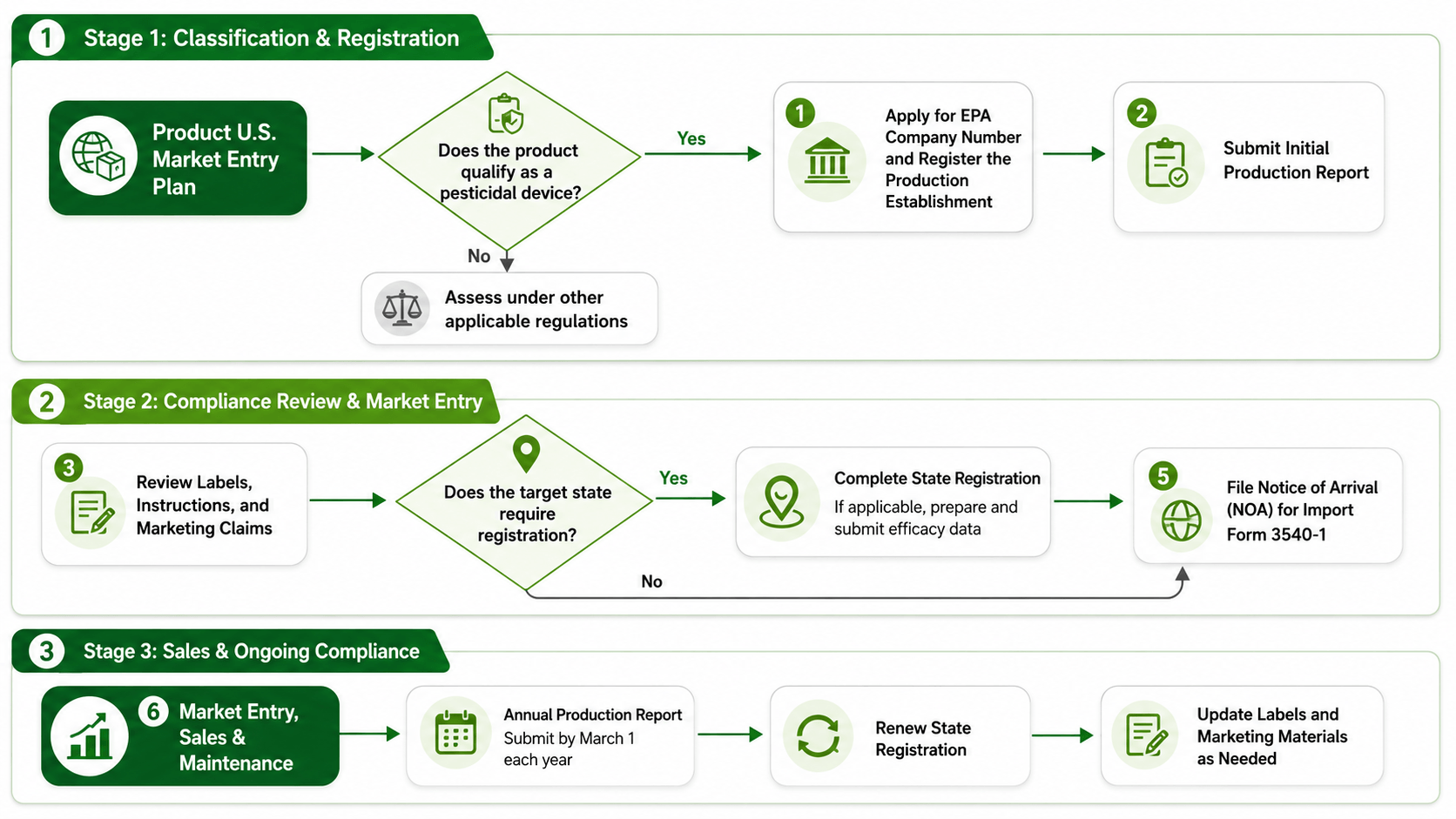
Note: Some U.S. states and jurisdictions currently impose additional state-level registration requirements for certain pesticidal devices, depending on the device type and applicable state requirements. Companies should confirm the specific compliance obligations based on their target sales states. States and jurisdictions that currently require registration for certain pesticidal devices include:
Colorado;
District of Columbia;
Hawaii;
Indiana;
New Mexico;
Oklahoma;
Wyoming;
West Virginia.
For broader information on state-level requirements, see State Pesticide Registration in the U.S..
REACH24H Services
Based on U.S. EPA regulatory requirements applicable to pesticidal devices, REACH24H can provide the following services according to the actual circumstances of the company and product:
Product regulatory status and compliance pathway analysis;
EPA company number and production establishment registration support;
Initial production report support;
Annual production report support;
U.S. EPA pesticidal device compliance support;
Compliance review of product labels, instructions, and e-commerce sales pages;
Notice of Arrival (NOA) filing support;
U.S. state-level pesticidal device registration support;
M009 product classification determination support;
Product information and data gap analysis;
Comprehensive regulatory consulting and customized training;
Annual U.S. agent services.
Why Choose REACH24H?
15+ Years
U.S. EPA Pesticide Device Registration Project Experience
3,000+
Federal & State Registrations Supported
50 States +
Washington, D.C.
U.S. State Market Coverage
Extensive Experience in U.S. Pesticide Regulatory Projects
REACH24H has been listed by the U.S. EPA as an official compliance consulting service organization. REACH24H has long monitored U.S. EPA regulatory and enforcement requirements for pesticides, antimicrobial products, and related devices. Based on product characteristics, REACH24H can assist companies in identifying the applicable regulatory pathway and provide regulatory and technical support for establishment registration, reporting, labeling, import requirements, and state-level requirements that may apply when entering the U.S. market.
U.S.-Based Regulatory and Project Coordination
REACH24H’s U.S. team works with its international regulatory teams to coordinate product information, regulatory communications, U.S. agent arrangements, and ongoing project management. This helps companies manage U.S. pesticidal device compliance across different functions, locations, and time zones while maintaining a clear point of coordination throughout the project.
Multidisciplinary Regulatory and Technical Team
REACH24H has technical professionals with backgrounds in analytical chemistry, chemical engineering, biology, pharmacology, environmental science, and other disciplines, as well as internationally certified toxicologists and professionals specializing in risk assessment. The team can conduct comprehensive evaluations based on product formulation, toxicology, efficacy, and regulatory requirements.
Testing and Technical Resource Coordination
REACH24H works with third-party laboratories and technical resources across relevant markets and can assist companies with testing program planning, study monitoring, and data compliance support.
Frequently Asked Questions About U.S. EPA Pesticidal Devices
U.S. EPA PESTICIDAL DEVICE COMPLIANCE SUPPORT
Planning to Export or Sell Pesticidal Devices in the United States?
If your product involves UV antimicrobial, air purification, ozone treatment, water treatment, insect control, insect trapping, pest repellency, or other pest-control functions, you can provide REACH24H with basic information including the product operating principle, composition information, labels and promotional materials, actual production establishment, and intended sales states.
Based on the product circumstances, REACH24H can assist companies in determining the applicable U.S. EPA regulatory pathway and assessing relevant requirements involving establishment registration, production reporting, labeling and efficacy claims, Notice of Arrival (NOA), state-level registration, or M009 product classification determination.
Contact Us for U.S. EPA Pesticidal Device Compliance Support