
U.S. TSCA COMPLIANCE SERVICES FOR EXISTING AND NEW CHEMICALS
Companies manufacturing or importing industrial chemicals into the United States must first determine whether each substance is subject to the Toxic Substances Control Act (TSCA), whether it is listed on the U.S. Environmental Protection Agency's TSCA Chemical Substance Inventory, and which pre-market or ongoing obligations apply. An Inventory-listed substance may still trigger import certification, a Significant New Use Rule (SNUR), Chemical Data Reporting (CDR), Notice of Activity (NOA) Form B, Section 6 restrictions, or other requirements. A substance not listed on the Inventory may require a Premanufacture Notice (PMN) or a valid exemption before non-exempt commercial manufacture or import.
REACH24H reviews substance identity, intended use, supply-chain roles, annual volume, commercialization plans, and available data to help companies identify and complete the appropriate U.S. TSCA compliance pathway.
Start with a pathway assessment: Submit your substance or product information to evaluate TSCA applicability, Inventory status, likely deliverables, timing, and cost.
Quick Navigation
U.S. TSCA Compliance at a Glance
| Decision Question | What It Means | Typical Next Action |
|---|---|---|
| Is the substance and intended use subject to TSCA? | TSCA exclusions are generally tied to the intended use. A substance used solely as a pesticide, food, food additive, drug, cosmetic, tobacco product, nuclear material, or munition may be regulated under another federal law. | Confirm the substance, intended use, and the U.S. importer or manufacturer responsible for compliance. |
| Is each chemical substance listed on the TSCA Inventory? | A listed substance is an existing chemical. A non-listed substance is a new chemical unless an exclusion or exemption applies. Mixtures are not listed as such; their component substances must be assessed. | Search the public Inventory and, where a confidential identity may be involved, consider a bona fide notice to EPA. |
| Is an existing substance active or inactive? | An inactive designation does not prohibit commercialization permanently, but the substance must be re-designated before non-exempt commercial manufacture, import, or processing resumes. | Submit NOA Form B before the activity begins, but no more than 90 days in advance. |
| Is the substance subject to a SNUR, Section 5 order, Section 6 rule, or another TSCA action? | Inventory listing alone does not establish that every use is permitted without conditions. | Review regulatory flags, use conditions, volume limits, worker protections, downstream notifications, recordkeeping, and any SNUN trigger. |
| Does the site meet a CDR reporting threshold? | CDR generally applies at 25,000 lb per chemical per site, or 2,500 lb for chemicals subject to certain TSCA actions, subject to exemptions and company-size rules. | Track U.S. manufacturing and import volumes by site and assess the 2028 reporting cycle. |
| Is the substance new and non-exempt? | EPA must review a Section 5 notice and make a statutory determination before the applicable non-exempt activity can begin. | Select and prepare a PMN or, if the eligibility criteria are met, an LVE, LoREX, TME, polymer exemption, or other applicable route. |
What Does U.S. TSCA Cover?
The Toxic Substances Control Act is the principal U.S. federal law governing industrial chemical substances. It was enacted in 1976 and substantially amended in 2016 by the Frank R. Lautenberg Chemical Safety for the 21st Century Act. The U.S. Environmental Protection Agency (EPA) administers the law.
TSCA generally covers organic and inorganic chemical substances, polymers, substances of unknown or variable composition, complex reaction products and biological materials (UVCBs), and certain microorganisms. Mixtures may be subject to TSCA requirements, but the TSCA Inventory lists chemical substances rather than mixtures.
Product categories such as pesticides, foods and food additives, drugs, cosmetics, tobacco products, nuclear materials, and munitions are excluded from TSCA's definition of a chemical substance when they are manufactured, processed, or distributed for those regulated uses. The same substance may still be subject to TSCA when it is also manufactured or used for an industrial purpose.
Why the TSCA Inventory Is the Starting Point
The TSCA Inventory contains more than 86,000 existing chemical substances. EPA updates the non-confidential public version approximately every six months, while the master Inventory also includes specific identities claimed as confidential.
A substance on the Inventory is an existing chemical substance.
A substance not on the Inventory is a new chemical substance, unless an exclusion or exemption applies.
A public search may not resolve a confidential identity. A company with a valid commercial need may submit a Bona Fide Intent to Manufacture or Import Notice, commonly called a bona fide notice, for an authoritative EPA determination.
Inventory flags and the active/inactive designation must be reviewed separately. Listing does not by itself confirm that the planned manufacture, import, processing, or use is unrestricted.
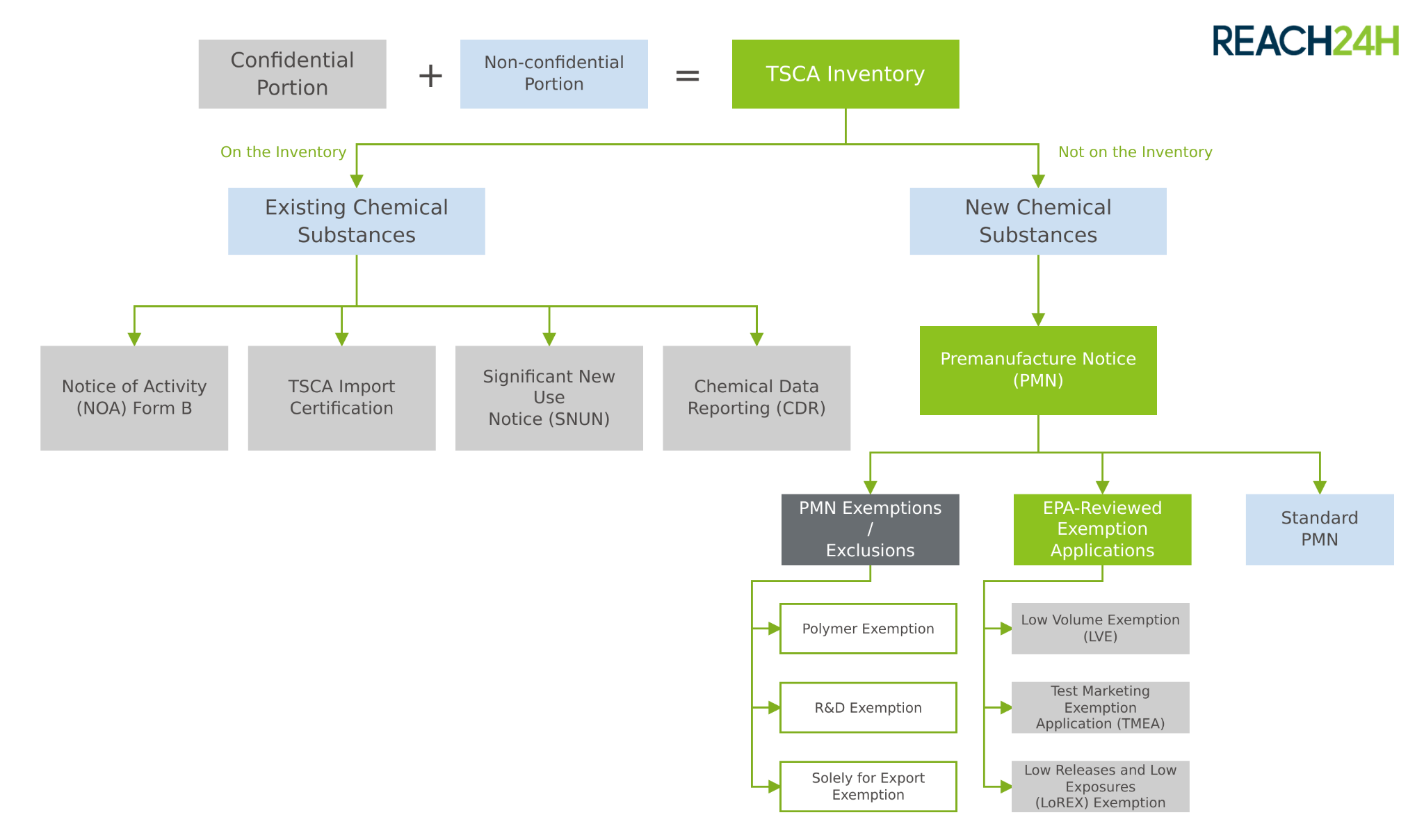 U.S. TSCA Inventory and chemical notification pathways
Ongoing Obligations for Existing Chemical Substances
Existing chemical status does not end the compliance assessment. Manufacturers, importers, processors, and other supply-chain actors may have distinct obligations depending on the substance, site, activity, and applicable TSCA action.
| Trigger | Obligation | Practical Compliance Action |
|---|---|---|
| Import of a TSCA-regulated chemical substance or mixture | TSCA import certification | The U.S. importer or its authorized agent files a positive certification when the shipment is subject to TSCA and complies with applicable rules and orders. A negative certification is used when the shipment is not subject to TSCA and is not otherwise clearly identified as excluded. Chemicals that are part of articles generally do not require certification unless a specific TSCA rule provides otherwise. |
| Planned activity designated as a significant new use under a SNUR | Significant New Use Notice (SNUN) | Notify EPA at least 90 days before manufacturing, importing, or processing for the designated significant new use. The activity cannot begin until EPA has reviewed the notice, made a determination, and taken any required action. |
| Applicable reporting threshold reached at a U.S. site | Chemical Data Reporting (CDR) | Determine the threshold and exemptions for each substance and site. For the 2028 cycle, production volume data for 2024-2027 must be assessed. The scheduled submission period is June 1 to September 30, 2028. |
| Existing substance designated inactive | Notice of Activity (NOA) Form B | Notify EPA before non-exempt commercial manufacture, import, or processing resumes, but no more than 90 days before the anticipated start date. EPA then changes the commercial activity designation to active. |
| Substance subject to a Section 5 order, Section 6 risk-management rule, testing requirement, or another TSCA action | Substance-specific risk management and information duties | Identify and implement applicable prohibitions, use conditions, exposure controls, volume limits, labeling or SDS requirements, recordkeeping, downstream communication, reporting, and testing obligations. |
Compliance Pathways for New Chemical Substances
A company that intends to manufacture or import a new chemical substance for a non-exempt commercial purpose must normally submit a Section 5 notice before the activity begins. EPA does not certify a PMN substance as safe or issue a product approval. EPA reviews the notice, makes a statutory determination, and may allow the activity as described or impose restrictions through an order or rule.
Main New-Chemical Routes
| Pathway | Typical Fit | Statutory Review Period* | Key Consideration |
|---|---|---|---|
| Premanufacture Notice (PMN) | New chemical substance for non-exempt commercial manufacture or import when no exemption applies | 90 days | EPA must make a determination and take any required action before the activity can begin. The practical project timeline may be longer if the notice is incomplete, information changes, additional evaluation is needed, or restrictions must be resolved. |
| Low Volume Exemption (LVE) | Qualifying new substance manufactured or imported at no more than 10,000 kg per year | 30 days | Eligibility is substance- and use-specific. New PFAS and certain persistent, bioaccumulative, and toxic chemicals are ineligible. An LVE substance is not added to the TSCA Inventory. |
| Low Releases and Low Exposures Exemption (LoREX) | Qualifying activity with sufficiently low releases and human exposure | 30 days | The applicant must substantiate the release and exposure conditions. New PFAS and certain persistent, bioaccumulative, and toxic chemicals are ineligible. A LoREX substance is not added to the Inventory. |
| Test Marketing Exemption (TME) | Limited manufacture or import for genuine test-marketing activity | 45 days | The amount, recipients, use, and test-marketing period are restricted. A TME does not add the substance to the Inventory. |
| Polymer Exemption | A qualifying polymer that meets the definition, molecular-weight criteria, compositional conditions, and exclusion criteria in 40 CFR 723.250 | Eligibility assessment rather than the standard PMN review | Detailed structural, monomer/reactant, molecular-weight distribution, and recordkeeping information may be needed. Certain chemistries are excluded. Exempt polymers are not added to the Inventory through the exemption. |
| Research and Development Exemption | Qualifying research and development activity under controlled conditions | No standard PMN review period | The activity must remain within the exemption conditions, including appropriate supervision, risk communication, and records. Commercial manufacture or import requires a separate assessment. |
*Remark: The actual review period for various types of new substance notifications differs from the statutory review period, and enterprises are advised to plan their commercial schedules in advance.
U.S. TSCA New-Chemical Submission Process
Confirm Scope and Inventory Status
Verify the substance identity, intended use, and whether an exclusion applies. Search the public TSCA Inventory and review regulatory flags and commercial activity status. If a confidential Inventory identity may exist and a valid commercial need can be demonstrated, consider a bona fide notice.
Select the Appropriate Route
Assess whether the substance and planned activity qualify for an exclusion, polymer exemption, research and development exemption, LVE, LoREX, or TME. If no exclusion or exemption applies, prepare a PMN. The assessment should consider chemical structure, use, annual volume, release, worker and consumer exposure, environmental fate, hazard information, and commercialization plans.
Prepare the Dossier and Submit Electronically
Information commonly needed for a PMN or exemption submission includes:
Chemical identity, structure, molecular formula, Chemical Abstracts name, and CAS Registry Number where available;
Manufacturing or import process, byproducts, impurities, sites, and production volume;
Intended industrial, commercial, and consumer uses;
Worker, general-population, and consumer exposure information;
Environmental releases, pollution-control measures, and disposal practices;
Available physical-chemical, environmental fate, health, and environmental effects information;
Safety Data Sheet (SDS) and other relevant hazard communication materials;
Confidential Business Information (CBI) claims, substantiation, certification, and a structurally descriptive generic name when required.
A PMN does not automatically require a standard testing package. However, all information in the submitter's possession or control and all information known to or reasonably ascertainable must be included. Data gaps may affect EPA's assessment and can lead to additional questions, restrictions, or testing requirements.
EPA Review and Statutory Determination
EPA reviews chemical identity, hazard, exposure, environmental release, and reasonably foreseen conditions of use. For a PMN, MCAN, or SNUN, EPA must make a statutory determination before the applicable activity may begin.
If EPA determines that the activity is not likely to present an unreasonable risk, the submitter may commence after receiving EPA's official notification.
If information is insufficient, the substance may present an unreasonable risk, or substantial production, release, or exposure conditions apply, EPA may issue a Section 5(e) order. The order may impose exposure controls, use restrictions, volume limits, testing triggers, or other conditions. EPA may also promulgate a SNUR.
If EPA determines that the activity presents an unreasonable risk, EPA must take action under Section 5(f) to protect against that risk.
Commence Manufacture or Import and File the NOC
After the PMN review is completed and the permitted non-exempt commercial manufacture or import begins, the original PMN submitter must file a Notice of Commencement of Manufacture or Import (NOC) within 30 calendar days.
EPA considers the substance added to the TSCA Inventory when it receives a complete NOC. Substances commercialized only under LVE, LoREX, TME, research and development, or polymer exemption conditions are not added to the Inventory through those exemptions.
How REACH24H Can Help
TSCA applicability and Inventory status assessment: Review substance identity, intended use, product composition, supply-chain roles, public Inventory status, regulatory flags, and active/inactive status to identify the likely pathway.
Bona fide notice support: Prepare and coordinate the information needed for EPA to determine whether a substance may be present on the confidential portion of the TSCA Inventory.
Import certification preparation: Help the U.S. importer or its authorized agent determine whether positive certification, negative certification, or no certification applies and prepare the supporting certification language and substance-level evidence.
PMN and exemption pathway support: Assess PMN, LVE, LoREX, TME, polymer exemption, and research and development options; conduct a data-gap review; prepare the submission; coordinate electronic filing; and support responses during EPA review.
SNUR and SNUN support: Interpret substance-specific SNUR conditions, prepare a practical requirements summary for the supply chain, assess whether a planned activity is a significant new use, and support SNUN preparation and submission where triggered.
CDR assessment and reporting: Determine reportable substances and sites, review thresholds and exemptions, organize volume and use data, prepare Form U information, and support electronic submission for the 2028 reporting cycle.
NOA Form B support: Confirm inactive status, prepare the forward-looking activity notification, coordinate confidential supplier information where needed, and support submission before commercialization resumes.
PFAS and high-concern substance support: Assess Section 8(a)(7) PFAS reporting, applicable Section 5 or Section 6 controls, and substance-specific requirements for high-concern or emerging materials.
CBI and supply-chain confidentiality support: Develop a submission strategy for confidential identities, letters of support, joint submissions, substantiation, generic names, and claim-expiration management while limiting unnecessary disclosure across the supply chain.
Integrated TSCA compliance strategy: Prepare a product-line or portfolio-level action plan that prioritizes Inventory status, pre-market notices, ongoing reporting, timing, data needs, and supply-chain responsibilities.
Why Choose REACH24H?
9
global branches
300+
specialists
15,000+
enterprises served
20+
certified toxicologists
U.S. Presence with Global Project Coordination
Our U.S. team and cross-regional specialists support regulatory communication, time-zone coordination, and information transfer among overseas suppliers, U.S. importers, laboratories, and other project parties.
17 Years of Chemical Regulatory Experience
REACH24H has supported chemical market-access and product-stewardship projects across major global jurisdictions, including practical work on PMN, LVE, SNUN, CDR, and related TSCA requirements.
Technical and Regulatory Integration
Our team combines chemical identity review, pathway analysis, exposure and release assessment, data-gap evaluation, submission preparation, and ongoing compliance planning.
Multilingual Supply-Chain Support
English, Chinese, Japanese, Korean, and other language capabilities help global suppliers and U.S. importers coordinate technical data without losing regulatory context.
Confidentiality-Focused Project Management
We use controlled information flows and confidentiality arrangements to coordinate supplier, customer, and consultant inputs while protecting commercially sensitive substance and formulation information.
Digital Inventory Screening
REACH24H's chemical inventory screening resources support initial public-list checks by chemical name or CAS Registry Number, followed by case-specific analysis where a public result is not sufficient.
Frequently Asked Questions
U.S. TSCA COMPLIANCE SUPPORT
Start Your U.S. TSCA Compliance Assessment
If you plan to manufacture, import, or sell chemicals or products containing chemicals in the United States, prepare the following information for an initial assessment.
Next step: Contact REACH24H to discuss your U.S. TSCA pathway, expected deliverables, project schedule, and cost.
Assessment Focus
✓ Substance name, CAS Registry Number, composition, and structural information where available;
✓ Product function, intended uses, downstream applications, and non-TSCA uses, if any;
✓ Expected annual manufacture or import volume and target commercialization date.
Related U.S. TSCA Resources
U.S. TSCA Enforcement Alert: PMN, NOA Form B and CDR Compliance Risks
U.S. TSCA CBI Claims Expiring in 2026: What Companies Must Know


