EU Plant Protection Products Regulation (EU PPP) | Pesticide Registration & Authorisation
Active Substance Approval | Technical Equivalence (TE) | PPP Authorisation | Zonal Authorisation | Mutual Recognition | Authorisation Renewal
Regulation (EC) No 1107/2009 (the EU Plant Protection Products Regulation, or EU PPP Regulation) lays down harmonised rules for the approval of active substances and the placing on the market of plant protection products (PPPs) in the European Union. It was adopted in 2009 to replace Directive 91/414/EEC and has applied since 14 June 2011.
For manufacturers, formulators and authorisation holders planning to place technical materials or formulated plant protection products on the EU market, the appropriate regulatory route will depend on the approval status of the active substance, the source of the technical material, the intended uses, the target Member States and the available data package.
REACH24H supports EU pesticide registration and PPP market access through pathway assessment, data gap analysis, dossier preparation, risk assessment, testing strategy, liaison with competent authorities and project management, helping applicants plan the right route before major registration and testing investments are made.
Which EU Pesticide Registration Pathway Applies to Your Product?
"EU pesticide registration" is not a single procedure. Depending on where a project starts, the regulatory route may involve active substance approval, technical equivalence, first product authorisation, zonal authorisation, mutual recognition or authorisation renewal.
| Typical Scenario | Main Regulatory Route | Key Focus |
|---|---|---|
| A new pesticide active substance is being developed | Active Substance Approval | RMS, dossier, EFSA peer review, approval conditions |
| A new/non-reference technical source is intended for the EU | Technical Equivalence (TE) | Specification, manufacturing process, impurity profile, equivalence to the reference source |
| A formulated PPP is to be placed on the market in an EU Member State for the first time | Product Authorisation | Product dossier, access to active-substance data, risk assessment, uses and national requirements |
| The same PPP is planned for multiple Member States | Zonal Authorisation | zRMS, zonal assessment and multi-country filing strategy |
| The PPP is already authorised in one Member State and is to be marketed in others | Mutual Recognition | Reference authorisation, intended uses and target-country eligibility |
| Existing PPP authorisations must be renewed following renewal of the active substance | Authorisation Renewal | Latest approval conditions, current data requirements and product renewal |
Where several products or Member States are involved, the technical source, the Member State of first authorisation, zRMS and potential mutual-recognition markets should ideally be considered together at the beginning of the project.
Not sure which EU pesticide registration route applies to your product?
Share your active substance, technical source, product type, available data and target EU markets for an initial pathway assessment.
Assess Your EU PPP Registration PathwayHow Is EU Pesticide Registration Regulated?
To support implementation of Regulation (EC) No 1107/2009, Regulation (EU) No 283/2013 and Regulation (EU) No 284/2013 set out the key data requirements for active substances and plant protection products, respectively. In addition, the European Commission, EFSA and Member State competent authorities publish guidance documents covering specific topics such as procedures, data protection and risk assessment.
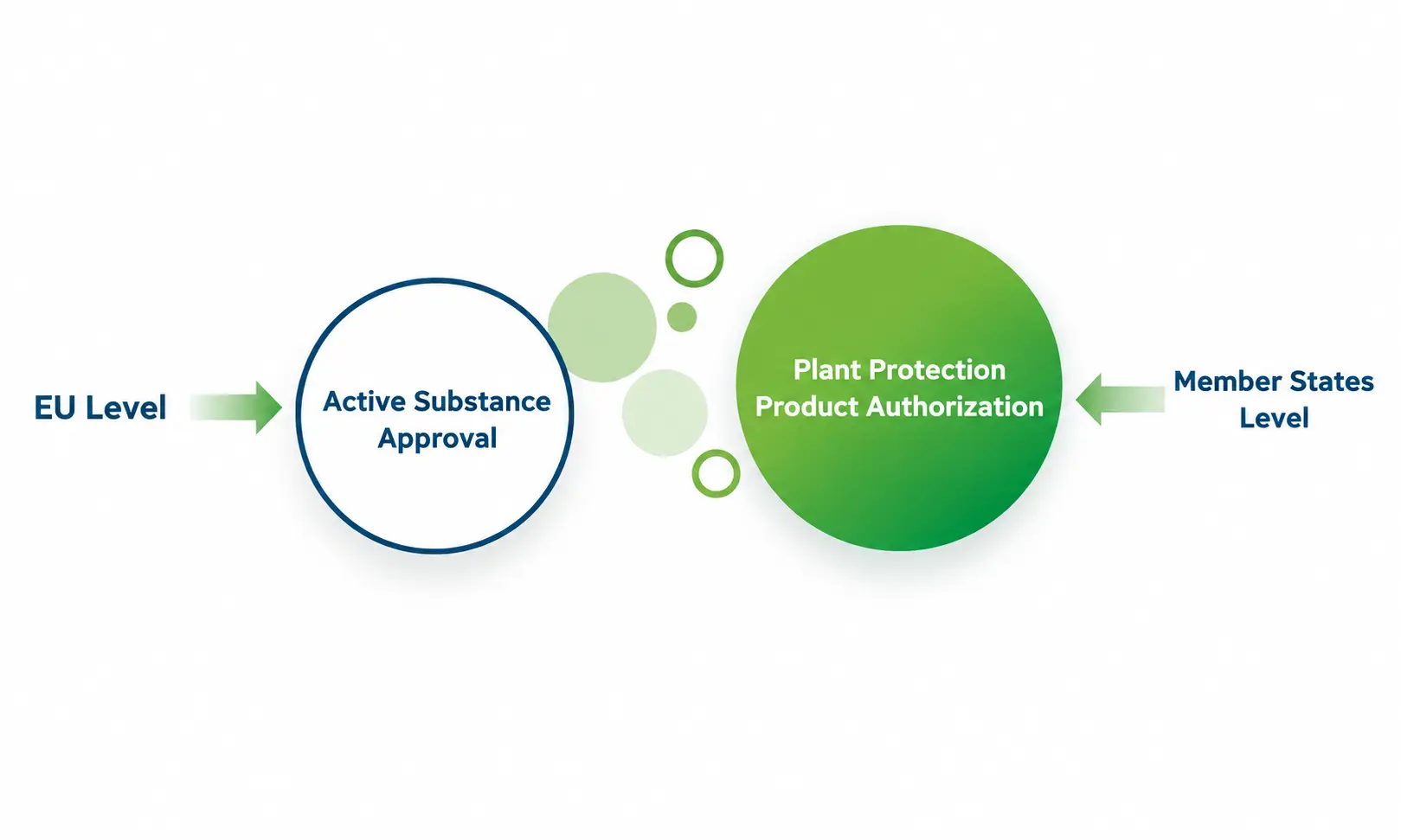
The Regulation applies to active substances, safeners and synergists, all of which are approved at EU level, as well as to plant protection products, which are authorised at Member State level. Adjuvants, such as tank-mix adjuvants, are not approved under the same system; Article 58 of the Regulation allows Member States to lay down national rules on their authorisation and use.
EU Level: Active Substance Approval
The active substance contained in a PPP is assessed and approved at EU level. The assessment typically covers identity, physicochemical properties, analytical methods, toxicology, residues, environmental fate and behaviour, and ecotoxicology.
Member State Level: Plant Protection Product Authorisation
Approval of an active substance does not automatically allow a formulated PPP containing that substance to be marketed throughout the EU. The plant protection product must still be authorised by each Member State concerned for its intended uses, taking into account product composition, risk assessment, GAP, labelling and national conditions.
This two-step system is why the commercial term "EU pesticide registration" may refer to different regulatory tasks. Defining whether the key issue is the active substance, the technical source or the final product is an essential first step.
EU Pesticide Registration Process
The exact procedure varies by application type. A new active substance is subject to an EU-level approval procedure involving a Rapporteur Member State, EFSA peer review and EU-level decision-making, while PPP product authorisation is mainly assessed by Member States under the zonal authorisation system.
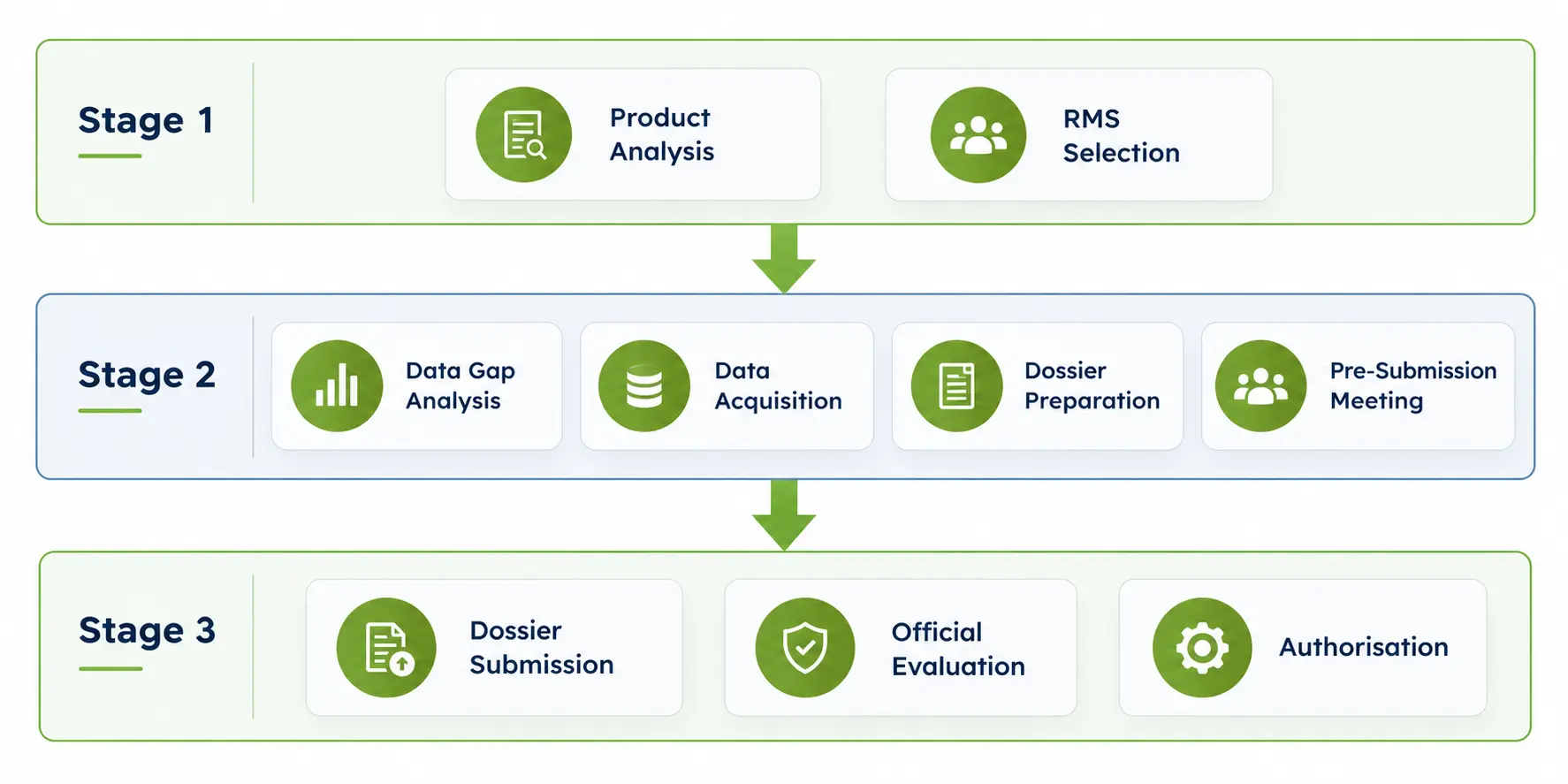
A typical project workflow is: regulatory pathway assessment → review of existing data and data gap analysis → RMS/zRMS and target-market planning → additional studies, risk assessment and dossier preparation as required → submission → authority assessment and response to questions → approval/authorisation → post-authorisation maintenance and renewal.
Active Substance Approval and Technical Equivalence (TE)
Approval of Active Substances
Active substances are approved at EU level. For a new active substance, the applicant submits a dossier to a Rapporteur Member State (RMS) and a co-Rapporteur Member State (co-RMS). The RMS carries out the initial assessment and prepares a Draft Assessment Report (DAR). EFSA then organises the peer review of the DAR and adopts a conclusion, on the basis of which the European Commission prepares a draft decision that is put to a vote of the Member States in the Standing Committee on Plants, Animals, Food and Feed (SCoPAFF).
The exact data requirements and assessment scope depend on the properties of the substance, representative uses and the applicable guidance documents.
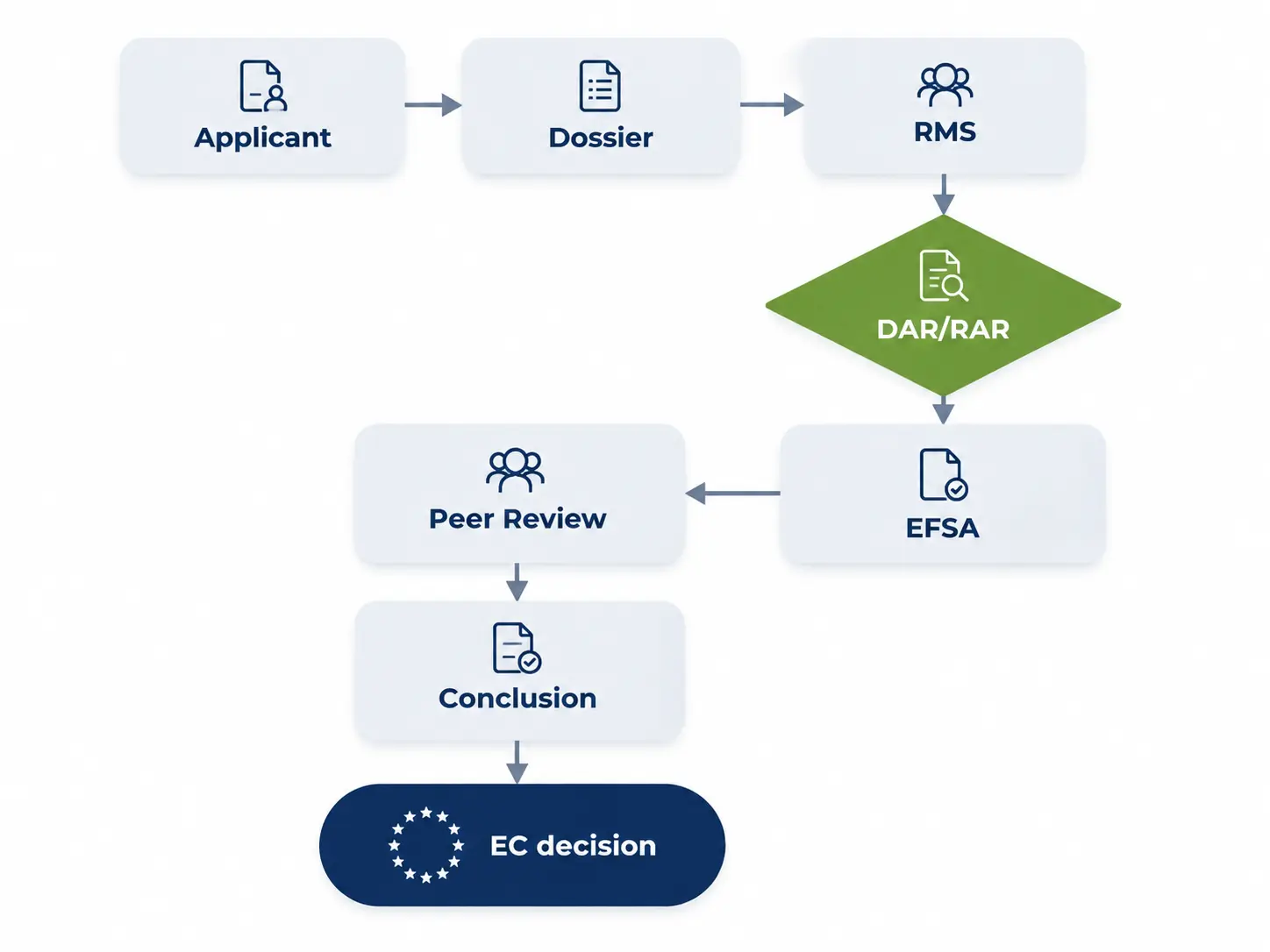
Procedure for the approval and renewal of an active substance under the EU PPP Regulation
Technical Equivalence Assessment
Technical equivalence (TE) is assessed to determine whether a technical material from a new source is equivalent to the reference source on which the approval of the active substance was based. The assessment focuses on the purity of the active substance, the impurity profile and, where relevant, toxicological and ecotoxicological characteristics.
Common situations where a TE assessment may be required include:
Technical material produced by a manufacturer other than the reference-source manufacturer.
A reference source, or previously accepted TE source moving from pilot- or small-scale production to commercial-scale production.
Changes to the manufacturing process; or manufacturing site, or the addition of alternative manufacturing sites.
A positive TE conclusion confirms that the technical source is equivalent to the reference source at EU level; it does not replace the Member State authorisation required for the formulated plant protection product.
Related service: EU Technical Equivalence (TE) Assessment for Pesticide Active Substances
EU Plant Protection Product (PPP) Authorisation
Authorisation of plant protection products takes place at Member State level. Before submitting an application, applicants should verify the approval status of the active substance, the acceptability of the technical source, the intended uses, access to protected data and the requirements of the target Member States.
A product dossier typically comprises product composition and physicochemical properties, analytical methods, human-health risk assessment, residues, environmental fate and behaviour, ecotoxicology, efficacy, GAP, labelling and national addenda. A PPP may be placed on the market and used in a Member State only once the relevant authorisation has been granted and its conditions are met.
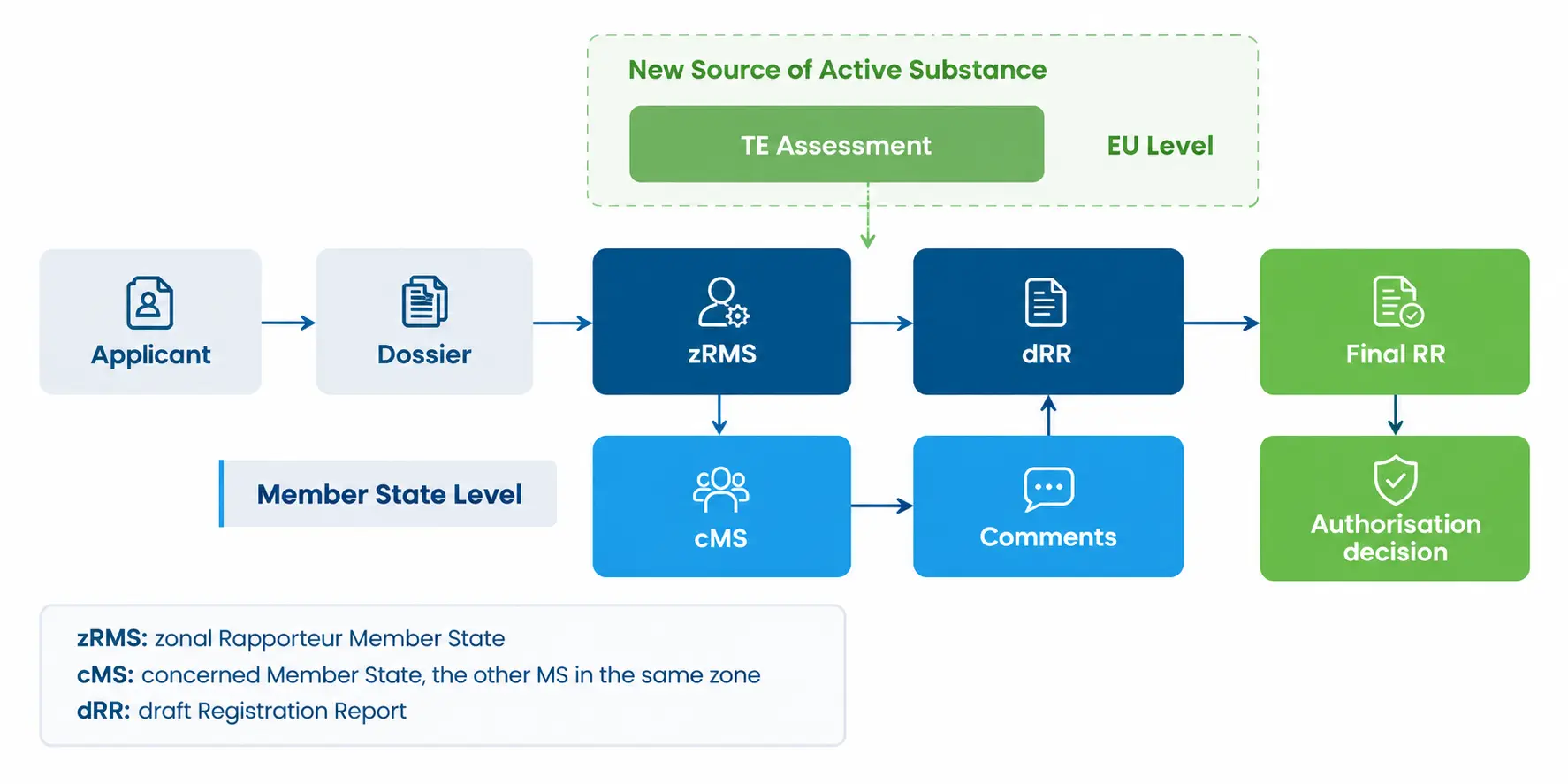
Zonal Authorisation
To avoid duplication of evaluation work, the EU PPP Regulation introduced a zonal system for product authorisation. Based on comparable agricultural, plant health and environmental (including climatic) conditions, Member States are grouped into three zones — Zone A (North), Zone B (Centre) and Zone C (South), with a zonal Rapporteur Member State (zRMS) carrying out the core assessment.
The other Member States concerned may have additional data requirements reflecting local agricultural and environmental conditions, including efficacy, residues or environmental fate. For certain uses such as greenhouse uses, post-harvest treatment, treatment of empty storage rooms or containers, and seed treatment, the whole EU is treated as a single zone for the purposes of evaluation.
Obtaining authorisation in one Member State does not mean that a PPP can automatically be sold throughout the EU. The choice of zRMS should take into account the relevant zone, priority markets, intended uses, national requirements, assessment capacity and the applicant's wider multi-country strategy.
Mutual Recognition
Where the same plant protection product is already authorised in one Member State, the applicant may apply for mutual recognition in other Member States. Mutual recognition reduces duplication, but the target Member State still takes its own authorisation decision under the applicable procedure.
For this reason, the Member State of first authorisation, the zRMS and potential mutual-recognition markets are best planned together at an early stage rather than addressed one by one after the first authorisation has been granted.
Authorisation Renewal under Article 43
After renewal of an active substance, PPPs containing that substance do not automatically retain their authorisations. The authorisation holder assess the product against the renewed approval conditions, the current data requirements and the applicable authorisation criteria, and submit a renewal dossier within the prescribed timeframe — as a rule, within three months of the renewal of approval of the active substance.
The competent authority then verifies whether the PPP continues to meet the applicable authorisation requirements and decides whether the authorisation can be renewed.
What Data Are Required for EU Pesticide Registration?
The data package required depends on the application type. Rather than applying a generic checklist to every project, applicants should first confirm the regulatory pathway and assess whether the available data can support the intended application.
| Application Type | Main Data Areas |
|---|---|
| Active Substance Approval | Identity/specification, physicochemical properties, analytical methods, toxicology, residues, environmental fate, ecotoxicology, representative uses, etc. |
| Technical Equivalence | Technical specification, manufacturing process, impurity profile and, where needed, toxicological and ecotoxicological equivalence information. |
| PPP Product Authorisation | Product composition, physicochemical properties, analytical methods, human-health risk assessment, residues, environmental fate and behaviour, ecotoxicology, efficacy, GAP, labelling and national requirements. |
Data Gap Analysis Before Additional Testing
Applicants often lack a complete data package at the outset. Before commissioning additional studies, existing studies, literature, data rights and previous assessment outcomes should be reviewed to identify which information can still be used, which gaps can be addressed through scientific justification or alternative approaches, and which gaps genuinely require new testing.
Depending on the issue, the strategy may combine literature review, data-quality assessment, read-across, (Q)SAR, toxicological assessment of impurities or metabolites, risk assessment and targeted GLP testing.
Data Protection and Data Matching
The EU PPP framework provides data protection for qualifying studies and reports. In general, data supporting the first product authorisation benefit from 10 years of protection in the Member State concerned; data supporting low-risk PPPs benefit from 13 years of protection, and studies necessary for the renewal or review of an authorisation benefit from a 30-month protection period. The protection period can be extended by three months for each extension of authorisation for minor uses, up to a maximum of 13 years (15 years for low-risk products). Whether a data package can actually be used in practice also depends on the availability of a Letter of Access and on the data-rights position of the studies concerned.
REACH24H EU Pesticide Registration Services
REACH24H provides services on a modular technical support as well as coordinated project support across the main stages of EU PPP market access.
Regulatory Strategy and Pre-Submission Assessment
Product compliance analysis
Review of existing data and data gap analysis
Data evaluation and waiver assessment
Patent analysis
Comprehensive regulatory consulting
Active Substances and Technical Materials
EU Technical Equivalence (TE) assessment
EU new active substance approval
Active substance renewal support
Data Matching assessment
PPP Product Authorisation
EU PPP product authorisation, including applications under Articles 33 and 34
Zonal Authorisation support
Mutual Recognition support
Article 43 authorisation renewal support
Technical Assessment, Testing and Project Support
(Q)SAR reports
Endocrine-disruption risk assessment
Data gap analysis and waiver justification
GLP study planning and monitoring
Regulatory consulting and customised training
Assessment of authority questions and technical support for supplemental submissions
Why Choose REACH24H?
End-to-End EU PPP Technical Capability
REACH24H has many years of practical experience with EU PPP projects and offers integrated support covering active-substance work, technical equivalence, PPP authorisation, data evaluation, (Q)SAR, GLP testing and post-submission support, tailored to the applicant's project stage.
Multidisciplinary Technical Team
EU pesticide assessment spans analytical chemistry, toxicology, ecotoxicology, environmental fate, residues, exposure and efficacy. For complex projects, REACH24H can coordinate specialists across disciplines to reduce inconsistencies between dossier sections and avoid unnecessary rework.
Extensive Multi-Member-State Experience
REACH24H has completed more than 400 EU Technical Equivalence (TE) applications covering 15 EU Member States, including Germany, France and Poland. This multi-country experience supports not only individual applications but also wider market-entry and product-portfolio planning.
From Data Gap Identification to Testing Strategy
Where a dossier is incomplete or raises difficult issues relating to impurities, metabolites or toxicology, REACH24H can first identify the genuine data gaps using literature, (Q)SAR and risk assessment, then plan targeted GLP testing and technical justification where needed rather than defaulting immediately to additional studies.
EU Pesticide Registration Project Cases
Front-Loaded Dossier Review Helped a TE Project Reach a Conclusion in About One Month
EU Technical Equivalence assessments involve detailed scrutiny of technical specifications, impurity profiles and supporting toxicological and ecotoxicological information. Questions from the assessing authority can affect the project schedule.
Drawing on experience with EU TE applications covering a wide range of active substances, REACH24H places strong emphasis on pre-submission dossier review. The team reviews the technical package in line with EU assessment practice, identifies issues likely to trigger questions from the authority — such as those related to the specification, impurities and data gaps — and resolves and verifies them internally before formal submission.
In one project, this front-loaded approach enabled the application to progress from formal submission to a positive TE conclusion in about one month.
Weight-of-Evidence Strategy Resolved a Toxicological Concern for a Trace New Impurity
In one EU project, a new impurity was detected in the technical material at a level below 0.1%. During the initial screening, the assessor identified a potential toxicological concern and requested additional evidence. As the impurity was present at a very low level, obtaining sufficient isolated material for conventional testing was technically difficult.
REACH24H toxicology experts evaluated the toxicological mode of action, the structural features and available evidence for the impurity, and integrated non-animal data with information from recognised toxicological databases. The evidence was organised into a weight-of-evidence (WoE) argument aligned with the applicable EU technical guidance.
The authority accepted the technical justification, resolving the toxicological concern without the originally contemplated conventional test and allowing the project to proceed.
Frequently Asked Questions
Related Services
EU PPP Compliance Support
Plan Your EU PPP Market Access Strategy
If you are evaluating active substance approval, a new technical source, first PPP authorisation, multi-country market access, mutual recognition or authorisation renewal, REACH24H can help identify the applicable route and key data gaps.