REACH24H PRODUCT CHEMISTRY INSIGHTS | ISSUE 1
Product chemistry is a critical component of any agrochemical registration dossier. While individual requirements may appear relatively straightforward, the overall package covers a wide range of analytical and physicochemical endpoints. Product composition, specifications, analytical methods, physicochemical properties, and stability data are closely interrelated and should present a consistent and scientifically sound picture of the product. This first issue examines the underlying logic behind requirements for both technical materials and formulated products within broader global pesticide and fertilizer compliance.
1. Introduction
In recent years, product chemistry-related issues have been identified in nearly half of agrochemical applications rejected during regulatory review in China, while around 70% of requests for additional information have included comments related to product chemistry.
To help applicants better understand product chemistry data requirements and avoid common issues during the registration process, REACH24H Product Chemistry Insights is officially launched as a series of expert articles. The series will focus on key topics such as quality specification setting, analytical methods, and laboratory selection.
As the first article in the series, this article systematically examines the underlying logic behind product chemistry data requirements for both technical materials and formulated products.
Regulatory review comments often arise from inconsistencies between different parts of the product chemistry package. For example, the reported flash point may not be consistent with the declared product composition; the storage stability conditions may not adequately reflect the intended storage and transportation conditions; or the packaging material specified for the product may differ from the material used in compatibility or corrosion testing.
These may seem like separate technical issues, but they point to the same underlying principle: the product chemistry dossier should provide a coherent and scientifically supported characterization of the product. The data should be internally consistent and, taken together, enable regulators to understand what the product is, how it behaves, how stable it remains over time, and what potential risks may need to be considered.
Product chemistry is therefore not simply a matter of identifying a list of required tests. The key is to understand what each endpoint is intended to demonstrate and how the results fit together across the dossier. This perspective is essential for developing a complete and robust product chemistry package and for identifying potential regulatory concerns before they become review issues.
Understanding this underlying logic enables applicants to identify potential registration risks at an early stage of data preparation and to develop a more coherent and scientifically robust product chemistry data package.
This article therefore reviews the key considerations behind common product chemistry data requirements from two perspectives: the active substance and technical material, and the formulated product.
2. Active Substance and Technical Material
For the active substance and technical material, product chemistry is primarily concerned with three parts: five-batch analysis, physicochemical properties, and stability.
Together, these data establish the identity and composition of the technical material, characterize its key physicochemical properties, and demonstrate whether its quality remains consistent over time.
Five-batch analysis provides a representative picture of the composition of commercially manufactured technical material and serves as the basis for defining the active substance content, impurity profile, and key quality specifications. Physicochemical characterization describes the key properties of the active substance and technical material, including their structural, physical, chemical, and hazard-related characteristics. Stability data, in turn, demonstrate whether the material remains within the established quality specifications under the relevant storage conditions.
Taken as a whole, these data provide the compositional and physicochemical foundation for the broader registration assessment, including formulation development, toxicological evaluation, and environmental risk assessment.
2.1 Five-Batch Analysis: Demonstrating Consistency of Product Composition
Five-batch analysis is a core component of technical material product chemistry and an important basis for establishing product specifications.
By analyzing five representative industrial-scale production batches, applicants can establish:
Active ingredient specification;
Limits for relevant impurities;
Limits for significant impurities; and
Water content and other critical quality parameters.
Five-batch analysis establishes the compositional profile and identity of the technical material while defining a clear compositional boundary for subsequent safety and risk assessments. It therefore serves as one of the key foundations of the overall registration dossier.
2.2 Physical and Chemical Properties: From Molecular Structure to Environmental Behavior
Physicochemical properties describe the physical and chemical characteristics of a substance or product, while also providing insight into its behavior during storage, transportation, use, and after release into the environment.
These data are used not only to assess product quality, but also to provide essential parameters for toxicological, ecotoxicological, and environmental risk assessments.
The table below summarizes the commonly assessed physicochemical endpoints and their key purposes.
| Property / Endpoint | Primary Purpose |
|---|---|
| Appearance | Product identification and quality control |
| Molecular structure and spectroscopic characterization | Confirmation of chemical identity, structure, and isomeric composition |
| Melting point / melting range, boiling point, freezing point | Characterization of phase-change properties and support for storage, transportation, and processing conditions |
| Density / relative density | Characterization of physical properties and support for packaging and application-rate calculations |
| Vapour pressure, Henry’s law constant | Prediction of volatilization losses and environmental transport |
| Water solubility and solubility in organic solvents | Support for formulation development and environmental fate assessment |
| n-Octanol/water partition coefficient (log Pow) | Characterization of lipophilicity and assessment of bioaccumulation potential |
| Dissociation constant in water (pKa) | Determination of ionization behavior and its influence on solubility, adsorption, and mobility |
| pH | Characterization of acid-base properties and support for stability and compatibility assessment |
| Optical rotation, refractive index | Supporting identity characterization of chiral compounds and liquid technical materials |
| Hydrolysis | Prediction of persistence and degradation behavior in aquatic environments |
| Photolysis | Assessment of photodegradation behavior and degradation products |
| Particle size | Assessment of dust characteristics and inhalation exposure potential |
| Oxidizing/reducing properties | Identification of potential reaction hazards upon contact with oxidizing or reducing agents |
| Explosivity | Basis for classification of explosive hazards |
| Flammability, self-heating, auto-ignition temperature, flash point | Comprehensive assessment of flammability and support for storage, transportation, and fire-safety management |
| Surface tension | Characterization of wetting behavior and its influence on droplet formation and spray performance |
2.3 Stability
The primary purpose of stability studies is to evaluate whether a product can maintain acceptable quality during storage and transportation and when in contact with packaging materials or metals under relevant conditions.
The results provide a scientific basis for:
Packaging material selection;
Shelf-life determination; and
Establishment of appropriate storage and transportation conditions.
Key stability considerations include:
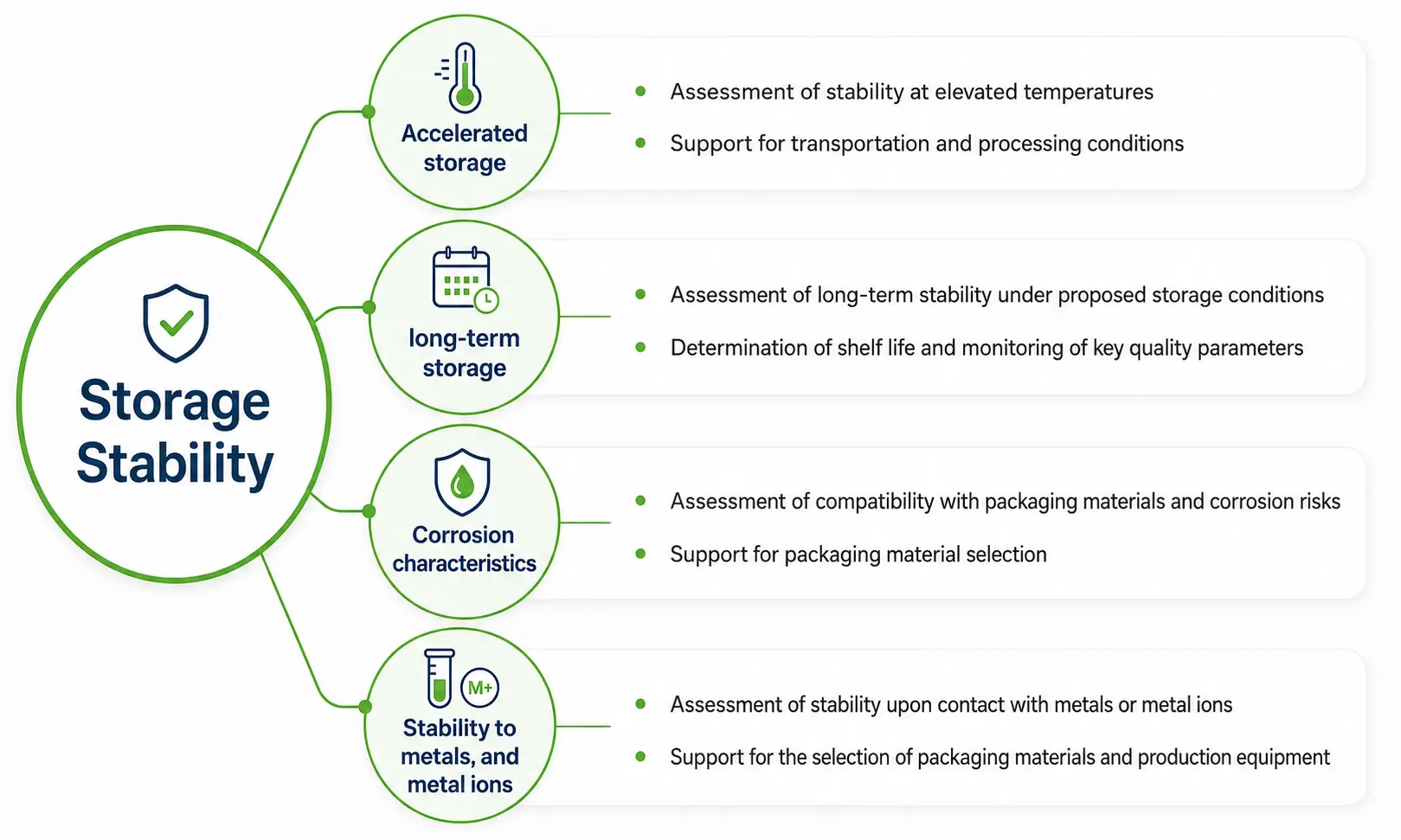
Note: For technical materials, stability assessment is generally focused on accelerated storage testing. Long-term storage stability is not routinely required for technical materials in many registration systems. Actual testing should therefore be determined based on the specific regulatory requirements of the target market.
3. Formulation
A formulation is more than a simple mixture of an active substance and co-formulants. Through formulation design and manufacturing processes, specific properties and performance characteristics are developed to meet the intended use of the product.
While product chemistry for technical materials focuses mainly on composition, quality specifications, and intrinsic physicochemical properties, formulation product chemistry places greater emphasis on whether the formulation can maintain its required quality and performance during storage, transportation, and use, while also meeting applicable safety and regulatory requirements.
The product chemistry parameters for a formulation therefore depend on its formulation type, intended use, and specific performance and safety considerations. These requirements can generally be grouped into four main areas.
3.1 Basic Physicochemical Properties
Basic physicochemical properties establish the fundamental characteristics of the formulated product and provide a basis for evaluating its safety during storage, transportation, and use. They are also important for quality control and hazard classification.
Typical parameters include appearance, pH, density, and viscosity.
For example, viscosity directly affects the pourability, pumping, mixing, and atomization/spray performance of a formulation. For products containing hydrocarbon solvents, kinematic viscosity at 40°C may also be relevant to the assessment of inhalation hazard classification.
3.2 Application Performance
Formulations need to undergo dilution, mixing, spraying, spreading, or other application processes specified on the label before delivering their intended function.
Therefore, application-performance testing is directly related to whether the product can achieve its intended use and performance.
Because formulation types and application methods vary, the relevant performance parameters also differ. Depending on the physical form of the product and the system formed after dilution with water, the main categories can be summarized as follows:
Liquid Suspension / Dispersing Formulations
For suspension concentrates (SC), capsule suspensions (CS), and similar formulations, typical parameters include suspensibility, spontaneous dispersion, wet sieve test, and pourability. For oil-based suspension formulations, maintaining dispersion stability is particularly important.
These parameters are used to confirm that the product can be uniformly dispersed after dilution, thereby avoiding excessive sedimentation or phase separation.
Solid Water-Dispersible Formulations
For wettable powders (WP) and water-dispersible granules (WG), typical parameters include wetting time, wet sieve test, suspensibility, and persistent foaming.
Water-dispersible granules may also require assessment of dispersion properties, dustiness, flowability, and attrition resistance, as appropriate, to ensure that the granules disintegrate and disperse effectively after being added to water.
Emulsifiable Formulations
For emulsifiable concentrates (EC), suspo-emulsions and other emulsion-forming formulations, key parameters include emulsion stability and re-emulsification, which assess whether the product forms and maintains a stable emulsion after dilution with water and whether unacceptable separation, creaming, or oiling-off occurs.
Water-Soluble Formulations
For soluble concentrates, soluble powders, and soluble granules, the key consideration is generally solution stability.
Soluble powders and soluble granules may also require assessment of degree of dissolution and persistent foaming, confirming that the active ingredient dissolves sufficiently and that unacceptable precipitation or crystallization does not occur in the spray solution.
For soluble granules, dustiness, flowability, and attrition resistance may also be relevant.
Direct-Application Formulations
For directly applied granules, key parameters generally include particle size distribution, dustiness, flowability, and attrition resistance.
These parameters help ensure uniform application while minimizing dust exposure and particle breakage during handling and application.
3.3 Storage Stability
Storage stability studies demonstrate whether a formulated product can maintain acceptable active ingredient content, physical condition, and critical application-performance characteristics throughout the proposed storage period under the specified storage conditions.
Typical studies may include:
Long-term storage stability;
Accelerated storage stability;
Low-temperature stability;
Freeze-thaw stability; and
Packaging compatibility.
Stability assessment should not focus solely on whether the active ingredient undergoes degradation. Changes in physical and chemical properties and critical technical performance parameters should also be evaluated to ensure that the product maintains consistent quality and application performance throughout its proposed shelf life.
3.4 Special Functional Properties
For products with specific structures or specialized application methods, such as microencapsulated formulations, seed-treatment products, aerosols, mosquito coils, electric mosquito repellents, smoke-generating products, and similar formulations, additional product-specific parameters may need to be evaluated in addition to conventional physicochemical and application-performance characteristics.
For example:
Microencapsulated formulations: release rate of the active ingredient should be assessed to demonstrate the intended controlled-release characteristics.
Seed-treatment products: adhesion and coating uniformity should be evaluated to ensure consistent seed treatment.
Aerosol products: spray performance and valve reliability should be assessed.
Mosquito coils and electric mosquito repellents: burning time and active ingredient release characteristics should be evaluated to ensure consistent efficacy throughout the intended period of use.
4. Conclusion
Whether for a technical material or a formulated product, product chemistry data serve as a cornerstone of agrochemical development and registration.
Product chemistry is not an isolated component of the registration dossier. It runs throughout the entire process of product development, quality control, and regulatory assessment, while also providing fundamental data and scientific support for efficacy evaluation, environmental fate assessment, and human health and ecological risk assessment.
This article has focused on the common requirements across major global markets and reviewed the physicochemical endpoints for technical materials and formulated products, together with the underlying logic behind these requirements.
In the next issue, we will further examine the specific product chemistry physicochemical data requirements across major regulatory jurisdictions, including China, the European Union, the United States, Canada, Australia, and other major markets.
How REACH24H Can Help
REACH24H has long been committed to monitoring agrochemical registration and regulatory developments in major global markets, including China, the European Union, the United States, Canada, Australia, and Brazil. Our broader global agrochemical compliance services cover registration and technical support across these markets.
We continuously track regulatory requirements, review approaches, and technical developments relating to product chemistry in these markets. Our expertise covers relevant technical frameworks and guidance developed by FAO/WHO and OECD, as well as regulatory guidance and assessment requirements issued by authorities and agencies including EPA, EFSA, and APVMA.
We have extensive experience in product composition, quality specification, impurity control, analytical methods, and scientific risk assessment, and provide technical support throughout the product development and registration process.
Whether you are looking to incorporate product chemistry considerations into product development, testing strategies, or dossier preparation, or are dealing with complex product chemistry challenges during registration, REACH24H can help you identify and address potential risks early, provide practical technical solutions, minimize requests for additional information and repeated dossier revisions, and ultimately streamline the registration process.
For market-specific requirements, see our China Pesticide Registration, U.S. EPA Pesticide Registration, and EU Plant Protection Products Regulation resources.
Need support with agrochemical product chemistry or registration data strategy?
REACH24H can support product chemistry data review, specification and impurity assessment, analytical methods, testing strategy, dossier preparation, and technical responses throughout pesticide registration projects.
Recommended Reading
Official Resources
OECD — Report on Pesticide Regulatory Data Requirements Regarding Product Chemistry
OECD Guidelines for the Testing of Chemicals, Section 1: Physical-Chemical Properties
FAO/WHO Manual on the Development and Use of Specifications for Chemical Pesticides
EUR-Lex — Commission Regulation (EU) No 283/2013: Data Requirements for Active Substances
EUR-Lex — Commission Regulation (EU) No 284/2013: Data Requirements for Plant Protection Products
APVMA — Chemistry and Manufacture Requirements for Agricultural Chemical Products