CANADA DISINFECTANT & PEST CONTROL DEVICE REGISTRATION
Canada regulates disinfectant products and Pest Control Devices under different frameworks depending on their intended use, target microorganisms, mode of action and product claims. Pool and spa sanitizers, certain water and air sanitizers, and a range of Pest Control Devices may fall under the Pest Control Products Act (PCPA), while surface disinfectants and surface sanitizers are regulated under the Biocides Regulations.
The Canadian pesticide regulator is the Pesticides Regulatory Directorate (PRD), formerly the Pest Management Regulatory Agency (PMRA). REACH24H supports companies with Canadian disinfectant registration, Pest Control Device assessment and registration/authorization, Canadian representation, data-gap assessment, data compensation strategy and, where applicable, Canada Biocide Market Authorization projects.
How Are Disinfectants and Pest Control Devices Regulated in Canada?
The first step for a company entering the Canadian market is to determine which regulatory framework applies to the product. Products that may look similar commercially can follow different pathways depending on where and how they are used.
| Product Category | Typical Products | Regulatory Authority | Main Regulatory Framework |
|---|---|---|---|
| Pool, spa, water-treatment and other PCPA disinfectant products | Pool chlorine products, calcium hypochlorite products, spa sanitizers, cooling-tower antimicrobial products and algaecides | Health Canada, Pesticides Regulatory Directorate (PRD) | Pest Control Products Act and Pest Control Products Regulations |
| Pest Control Devices | UV disinfection devices, ozone-generating devices, electrolytic chlorine generators and copper-ion devices | Health Canada, PRD | Product-specific registration, authorization or other applicable PCPA requirements |
| Surface disinfectants and surface sanitizers (biocides) | Surface disinfectants, disinfectant wipes and similar products; common active ingredients may include quaternary ammonium compounds, ethanol or isopropanol | Health Canada, Natural and Non-prescription Health Products Directorate (NNHPD) | Biocides Regulations / Market Authorization |
Regulator name update: In 2026, the Pest Management Regulatory Agency was renamed the Pesticides Regulatory Directorate. The regulator's core responsibilities under the PCPA remain unchanged. Because “PMRA registration” remains widely used in industry, this page also uses PMRA where it helps clarify historical or commonly used terminology.
Canada PCPA Registration for Disinfectant Products
Which disinfectant products fall under the PCPA?
Products that may remain subject to PCPA requirements include:
swimming pool and spa sanitizers;
certain water sanitizers;
certain air sanitizers;
antimicrobial products used in some agricultural or greenhouse applications;
other products that meet the definition of a pest control product.
For products that require registration, the application package may involve administrative information, proposed labels, manufacturing information, physical and chemical data, safety data and efficacy data.
Once a product is registered, it receives a Pest Control Product Registration Number and must be manufactured, marketed and used in accordance with its approved label. For a broader overview of Canada's pesticide registration framework, see our Canada Pesticide Registration: PRD Compliance Guide.
Can an existing Canadian reference product simplify the application?
If an active ingredient is already registered in Canada and a suitable reference product exists, the applicant can evaluate whether a similar-product pathway or an alternative data strategy is appropriate.
Common active ingredients relevant to pool and water-treatment products include:
Sodium Hypochlorite
Calcium Hypochlorite
Trichloro-s-triazinetrione
Sodium Dichloro-s-triazinetrione
Health Canada maintains a Similar Type Products resource that helps applicants compare submission types, associated requirements, timelines and fees.
The existence of a reference product does not automatically mean that additional studies are unnecessary. The applicant must also consider formulation differences, proposed uses and claims, the data supporting the reference product and the applicable data-protection status.
Which Pool and Spa Products May Qualify as Scheduled Products?
Certain Domestic Class pool and spa products may be marketed as scheduled products rather than going through the ordinary registration process, provided all applicable regulatory conditions are met. These products remain subject to the Pest Control Products Act even though they are exempt from ordinary registration.
| Use | Active Ingredient | Concentration (%) | Available Chlorine (%) |
|---|---|---|---|
| Swimming pool | Sodium hypochlorite | 10.8 | 10.3 |
| Swimming pool | Calcium hypochlorite | 65 or 70 | 65 or 70 |
| Swimming pool | Trichloro-s-triazinetrione | 100 | 90 |
| Swimming pool | Sodium dichloro-s-triazinetrione | 100 | 62 |
| Swimming pool | Sodium dichloro-s-triazinetrione dihydrate | 100 | 56 |
| Spa | Lithium hypochlorite | 29 | 35 |
| Spa | Sodium dichloro-s-triazinetrione | 100 | 62 |
| Spa | Sodium dichloro-s-triazinetrione dihydrate | 100 | 56 |
Eligibility cannot be determined from the active ingredient name alone. The product must also meet applicable requirements relating to the source of the registered technical active ingredient, product class, concentration, packaging and labelling.
Canada Registration and Authorization for Pest Control Devices
Certain devices used to control microorganisms are regulated as Pest Control Devices under Canada's Pest Control Products Act (PCPA).
chlorine generators for pools and spas;
copper-ion generators;
ultraviolet (UV) disinfection devices;
ozone-generating devices;
other Pest Control Devices intended to control microorganisms.
For these products, companies should first determine whether the equipment is a Pest Control Device under the PCPA and then identify whether registration, authorization or another regulatory pathway applies. For U.S. market requirements, see our U.S. EPA Pesticide Device Compliance service page.
What information is normally important for a Pest Control Device?
product description and operating principle;
key technical specifications;
intended use and operating environment;
safety information;
efficacy or performance evidence;
proposed product claims;
labelling and instructions for use.
Unlike a conventional chemical disinfectant, the operating principle and technical specifications are often central to determining both the regulatory status of a device and the evidence required to support its claimed antimicrobial performance.
Do all UV and ozone devices require registration?
No. The applicable pathway depends on the device.
Certain UV and ozone-generating devices intended to control human pathogens on surfaces, objects, in water or in air are subject to the PCPA.
Some UV devices that satisfy specific technical, safety and labelling conditions can be authorized without individual product registration. Other regulated UV devices, and ozone-generating devices that do not qualify for an applicable authorization or exception, may require registration.
Where the regulatory status is unclear, a company can consider seeking a subject-to-regulation determination before proceeding with a full registration project.
Who Can Apply and How Does the Canadian Registration Process Work?
Is a Canadian representative required?
Foreign companies may hold Canadian pest control product registrations. However, a foreign registrant must name one Canadian representative, and the Canadian representative's address is used as the regulatory mailing address for Health Canada correspondence.
The applicant or registrant remains responsible for the product registration and for meeting the applicable conditions of registration. REACH24H provides Canadian representative support for applicable PCPA projects as part of its Canada disinfectant and Pest Control Device services.
How does the review process work?
The exact submission category and review process depend on the product, proposed claims, active ingredient, available data and application pathway.
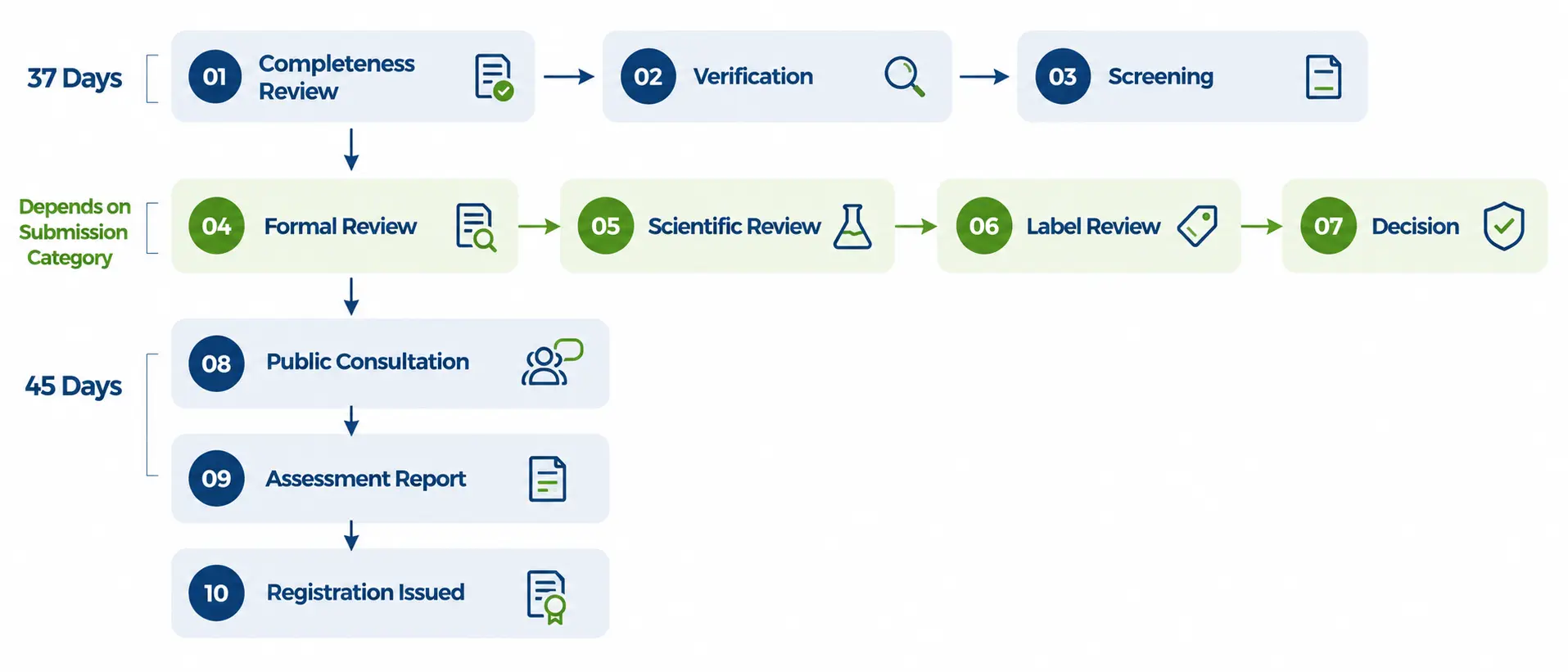
01. Regulatory classification and pathway assessment
Determine whether the product falls under the PCPA or the Biocides Regulations and identify the applicable registration or authorization route.
02. Existing data and document review
Review product information, technical data, efficacy evidence, safety information and proposed claims.
03. Data-gap assessment
Identify missing information and determine whether existing data, scientific rationales, reference-product information or additional studies may be needed.
04. Application preparation
Prepare the required regulatory and technical materials for the applicable pathway.
05. Verification and screening
Health Canada checks whether the application contains the required administrative, format, data and fee elements before formal review.
06. Scientific and regulatory assessment
Depending on the submission, Health Canada may review product chemistry, efficacy/value, toxicology, exposure and environmental information.
07. Regulatory decision
If the applicable requirements are met, the product may receive a registration or other applicable authorization.
For technically complex products or novel technologies, a pre-submission consultation may also be appropriate before the formal application is filed.
What Data and Testing May Be Required?
The exact information required depends on the product and application pathway.
Chemical disinfectant products
administrative information;
proposed labels;
formulation and manufacturing information;
physical and chemical data;
safety data;
efficacy data.
Pest Control Devices
operating principle;
technical specifications;
device safety;
performance and efficacy;
product claims;
labelling.
Additional testing is not automatically required in every project. Existing Canadian reference products, previously generated studies, available regulatory data and scientifically justified waivers may affect the final data strategy.
Similar Products, Data Protection, Data Compensation and Government Fees
Canada has specific rules governing the use of proprietary test data in pest control product registration.
Exclusive-use data
Certain data supporting new active ingredients, products containing new active ingredients, and qualifying new substances or compounds are protected by exclusive rights. The general exclusive-rights period is 10 years after the relevant registration date and may be extended in qualifying minor-use circumstances.
Compensable data
If an applicant needs to rely on compensable data, the project may require:
identification of the relevant protected data;
negotiations with the data holder;
payment of applicable compensation;
submission of the required access documentation.
The compensable period under the Pest Control Products Regulations must not exceed 12 years, subject to the applicable regulatory provisions. As a result, the fact that a similar registered Canadian product exists does not by itself mean that the supporting data can be used without cost or without further regulatory analysis.
How are government fees determined?
Canadian pest control product application fees are component-based. More than one assessment component may apply to a single submission.
| Category L Application | Indicative Government Fee Range (CAD) |
|---|---|
| Technical-grade active ingredient | 9,584-13,049 |
| End-use product / formulation | 7,053-10,518 |
The actual government fee depends on the assessment components triggered by the individual application, and Health Canada adjusts applicable fees periodically. A project-specific fee estimate should therefore be made after the product, submission category and data requirements have been assessed.
Canada Biocide Market Authorization for Surface Disinfectants
Surface disinfectants and surface sanitizers that meet the definition of a biocide are regulated under Canada's Biocides Regulations rather than the PCPA.
Before a new biocide can be imported, sold or advertised in Canada, it generally requires a Market Authorization from Health Canada.
Depending on the product and available regulatory information, relevant application pathways may include:
Full Review: generally used where a more complete safety, efficacy and quality assessment is required;
Comparison: an application based on an authorized comparison biocide, where the applicable criteria are met;
Use of Foreign Decisions (UFD): a pathway that can leverage a decision from a recognized foreign regulatory authority when the eligibility requirements are satisfied.
Other Health Canada application pathways may also apply depending on the product. REACH24H can support Canada Biocide Market Authorization projects for products within this regulatory scope.
Can a U.S. EPA-registered disinfectant use the UFD pathway?
The U.S. Environmental Protection Agency (EPA) is included on Health Canada's List of Foreign Regulatory Authorities for Biocides.
If the Canadian product and the EPA-authorized foreign biocide meet the applicable UFD criteria, the foreign regulatory decision may be used to support a Canadian Market Authorization application.
Under the UFD pathway, full safety, efficacy and quality data are generally not required to be resubmitted. However, the applicant must still meet the pathway requirements and provide the required application information, and Health Canada may request additional information when necessary to determine whether a Market Authorization can be issued.
What Is Changing for Pest Control Devices in Canada?
Health Canada published PRO2025-02 in March 2025 to propose changes to the regulatory framework for Pest Control Devices.
| Proposed Approach | Examples |
|---|---|
| Authorization with conditions | Certain pool/spa chlorine generators, copper-ion generators and devices controlling microorganisms by UV radiation |
| Authorization without additional conditions | Certain water filters, air filters and other devices operating strictly through mechanical or physical means |
| Exemption from the PCPA | Certain pesticide-application equipment and other specified low-risk device categories |
| Continued registration | Devices generating substances for pest control, such as ozone, hydroxyl radicals or chlorine, unless a specific authorization or exemption applies |
The PRO2025-02 pre-consultation is closed, but the device amendments are not yet the final regulatory framework.
Health Canada's 2026-2028 Forward Regulatory Plan indicates that a Canada Gazette, Part I proposal for Pest Control Devices and Edible Products is expected in fall 2026, with final amendments currently planned for spring 2027.
Companies with near-term Canadian market plans should therefore assess their devices against the current rules rather than assuming the proposed exemptions or authorizations are already available.
REACH24H Canada Disinfectant and Pest Control Device Services
REACH24H supports manufacturers, importers, brand owners and other companies planning to place disinfectant products or Pest Control Devices on the Canadian market.
Canada PCPA disinfectant registration
Pre-assessment of disinfectant and Pest Control Devices
Canada PCPA Pest Control Device Registration and Authorization Support
Canada Biocide Market Authorization
Canadian representative services
Data assessment, gap analysis and waiver assessment
Data compensation strategy and support in discussions with data holders
Canadian pesticide regulatory and registration training
The appropriate project scope depends on the product's intended use, active ingredients, claims, available Canadian reference products, technical characteristics and existing data package.
For a broader view of REACH24H's global market-access capabilities in this sector, see our global disinfectant and biocide compliance services.
Why Work With REACH24H?
Familiar with Canadian disinfectant and Pest Control Device regulatory requirements
Canada applies different regulatory requirements to chemical disinfectants, pool and water-treatment products, UV devices, ozone-generating equipment and other antimicrobial technologies. REACH24H helps companies identify the applicable regulatory pathway based on the product's intended use, mode of action, technical characteristics and claims.
Application strategies built around the data you already have
For products with existing overseas registration materials, test data or Canadian reference products, REACH24H can assess the available information, identify data gaps and evaluate whether data reliance, waiver rationales or data-compensation strategies may be appropriate.
Canadian representative support for foreign companies
For PCPA projects that require a Canadian representative, REACH24H can provide Canadian representation support and assist with ongoing regulatory communication and project maintenance.
Support for multi-market disinfectant and device projects
REACH24H also supports disinfectant and device regulatory projects in other major markets, including U.S. EPA disinfectant requirements and EU BPR requirements. This can help companies with multi-market plans review existing data and regulatory requirements across jurisdictions more systematically.
Frequently Asked Questions
CANADA MARKET ACCESS
Which Canadian regulatory pathway applies to your product?
Submit your product information so REACH24H can assess the applicable PCPA registration, Pest Control Device pathway or Biocide Market Authorization route.
Request a Canada Regulatory Assessment