
TAIWAN TCCSCA AND OSHA CHEMICAL REGISTRATION SERVICES
Companies manufacturing chemicals in Taiwan or supplying chemical substances to the Taiwan market must first determine whether each substance is listed on the Taiwan Chemical Substance Inventory (TCSI), calculate the applicable annual quantity, and identify the correct registration route under the Toxic and Concerned Chemical Substances Control Act (TCCSCA) and the Occupational Safety and Health Act (OSHA).
REACH24H supports overseas manufacturers, Taiwan importers and manufacturers, and multinational regulatory teams with TCSI searches, new and existing chemical substance registration, local representative coordination, data gap analysis, testing strategy, dossier preparation, confidential business information protection, submission, and post-registration maintenance.
Quick Navigation
Taiwan Chemical Registration at a Glance
| Item | What Companies Need to Know |
|---|---|
| Market | Taiwan |
| Main laws | Toxic and Concerned Chemical Substances Control Act (TCCSCA) and Occupational Safety and Health Act (OSHA) |
| Main environmental authority | Ministry of Environment (MOENV), including the Chemicals Administration |
| Main occupational safety authority | Ministry of Labor (MOL), Occupational Safety and Health Administration |
| First classification question | Is the substance listed on the Taiwan region Chemical Substance Inventory (TCSI)? |
| Main registration routes | Existing substance Phase 1 registration, designated existing substance standard registration, and new substance small quantity, simplified or standard registration |
| Statutory registrant | Generally, the Taiwan manufacturer or importer; a qualified local representative may be appointed to handle applications and reports |
| Key planning factors | Substance identity, annual quantity, use, hazard profile, special form or R&D status, available data, CBI needs, and local supply-chain structure |
| Ongoing duties | Annual quantity reporting, change management, data updates, renewal where applicable, and safe-use information transfer |
What Are Taiwan TCCSCA and OSHA Chemical Registration?
Taiwan industrial chemical registration is built around two related but distinct legal systems: the environmental framework under the Regulations of New and Existing Chemical Substances Registration and the occupational safety framework under the Regulations Governing New Chemical Substances Registration.
| Regulatory system | Main legal basis | Main coverage | Practical implication |
|---|---|---|---|
| Environmental chemical management | Toxic and Concerned Chemical Substances Control Act (TCCSCA) and the Regulations of New and Existing Chemical Substances Registration | New chemical substances and existing substances meeting applicable registration conditions | TCSI status, registration type, quantity band, technical dossier, annual reporting, information updates, and business-secret protection |
| Occupational safety and health | Occupational Safety and Health Act (OSHA) and the Regulations Governing New Chemical Substances Registration | New chemical substances outside the applicable announced inventory | Chemical safety assessment, registration, and workplace hazard management |
The two systems have different regulatory purposes. Taiwan previously operated a coordinated receipt and review mechanism for new chemical substance applications. The Ministry of Labor regulation amended on August 8, 2025 further clarifies that a manufacturer or importer whose new chemical substance has already obtained registration approval from the environmental authority under TCCSCA may be exempt from submitting a duplicate registration application under the MOL regulation.
This does not remove other applicable occupational safety, hazard communication, SDS and labelling, or workplace management duties. Each project should still be assessed according to the substance, use, company role, and supply chain.
Who Needs a Taiwan Chemical Registration Assessment?
An assessment is recommended before manufacture, import, shipment planning, or a long-term supply agreement when a company is:
Manufacturing or importing industrial chemical substances in Taiwan.
Supplying substances, mixtures, formulations, polymers, or intermediates to customers in Taiwan.
An overseas manufacturer that needs to coordinate registration with one or more Taiwan importers.
Introducing a new chemical substance for commercial, scientific R&D, PPORD, or other controlled uses.
Manufacturing or importing polymers, monomers, reactants, or on-site isolated intermediates.
Increasing annual volume or changing a use, supplier, importer, company entity, or manufacturing process.
Seeking to protect substance identity, supplier details, tonnage, use information, or other commercially sensitive data.
Reusing EU REACH, K-REACH, Japan, U.S., or other market data for a Taiwan dossier.
Who Is the Registrant?
The statutory responsibility generally rests with the Taiwan manufacturer or importer. That local registrant may appoint a qualified representative in Taiwan to handle applications and reporting matters.
An overseas supplier is generally not the statutory registrant and should not treat a Taiwan representative as equivalent to an EU REACH Only Representative. The overseas supplier can coordinate data, confidentiality, importer coverage, and project governance with the local registrant and representative, but the appointment does not replace the legal responsibility of the Taiwan region manufacturer or importer.
How to Determine the Correct Taiwan Chemical Registration Pathway
Step 1: Confirm Substance Identity and TCSI Status
Start with the chemical name, CAS number, composition, purity and impurities, polymer structure, additives, and the actual form supplied. Then determine whether the substance is listed on the TCSI.
TCSI status is the principal dividing line between an existing chemical substance and a new chemical substance. A TCSI listing does not automatically mean that no registration or reporting duty applies.
Step 2: Assess the Existing Chemical Substance Route
For an existing chemical substance manufactured or imported at 100 kg or more per year, the registrant must apply for Phase 1 registration within six months from the date the threshold is first met. If approval is not obtained within the required period, manufacture or import cannot continue.
The competent authority may designate, in stages, existing substances, tonnage bands, and deadlines for standard registration. The concentrated timetable for the first batch of 106 priority existing chemicals has ended. Companies should not treat the historical deadline as a future grace period. The applicable action now depends on the substance, tonnage, prior registration status, and any current authority designation or notice. See REACH24H's overview of existing substance standard registration in Taiwan for additional background.
Step 3: Assess the New Chemical Substance Route
Substances not listed in the TCSI are generally treated as new chemical substances. The applicable registration route depends on the substance category and the projected annual manufacture or import volume. Regular new chemical substances may require small quantity, simplified, or standard registration, while on-site intermediates, polymers, PPORD substances, SRD substances, and polymers of low concern are subject to category-specific requirements.
Classification as a Category 1 substance for carcinogenicity, germ cell mutagenicity, or reproductive/developmental toxicity under CNS 15030 may trigger standard-registration information requirements, even when the projected volume would otherwise qualify for small quantity or simplified registration. Hazard and exposure assessment information may also be required once the relevant annual volume reaches 10 tons or more.
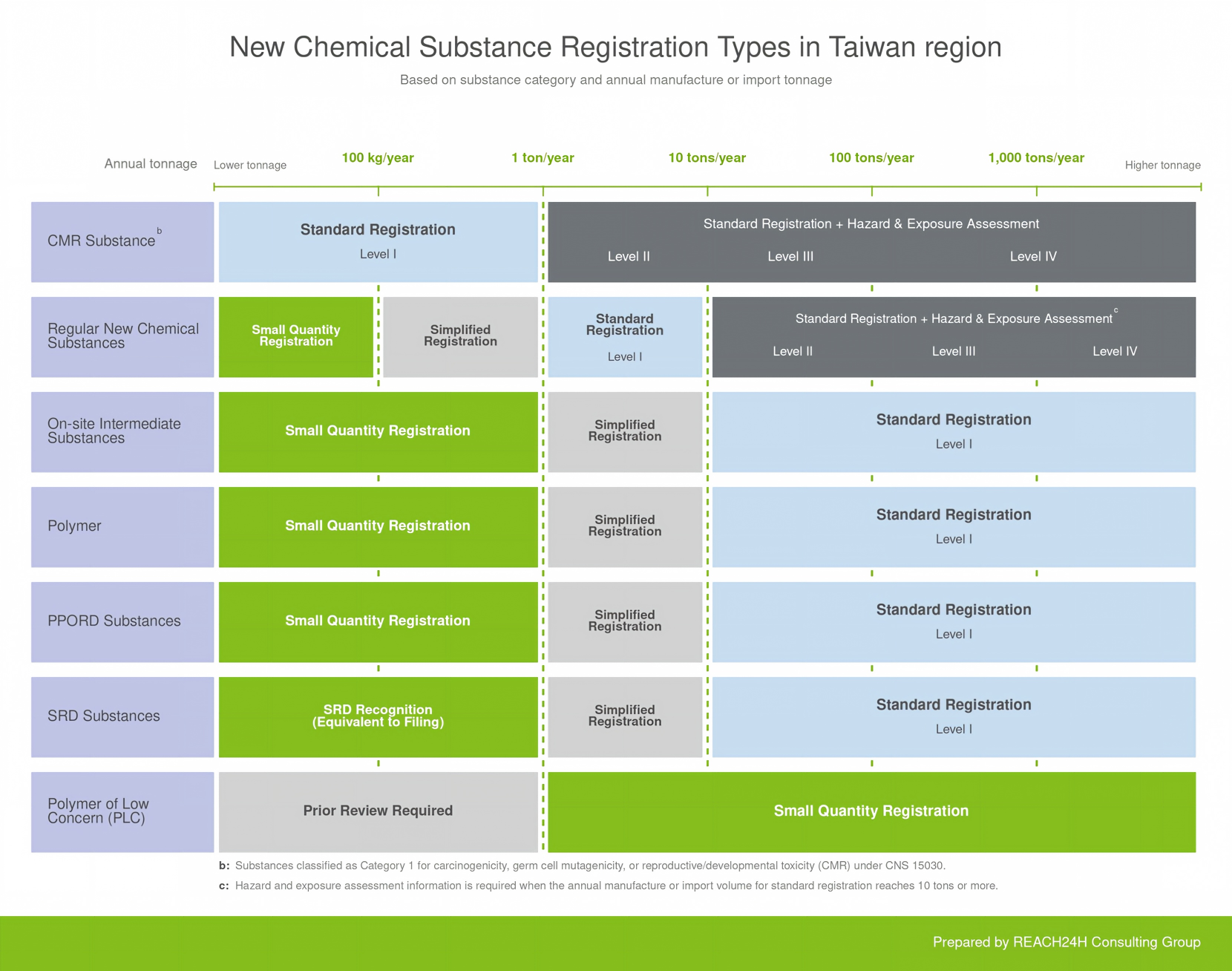
Figure: Taiwan TCCSCA New Chemical Substance Registration Types by Annual Tonnage
Step 4: Check Special Routes and Boundary Cases
Scientific research and development (SRD), product and process orientated research and development (PPORD), on-site isolated intermediates, polymers, and prior-verified polymers of low concern (PLC) are assessed under specific quantity bands and conditions in the appendices to the official registration regulations.
The route should be confirmed case by case. A low annual volume alone does not establish an exemption.
Pathway Decision Table
| Question | If Yes | If No / Next Question |
|---|---|---|
| Is the material within the scope of industrial chemical registration? | Continue with substance-level assessment | Document the legal basis for non-applicability and check other product, SDS, labelling, customs or workplace duties |
| Is the material a mixture? | Assess each individual substance in the mixture | Continue with the single-substance identity |
| Is the substance listed on the TCSI? | Assess Phase 1 and any designated standard-registration duties | Treat as a potential new chemical substance |
| Is an existing substance at 100 kg/year or more? | Phase 1 registration is generally required within six months | Voluntary registration may be possible; maintain quantity evidence |
| Is the substance on a designated standard-registration list and above the applicable band? | Confirm the current deadline, completion status, and outstanding data | Continue monitoring authority designations and volume |
| Is the new substance below 100 kg/year, 100 kg to less than 1 t/year, or 1 t/year or more? | Small quantity, simplified, or standard registration normally applies | Recheck aggregation, special uses, and substance form |
| Is the substance CMR Category 1 or subject to special conditions? | A higher information requirement or authority condition may apply | Continue with the ordinary route and data-gap review |
| Is a local representative required for project execution? | Confirm the Taiwan registrant, representative eligibility, appointment letter, scope and data rights | Confirm how the Taiwan registrant will manage the submission and ongoing duties |
Scope, Exemptions and Common Boundary Cases
The environmental registration regulations do not apply to certain substances or items, including:
Substances which occur in nature under the regulatory definition.
Chemical substances accompanying machines or equipment for test runs.
Inseparable intermediates in a reaction vessel or production process.
Materials for national security or national defense.
Chemical substances under customs supervision for re-export or transit.
Chemical waste from industrial processes.
Incidental reaction products or impurities with no commercial application.
Mixtures as such, although each individual constituent still requires assessment.
Articles.
TCSI-listed polymers that meet the 2% Rule.
Certain products governed by other laws, such as pesticides, feeds and feed additives, fertilizers, pharmaceuticals, cosmetics, foods and food additives, environmental agents, and controlled chemicals, may be outside the registration regulations as products. However, a chemical substance manufactured or imported as a raw material for those products may still fall within the industrial chemical registration system.
Important: An exemption or non-applicability conclusion does not necessarily mean that the business has no chemical compliance obligations. SDS, classification and labelling, workplace safety, customs, record keeping, priority management chemical reporting, controlled chemical permits, or product-specific rules may still apply.
Taiwan Third-Party Representative Support
A local representative is often described in the market as a third-party representative (TPR). Its legal position is different from an EU REACH Only Representative.
The Taiwan manufacturer or importer remains the registrant and appoints the qualified local representative. The representative must meet local eligibility requirements and provide a notarized or certified appointment letter where required.
For an overseas supplier, a properly structured arrangement can help:
Define the registrant, representative, data owner, importer, and overseas supplier responsibilities.
Coordinate substance identity, composition, use, quantity, and technical data.
Limit unnecessary disclosure of sensitive formulation or supplier information while meeting legal requirements.
Manage several importers, substances, or tonnage bands through one project governance model.
Control data-use permissions, testing rights, and joint-registration arrangements.
Maintain annual reports, changes, renewals, CBI periods, and responses to authority questions.
Before appointing a representative, companies should confirm the appointment scope, legal responsibility, information security model, data-use rights, access to registration numbers, and post-registration maintenance plan.
Required Data and Documents
Requirements vary according to substance identity, registration type, quantity level, use, hazard classification, and available evidence. A data gap analysis should be completed before testing or dossier compilation.
Company and Representative Information
Taiwan manufacturer or importer establishment and registration documents.
Representative information and the notarized or certified appointment letter where applicable.
Overseas supplier, data owner, importer, and technical contact information.
Substance Identity and Supply-Chain Information
Chemical name, CAS number, molecular formula, structural formula, and analytical information.
Purity, impurities, additives, composition range, and manufacturing-process description.
Monomer and reactant composition, GPC report, and PLC assessment information for polymers.
Expected annual manufacture or import quantity and the aggregation calculation.
Substance concentration in imported mixtures or formulations.
Uses, downstream conditions, exposure information, and recommended safe-use conditions.
Physicochemical, Toxicological and Ecotoxicological Data
Existing study reports, literature, and public-database information.
Physicochemical, toxicological, and ecotoxicological endpoint data.
Read-across, QSAR, weight-of-evidence, or other non-testing justifications.
Hazard assessment and exposure assessment information for applicable standard registrations.
Data ownership, letters of access, and permissions to use studies or joint-registration data.
Additional Materials
Chinese SDS and GHS label information where applicable.
CBI justification, evidence of economic value and non-public status, and proof of reasonable confidentiality measures.
SRD, PPORD, nanoscale substance, or other special-use forms.
Joint-registration arrangements, test-plan materials, and authority-specific online forms.
Taiwan region Chemical Registration Process
| Step | What Happens | Typical REACH24H Deliverable |
|---|---|---|
| 1. Substance and business mapping | Collect CAS number, composition, annual quantity, uses, import model, target date, and available data | Substance and supply-chain intake record |
| 2. TCSI search and applicability assessment | Determine new/existing status, exemptions, special-use routes, and polymer issues | TCSI evidence and applicability memo |
| 3. Registrant and representative confirmation | Define the Taiwan manufacturer/importer, representative, overseas data owner, and responsibilities | Responsibility matrix and appointment-document checklist |
| 4. Quantity band and pathway confirmation | Select Phase 1, designated standard, small quantity, simplified, standard, PLC, R&D, or another applicable route | Registration strategy and target timeline |
| 5. Data gap analysis | Compare existing evidence against endpoint and format requirements | Endpoint-level gap report and data-use plan |
| 6. Testing and non-testing strategy | Evaluate existing studies, data sharing, read-across, QSAR, expert evidence, and new tests | Testing plan, non-testing justification, and laboratory coordination plan |
| 7. Dossier preparation and submission | Prepare the technical dossier, online forms, translations, and official submission | Submission-ready dossier and filing record |
| 8. Authority review and supplementation | Manage questions, corrections, technical explanations, and supplemental data | Response package and communication log |
| 9. Approval and post-registration setup | Review conditions, quantity level, protected information, reporting duties, and future changes | Approval archive and ongoing compliance calendar |
Review Timelines and Official Fees
Official Review Periods
| Application type | Statutory review period after formal receipt |
|---|---|
| New substance small quantity registration; PLC prior verification or small quantity registration; existing substance Phase 1 registration; CBI protection or extension | 7 working days |
| New substance simplified registration; application for TCSI inclusion | 14 working days |
| New substance standard registration | 45 working days |
| Existing substance standard registration | 90 working days |
These are authority review periods after a complete application is formally received. They do not include data collection, testing, data purchase, translation, notarization or certification, internal confirmation, or correction periods.
Small quantity and simplified applications may be extended to 45 working days when authority conditions apply. The authority may extend a review period once. If corrections are requested, the correction period is excluded and the applicable review period is recalculated from receipt of the corrected information.
The TCCSCA registration regulations require an application for a new chemical substance to be filed 90 days before manufacture or import, and the substance may be manufactured or imported only after approval. Project planning should therefore begin well before the intended first shipment.
Official Review Fees
| Application type | Current official review fee (NT$) |
|---|---|
| New substance small quantity registration | 2,000 |
| New substance simplified registration | 20,000 |
| New substance standard registration | 50,000; 37,000 in specified qualifying cases |
| PLC prior verification | 1,000 |
| Existing substance Phase 1 registration | 100 |
| Existing substance standard registration | 50,000; 37,000 in specified qualifying cases |
| Protection of registered information | 12,500 per information item |
| Extension of protected information | 10,000 per information item |
Eligible academic institutions and small or medium-sized enterprises may qualify for a 75% fee rate for specified registration review items. Eligibility and current fee treatment should be checked against the official fee-charging standards before submission.
Official fees do not include testing, data access, translation, notarization or certification, technical service, representative service, or additional work arising from data gaps or authority questions.
2026 Regulatory Update for Certain Existing Substances
The Ministry of Environment has designated certain registrants for four existing substances to submit or update hazard and exposure assessment information by December 31, 2026, as set out in the official notice:
Antimony trioxide (CAS No. 1309-64-4)
Sulfuric acid (CAS No. 7664-93-9)
Toluene (CAS No. 108-88-3)
Zinc oxide (CAS No. 1314-13-2)
The requirement applies to designated registrants that received the authority notice and meet the specified conditions, including the relevant standard-registration levels and completion-number status. It is not a universal deadline for all 106 substances or every company handling these four substances.
Affected registrants should confirm whether the authority's hazard assessment example will be used, update the original manufacture, use and exposure information, and submit the applicable exposure scenario description.
The second and subsequent batches of existing-substance work remain an area to monitor. The published preliminary list for the second batch should not be presented as a final universal registration obligation until the legal designation process is complete.
Post-Registration Compliance
Registration approval is not the end of the compliance process. Companies should plan for:
Annual reporting: From the year following approval, report the previous year's actual manufacture or import quantity between April 1 and September 30.
Safe-use information transfer: When selling or transferring a registered substance, provide safe-use guidance and other information identifying the approved registration status.
Change management: Assess changes in company information, responsible person, substance identity, use, annual quantity, supply chain, or registration type.
Renewal: A new chemical substance registration approval under TCCSCA is valid for five years. Apply for extension during the period from six to three months before expiry.
CBI maintenance: Approved confidentiality is generally valid for five years. The cumulative maximum is 15 years for a new chemical substance and 10 years for an existing chemical substance, subject to the applicable rules.
Supplemental information: Provide new scientific, use, toxicological, ecotoxicological, hazard, or exposure information proactively or within a period designated by the authority.
Adjacent chemical controls: Check Priority Management Chemicals, Controlled Chemicals, SDS and labelling, toxic and concerned chemical controls, and other relevant obligations.
How REACH24H Can Help
Pre-Registration Assessment
TCSI search and status: Confirm whether the substance is existing or new.
Applicability and exemptions: Assess mixtures, articles, polymers, intermediates and R&D routes.
Quantity and pathway: Determine the appropriate registration category or level.
Registrant planning: Define local roles, appointment documents, responsibilities and data flow.
Data gap analysis: Compare available evidence with the target dossier.
Registration and Technical Support
Existing substance Phase 1 and standard registration.
New substance small quantity, simplified and standard registration.
PLC prior verification and polymer data preparation.
Testing, QSAR, read-across, weight-of-evidence and data-use strategy.
Hazard and exposure assessment preparation.
Dossier submission, authority communication and correction support.
Registered-information confidentiality and Chinese SDS/GHS support.
Post-Registration Maintenance
Annual quantity reporting.
Company, substance, use and quantity-band change assessment.
Renewal, data updates and TCSI inclusion support.
Supply-chain data management and safe-use communication.
Screening for Priority Management Chemicals, Controlled Chemicals and related obligations.
Project Deliverables
TCSI search results and substance identity records.
Applicability, pathway, quantity-band and target-timeline memorandum.
Responsibility matrix for the registrant, representative, supplier, importer and data owner.
Endpoint-level gap list, data-reuse plan and testing strategy.
Registration dossier, submission record, authority file and approval archive.
Ongoing compliance calendar for reporting, changes, CBI and renewal.
Why Choose REACH24H for Taiwan Chemical Registration?
Taiwan chemical compliance requires more than a TCSI database search. The correct route depends on substance identity, annual quantity, use, hazard profile, available data, confidentiality needs and the roles of the local registrant and representative. REACH24H connects these regulatory, scientific and supply-chain decisions before registration or testing begins.
Local Registration Coordination
Coordinate the Taiwan registrant, qualified representative, appointment documents, authority communication and long-term maintenance under a clearly defined responsibility structure.
Regulatory and Scientific Integration
Combine chemical regulatory assessment with analytical chemistry, toxicology, ecotoxicology and exposure expertise to define data gaps and evaluate lawful reuse of other-market data.
Cross-Border Data and CBI Planning
Support information exchange among overseas suppliers, Taiwan region importers, data owners and laboratories while planning data access, quantity tracking and confidentiality protection.
Full-Lifecycle Project Management
Move from TCSI screening and route selection through testing, dossier submission and authority questions to annual reporting, changes, data updates, CBI and renewal.
Taiwan region Chemical Registration FAQ
These questions address the registration, data, timing and supply-chain decisions most often faced by overseas suppliers and Taiwan region manufacturers or importers.
Taiwan region Chemical Registration Support
Need to confirm your substance status and registration route?
Submit the substance identity, composition, use and projected annual quantity for an initial TCCSCA and OSHA assessment.
Assessment Focus
✓TCSI Status and Substance Identity
✓TCCSCA and OSHA Registration Route
✓Data, Timeline and CBI Planning


