U.S. EPA PESTICIDE REGISTRATION SERVICES
Companies planning to sell or distribute products in the United States with insecticidal, herbicidal, fungicidal, rodenticidal, antimicrobial, disinfectant, repellent or plant-growth-regulating uses should first determine whether the product falls within the scope of the Federal Insecticide, Fungicide, and Rodenticide Act (FIFRA) and which U.S. EPA regulatory pathway applies.
REACH24H supports companies in assessing the appropriate U.S. EPA pesticide pathway based on the product type, formulation, active ingredient source, intended uses and target states. Our services cover regulatory pathway assessment, federal registration, U.S. agent support, state registration and post-registration maintenance.
Quick Navigation
Does Your Product Require U.S. EPA Pesticide Registration?
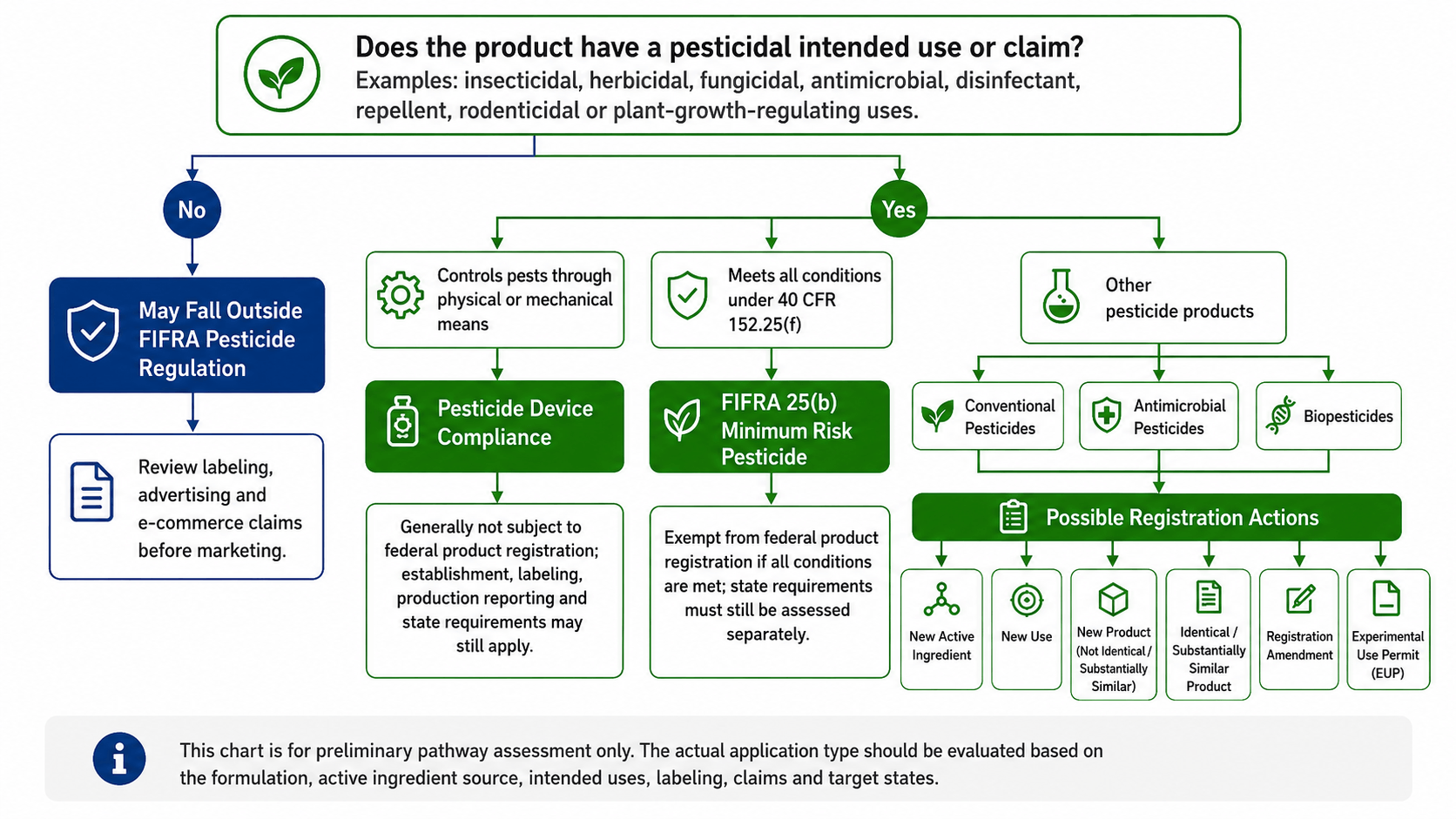
Whether a product falls within FIFRA depends not only on its formulation but also on its intended use, labeling, advertising and sales claims. Products intended to control pests, regulate plant growth, act as defoliants or desiccants, or function as nitrogen stabilizers may fall within FIFRA and require further assessment of the applicable registration, exemption or other compliance pathway.
| Product Category | Typical Examples | Federal-Level Consideration |
|---|---|---|
| Conventional Pesticides | Insecticides, herbicides, fungicides, rodenticides, plant growth regulators, defoliants, desiccants and nitrogen stabilizers | Generally require federal EPA product registration |
| Antimicrobial Pesticides | Disinfectants, sanitizers, sterilants and products intended to control microorganisms | Generally require federal EPA product registration; certain public-health claims may involve efficacy data |
| Biopesticides | Biochemical pesticides, microbial pesticides and plant-incorporated protectants (PIPs) | Generally require federal EPA product registration under the applicable review program |
| Pesticide Devices | Certain UV, air-treatment, water-treatment or other devices that control, repel or mitigate pests through physical or mechanical means | Generally not subject to federal product registration, but establishment registration, labeling, production reporting and state requirements may apply |
| FIFRA 25(b) Minimum Risk Pesticides | Products that meet all applicable active ingredient, inert ingredient, labeling and other exemption conditions | Exempt from federal product registration if all conditions are met; state requirements must still be assessed separately |
| Non-Pesticide Products | Ordinary chemicals, fertilizers, cleaning products or other products without pesticidal uses or claims | FIFRA may not apply, but labels, advertising and e-commerce claims should be reviewed to avoid unintended pesticidal claims |
Key Regulations Governing U.S. Pesticide Registration
U.S. pesticide market access is primarily governed by FIFRA, together with PRIA, Title 40 of the Code of Federal Regulations and, where relevant to food or feed uses, the Federal Food, Drug, and Cosmetic Act (FFDCA).
FIFRA
FIFRA establishes the core federal framework for pesticide product registration, labeling, production, distribution, enforcement and post-registration oversight. Unless an exemption applies, pesticides generally must be registered with EPA before they are sold or distributed in the United States.
PRIA 5
The Pesticide Registration Improvement Act establishes registration service fees and decision times for specified EPA actions. The current fee schedule contains 226 action categories covering conventional pesticides, antimicrobial pesticides, biopesticides, inert ingredients and other actions.
40 CFR
Title 40 contains implementing requirements covering pesticide registration, data requirements, data citation and compensation, labeling, exemptions, pesticide establishments and reporting.
FFDCA
Pesticides used on food or feed may also involve tolerance or tolerance-exemption requirements. These considerations can affect the registration pathway, data package and review timeline.
Choosing the Right U.S. EPA Registration Pathway
EPA first determines the relevant review program based on the product category and then identifies the applicable regulatory action and PRIA category. Companies should not estimate registration fees or timelines solely from general labels such as “new product” or “me-too registration.”
Common Registration Actions
| Registration Pathway | When It May Apply | Key Considerations |
|---|---|---|
| New Active Ingredient Registration | The proposed product contains an active ingredient that has not previously been used as an active ingredient in a U.S.-registered pesticide product | Comprehensive data strategy, food-use/tolerance considerations, risk assessment, budget and timeline |
| New Use Application | An existing active ingredient is proposed for a new crop, site, application method, target pest or other use | New-use data, tolerance implications, labeling and changes in risk assessment |
| New Product Registration (Not Identical/Substantially Similar) | The product uses a registered active ingredient source but its formulation, uses or labeling do not qualify for an identical or substantially similar route | Product-specific data, active ingredient source, formulation and labeling |
| Identical or Substantially Similar Product | The proposed product is identical or substantially similar in composition and use to an existing EPA-registered product | Reference product selection, data citation, active ingredient source and similarity of formulation and uses |
| Registration Amendment | Changes are proposed to the formulation, label, use, production information or other aspects of an existing registration | Nature of the change, whether additional data or fees are triggered, and label transition considerations |
| Experimental Use Permit (EUP) | Experimental use is planned under certain scales or conditions where an EUP may be required | Test scale, locations, crops/uses, data and project timing |
U.S. EPA Pesticide Registration Process
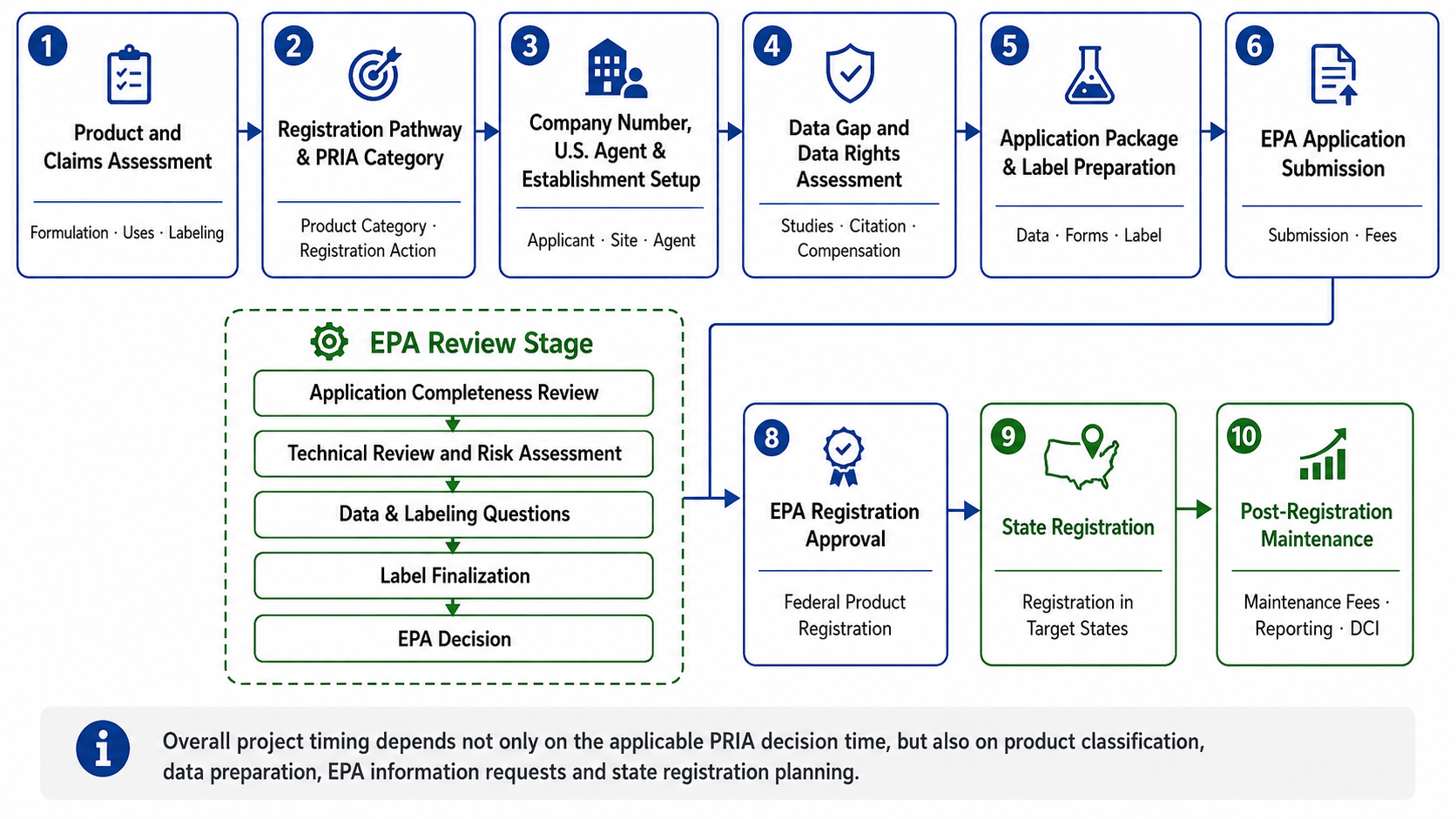
A U.S. pesticide registration project can be viewed in three main phases: application preparation and submission, EPA review, and post-approval market access. Overall timing extends beyond EPA's formal review period and may also depend on product classification, data preparation, EPA information requests and state registration planning.
PHASE 1
Prepare & Submit
Product & Claims Assessment
Review formulation, intended uses, labeling, advertising and claims.
Registration Pathway & PRIA Category
Determine the product category, regulatory action and applicable PRIA pathway.
Company Number, U.S. Agent & Establishment Setup
Address applicant, U.S. agent and pesticide-producing establishment requirements.
Data Gap & Data Rights Assessment
Evaluate data requirements, citation rights, compensation, bridging and waiver options.
Application Package & Label Preparation
Coordinate required studies and prepare forms, supporting information and proposed labeling.
EPA Application Submission
Submit the application under the applicable regulatory action and PRIA category.
PHASE 2
EPA Review Stage
PHASE 3
Market Access
EPA Registration Approval
Federal product registration.
Registration in Target States
Complete applicable state-level registration for intended markets.
Post-Registration Maintenance
Manage applicable federal and state maintenance obligations.
What Data Does EPA Evaluate?
Data requirements depend on the product category, intended uses, exposure scenarios, formulation and requested regulatory action. Not every project requires a completely new set of studies, but the applicant must demonstrate that each applicable data requirement has been addressed through an acceptable regulatory approach.
| Data Area | Examples |
|---|---|
| Product Chemistry | Active ingredient and product identity, composition, manufacturing process, impurities, physicochemical properties, analytical methods and quality control |
| Human Health | Acute, subchronic and chronic toxicity, carcinogenicity, reproductive and developmental toxicity, neurotoxicity and other applicable endpoints |
| Ecotoxicology | Potential effects on birds, fish, aquatic invertebrates, bees, plants and other non-target organisms |
| Environmental Fate | Degradation, metabolism, mobility, soil and water behavior, and potential environmental exposure |
| Residue Chemistry | Residue studies, analytical methods, dietary risk and tolerance/tolerance-exemption considerations for food or feed uses |
| Efficacy | Supporting efficacy data for certain antimicrobial, public-health or other applicable claims |
| Label and Use Information | Proposed uses, application methods, rates, frequency, risk-mitigation measures, personal protective equipment and environmental restrictions |
How Can Data Requirements Be Addressed?
Depending on the application and data requirement, potential strategies may include:
submitting applicant-owned study data;
citing EPA-reviewed data;
using the Formulator's Exemption, where applicable;
scientifically justified bridging, alternative methods or waiver requests;
using eligible public literature or government-generated data.
The acceptability of each approach depends on the specific application and EPA's review.
Data Protection and Compensation
FIFRA provides different data-rights protections for information submitted to EPA in support of pesticide registration.
Exclusive-Use Data
Data submitted for the first registration of a product involving a new active ingredient or a new combination of active ingredients, or for certain amendments adding a new use, may receive exclusive-use protection. In general, the exclusive-use period is 10 years from the date of product approval. During the protected period, an applicant seeking to cite exclusive-use data for a U.S. EPA pesticide registration must obtain authorization from the original data holder.
Compensable Data
Data submitted in support of registration that are no longer protected by exclusive-use rights may remain compensable for 15 years from the date they were first submitted to EPA. An applicant citing such data generally must send the original data holder an offer-to-pay statement. After the required offer-to-pay statement is made, authorization from the data holder is not required for citation of compensable data.
Other Citable Data
Data for which the applicable protection period has expired, government-generated data and eligible public literature may be cited directly, subject to applicable EPA requirements.
PRIA Fee Reductions and Review Timing
EPA provides fee-reduction provisions for qualifying small businesses applying for pesticide registration.
Small Business PRIA Fee Reductions
Eligible small businesses may apply for a 50% or 75% reduction in the applicable PRIA registration service fee. Eligibility generally considers the applicant and its affiliates, including global employee numbers and average annual global pesticide-related revenue over the previous three years.
| Fee Reduction | General Eligibility Framework |
|---|---|
| 50% Reduction | 500 or fewer employees and average annual global pesticide-related revenue of no more than USD 60 million over the previous three years |
| 75% Reduction | Meets the employee threshold and has average annual global pesticide-related revenue below USD 10 million over the previous three years |
Foreign applicants are not automatically excluded from these reductions because of their location, but supporting documentation and the applicable advance payment must be provided in accordance with EPA requirements.
Review Timeline
A PRIA Decision Time is the official decision period associated with a specific action category. It should not be treated as the total project duration. Upfront classification, data-gap assessment, testing, application package preparation, fee-reduction review, additional information requests and state registration should be planned separately.
Not sure which PRIA pathway applies to your product?
Request an EPA Assessment →Do Foreign Applicants Need a U.S. Agent?
Yes. An applicant located outside the United States must designate an agent residing in the United States to represent the applicant in registration matters and receive EPA correspondence.
Foreign companies should also distinguish among three different EPA identifiers.
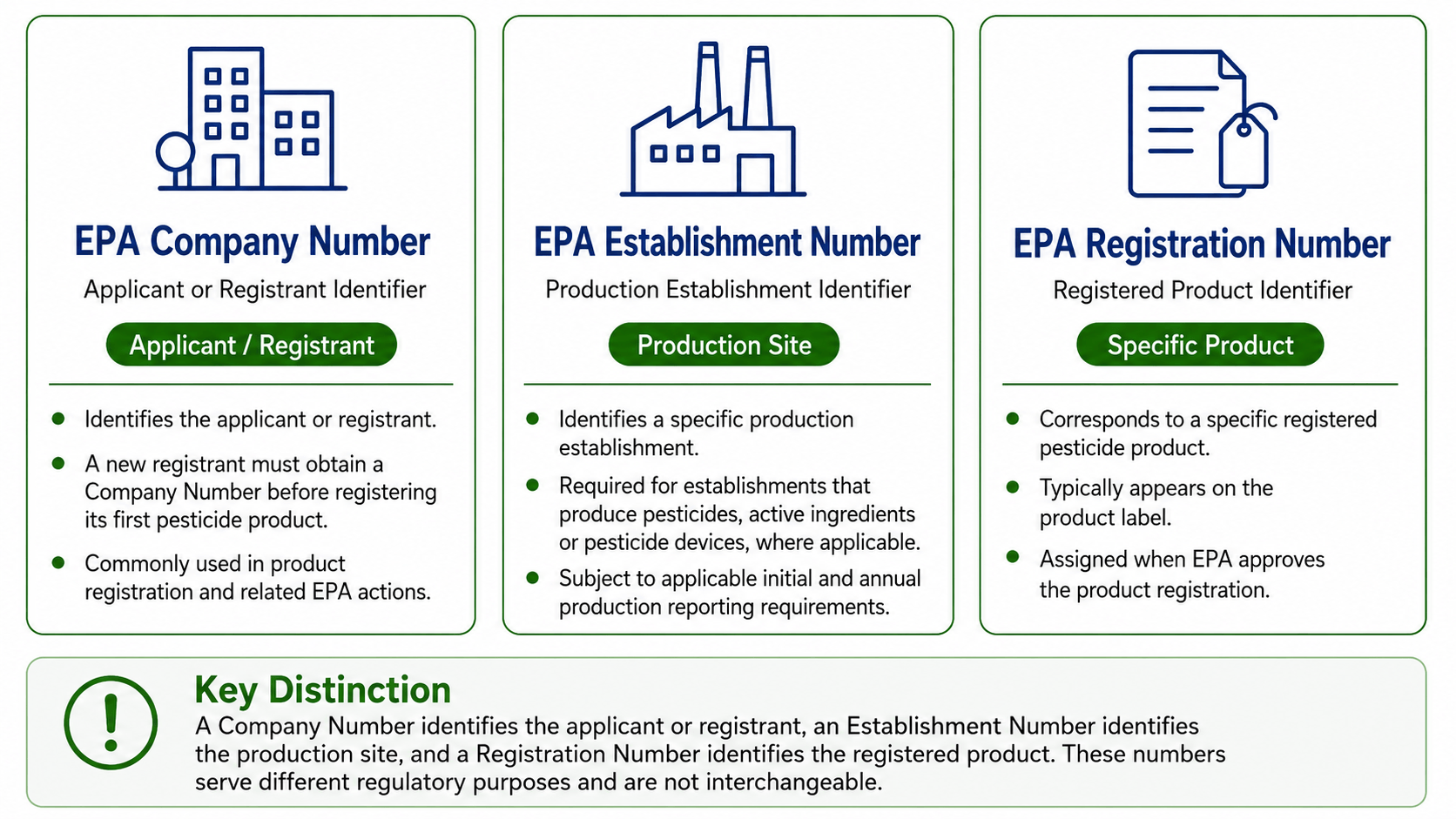
EPA Company Number
Identifies the applicant or registration holder. A new applicant typically needs to obtain a Company Number before proceeding with product registration and related EPA actions.
EPA Establishment Number
Identifies a specific production establishment. Facilities producing pesticides, active ingredients or pesticide devices may be required to register and comply with initial and annual production-reporting requirements.
EPA Registration Number
Identifies a specific EPA-registered pesticide product. The number is assigned after product registration is approved and is typically displayed on the product label.
These identifiers serve different regulatory purposes and are not interchangeable.
Does Federal EPA Registration Allow Sales in Every State?
Not necessarily.
Federal EPA registration is the core federal market-access requirement for registered pesticide products, but companies should separately assess the registration, renewal, labeling and other requirements of the states in which the product will actually be sold or distributed.
Companies planning nationwide e-commerce distribution should therefore consider where their products can actually be purchased and shipped, rather than evaluating only the state in which the business is located.
Related Service: U.S. State Pesticide Registration
Post-Registration Compliance
EPA registration is not the end of the compliance lifecycle. Registrants and pesticide-producing establishments may need to manage ongoing federal and state obligations, including:
annual pesticide product maintenance fees;
establishment production reporting;
state registration renewals;
formulation, source, use and label changes;
Data Call-Ins (DCIs);
EPA Registration Review;
relevant company and establishment information changes.
EPA reviews registered pesticides at least every 15 years under its Registration Review program and may require additional data through a DCI where needed.
How REACH24H Can Help
REACH24H provides regulatory and technical support across the U.S. pesticide market-access lifecycle, based on the product type, formulation, intended uses, claims and target markets.
1. Product Assessment and Registration Strategy
FIFRA regulatory classification and product-category assessment;
pathway assessment for conventional pesticides, antimicrobials, biopesticides, pesticide devices and FIFRA 25(b) minimum-risk pesticides;
registration strategy for new active ingredients, new uses, new products and identical/substantially similar products;
preliminary PRIA category, fee, timeline and federal/state market-access planning.
2. Federal Registration and U.S. Agent Support
EPA company number and establishment registration support;
U.S. agent support for foreign applicants;
new active ingredient, new product and registration amendment support;
application package and label preparation or review;
support with EPA information requests and technical responses.
3. Data and Technical Strategy
data-gap assessment across applicable scientific areas;
existing-data citation, Formulator's Exemption, bridging and waiver strategy assessment;
data-rights and compensation strategy;
testing and technical coordination based on project needs.
4. Special Product Compliance
biopesticide and antimicrobial/disinfectant registration support;
pesticide device and FIFRA 25(b) minimum-risk pesticide compliance;
inert ingredient and related state-level regulatory assessment;
product labeling and claims review.
5. State Registration and Post-Registration Support
state pesticide registration, renewal and amendments;
California and multi-state market-access support;
maintenance fee, production reporting and registration-information support;
DCI, Registration Review and other post-registration regulatory support.
Why REACH24H?
15+ Years
U.S. EPA Pesticide Registration Project Experience
3,000+
Federal & State Registrations Supported
50 States + Washington, D.C.
U.S. State Market Coverage
EPA Consultant Directory
REACH24H USA Inc. is listed in the U.S. EPA public directory of pesticide regulatory consultants.
U.S.-Based Project Coordination
REACH24H's U.S.-based and international teams support cross-border projects involving applicant coordination, documentation, U.S. agent arrangements, EPA correspondence and long-term project management.
Data Strategy & Project Feasibility
Assess data gaps, citation options, compensation, bridging and waiver strategies early so that key technical, timing and budget risks can be identified before submission.
Federal-to-State Market Access
Support extends from federal registration strategy through California and multi-state registration, renewals and post-registration maintenance for different pesticide product categories.
Selected Success Stories
Selected projects show how REACH24H applies regulatory strategy, data planning and project management to different U.S. pesticide market-access challenges.
CASE 01
EPA Manufacturing-Use Pesticide Registration Approved in 10 Months
Upfront risk assessment, a tailored registration strategy and end-to-end review management helped secure federal EPA approval in approximately 10 months, with no additional conditions.
View Full Case →CASE 02
U.S. EPA Approval for a New Herbicide Safener Source
REACH24H developed the data strategy and supported the EPA application for a new safener source, helping the supplier establish a compliant pathway to the U.S. market.
View Full Case →CASE 03
Navigating California Pesticide Registration Requirements
REACH24H supported companies in addressing California-specific data, labeling and submission requirements beyond federal EPA registration to support successful state-level approval.
View Full Case →CASE 04
Pesticide Registration Coverage Across All 50 States + D.C.
REACH24H has supported multi-state market access for end-use pesticides, manufacturing-use products, pesticide devices and minimum-risk pesticides, with registration coverage across all 50 states and Washington, D.C.
View Full Case →Frequently Asked Questions
U.S. EPA PESTICIDE REGISTRATION SUPPORT
Assessing a pesticide product for the U.S. market?
The cost and timeline of a U.S. EPA pesticide registration project can depend heavily on decisions made at the beginning of the project, including product classification, the applicable PRIA pathway and the data strategy. If you are assessing a technical-grade active ingredient, formulated pesticide, biopesticide, antimicrobial/disinfectant product, FIFRA 25(b) minimum risk pesticide or pesticide device for the U.S. market, REACH24H can help evaluate the applicable pathway based on the formulation, intended uses, claims, available data and target states.
Assessment Focus
✓ Product classification and applicable PRIA pathway
✓ Data availability, data rights and testing strategy
✓ U.S. agent, federal registration and target-state scope