U.S. PESTICIDE REGISTRATION | JANUARY-JULY 2026
U.S. EPA pesticide registration activity remained high through July 2026, led by conventional pesticides. As of July 30, the EPA had approved 481 pesticide product registrations, while new active ingredient approvals also reflected growing diversity across conventional chemistry, microbial and biochemical pesticides, and gene-edited plant-incorporated protectants (PIPs). For companies evaluating the U.S. market, these developments highlight the importance of registration strategy, product portfolio planning and coordinated federal and state compliance. Learn more about U.S. EPA pesticide registration.
U.S. EPA Pesticide Registration 2026 at a Glance
| Indicator | January-July 2026 | What It Shows |
|---|---|---|
| Total EPA pesticide product registrations | 481 | Registration activity remained high through July. |
| Conventional pesticide registrations | 367 / 76.3% | Conventional pesticides represented the largest registration category. |
| New active ingredients approved | 9 | Approvals spanned conventional, microbial, biochemical and gene-edited PIP pathways. |
| Chinese companies obtaining registrations | 17 companies / 52 registrations | Registration activity surpassed the full-year 2025 total. |
Registration Activity Remains High, Led by Conventional Pesticides
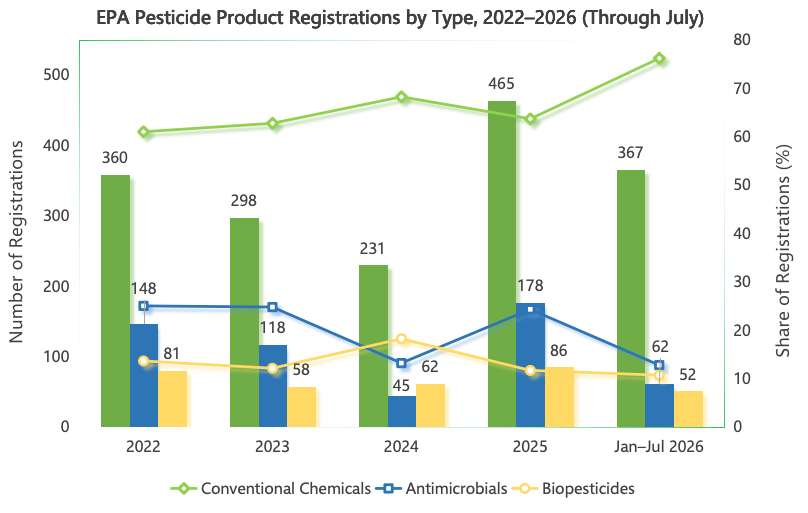
As of July 30, 2026, the EPA had approved 481 pesticide product registrations. Conventional pesticides performed particularly strongly, with 367 registrations secured during the first seven months - equivalent to 78.9% of the 465 registrations recorded for the full year of 2025. Antimicrobial pesticides and biopesticides accounted for 62 and 52 registrations, respectively.
From 2022 to 2025, conventional pesticides represented roughly 61%-68% of annual registrations. By July 2026, their share had risen to 76.3%, the highest level in recent years. Biopesticides remained broadly stable at 10.8%, while antimicrobial pesticide registrations accounted for 12.9%.
Overall, EPA pesticide registration activity remained elevated during the first seven months of 2026, with conventional pesticides becoming an increasingly prominent driver of registration activity. Companies preparing U.S. submissions can review the EPA's conventional pesticide registration guidance alongside the applicable product-specific requirements.
Active Ingredient Review: Herbicides Dominate as Biopesticides Diversify
EPA registrations approved from January through July 2026 involved more than 200 active ingredients. Sulfentrazone led with 19 registrations, followed by pyroxasulfone with 18 and chlorantraniliprole with 15. Established active ingredients such as S-metolachlor, bifenthrin and metribuzin also remained highly active.
Herbicides accounted for most of the leading active ingredients. This reflects both persistent demand for broad-acre weed control in North America and the commercial focus on combining residual herbicides such as sulfentrazone, metribuzin and chlorsulfuron with active ingredients offering different modes of action to address resistant weeds.
Demand for insecticides, including chlorantraniliprole and bifenthrin, and fungicides such as metalaxyl-M remained steady, while registrants continued to refresh their product portfolios through new combinations.
Top 10 Active Ingredients in EPA Registrations, January-July 2026
| Rank | Active Ingredient | Registrations | Pesticide Type |
|---|---|---|---|
| 1 | Sulfentrazone | 19 | Herbicide |
| 2 | Pyroxasulfone | 18 | Herbicide |
| 3 | Chlorantraniliprole | 15 | Insecticide |
| 4 | S-metolachlor | 12 | Herbicide |
| 5 | Bifenthrin | 11 | Insecticide |
| 6 | Metribuzin | 11 | Herbicide |
| 7 | 2,4-D, dimethylamine salt | 10 | Herbicide |
| 8 | Chlorsulfuron | 10 | Herbicide |
| 9 | Dicamba, dimethylamine salt | 9 | Herbicide |
| 10 | Metalaxyl-M | 9 | Fungicide |
Among biopesticides, indole-3-butyric acid, Priestia megaterium strain SYM36613, decanoic acid, octanoic acid, choline chloride and cytokinins were among the more active ingredients. Plant growth regulation, microbial control and emerging biotechnology are collectively broadening the range of biopesticide products.
New Active Ingredients: Chemical and Biological Innovation Advance in Parallel
From January through July 2026, the EPA approved nine new active ingredients. Unlike periods dominated by a single technology pathway, the latest approvals spanned conventional chemical pesticides, microbial pesticides, biochemical pesticides and gene-edited plant-incorporated protectants (PIPs), demonstrating the parallel development of conventional chemistry and biological innovation.
Conventional pesticide innovation
Fluoxapiprolin, epyrifenacil and diflufenican were newly registered, expanding the options available for disease and weed management.
Microbial and biochemical innovation
The new active ingredients included Priestia megaterium strain SYM36613, Wolbachia pipientis wAlbB strain in Culex quinquefasciatus mosquitoes (Debug quinx males), and PDHP 68949, with applications ranging from plant health to mosquito control. EPA maintains dedicated information on biopesticide regulatory actions.
Advanced biotechnology
CarriCea T1, the first pesticide based on CRISPR/Cas9 precision gene editing in citrus rootstock, received EPA registration. The product introduces three new PIP active ingredients associated with the citrus susceptibility genes ACD2, LLS1 and PLCP. This milestone opens a new pathway for managing citrus greening disease and establishes an important regulatory precedent for gene-edited pesticide products.
Conventional pesticides (3)
Fluoxapiprolin
Epyrifenacil
Diflufenican
Microbial pesticides (2)
Priestia megaterium strain SYM36613
Wolbachia pipientis wAlbB strain contained in live adult Culex quinquefasciatus males (DQB strain)
Biochemical pesticide (1)
PDHP 68949
Gene-edited PIPs (3)
Loss of function gene ACD2 (Accelerated Cell Death 2) and associated Cas9 protein and gRNA sequence
Loss of function gene LLS1 (Lethal Leaf Spot 1) and associated Cas9 protein and gRNA sequence
Loss of function gene PLCP (Papain-Like Cysteine Protease) and associated Cas9 protein and gRNA sequence
The EPA's current Section 3 PIP registration list includes the ACD2, LLS1 and PLCP active ingredients for citrus. Companies developing novel pesticide technologies can also review REACH24H's U.S. EPA new active ingredient registration support.
Registrant Landscape: Leading Registrants Expand Their Portfolios While Chinese Companies Increase U.S. Activity
Leading Registrants Pursue Multi-Dimensional Portfolios
From January through July 2026, 183 companies obtained new EPA registrations. Chemagco, Atticus and Rainbow Agrosciences ranked first, second and third with 32, 31 and 27 registrations, respectively. The ten leading registrants secured a combined 175 registrations, accounting for more than one-third of all approvals. Leading registrants continued to broaden product coverage through multiple active ingredients, formulation types and use scenarios.
| Registrant | Registrations | Pesticide Type |
|---|---|---|
| Chemagco LLC | 32 | Conventional pesticides (31); Biopesticides (1) |
| Atticus, LLC | 31 | Conventional pesticides |
| Rainbow Agrosciences, LLC | 27 | Conventional pesticides |
| Sharda USA LLC | 20 | Conventional pesticides |
| Agrovia LLC | 16 | Conventional pesticides (15); Biopesticides (1) |
| Sharda Cropchem Limited | 13 | Conventional pesticides |
| BASF Agricultural Solutions US, LLC | 10 | Conventional pesticides |
| Loveland Products, Inc. | 10 | Conventional pesticides |
| Control Solutions, Inc. | 9 | Conventional pesticides |
| Aceto Life Sciences, L.L.C., d/b/a Actylis | 7 | Conventional pesticides |
Chinese Companies Increase U.S. Registration Activity and End-Use Product Presence
Based on available data, 17 Chinese companies obtained 52 U.S. EPA pesticide registrations from January through July 2026. The number of registrations had already surpassed the full-year 2025 total.
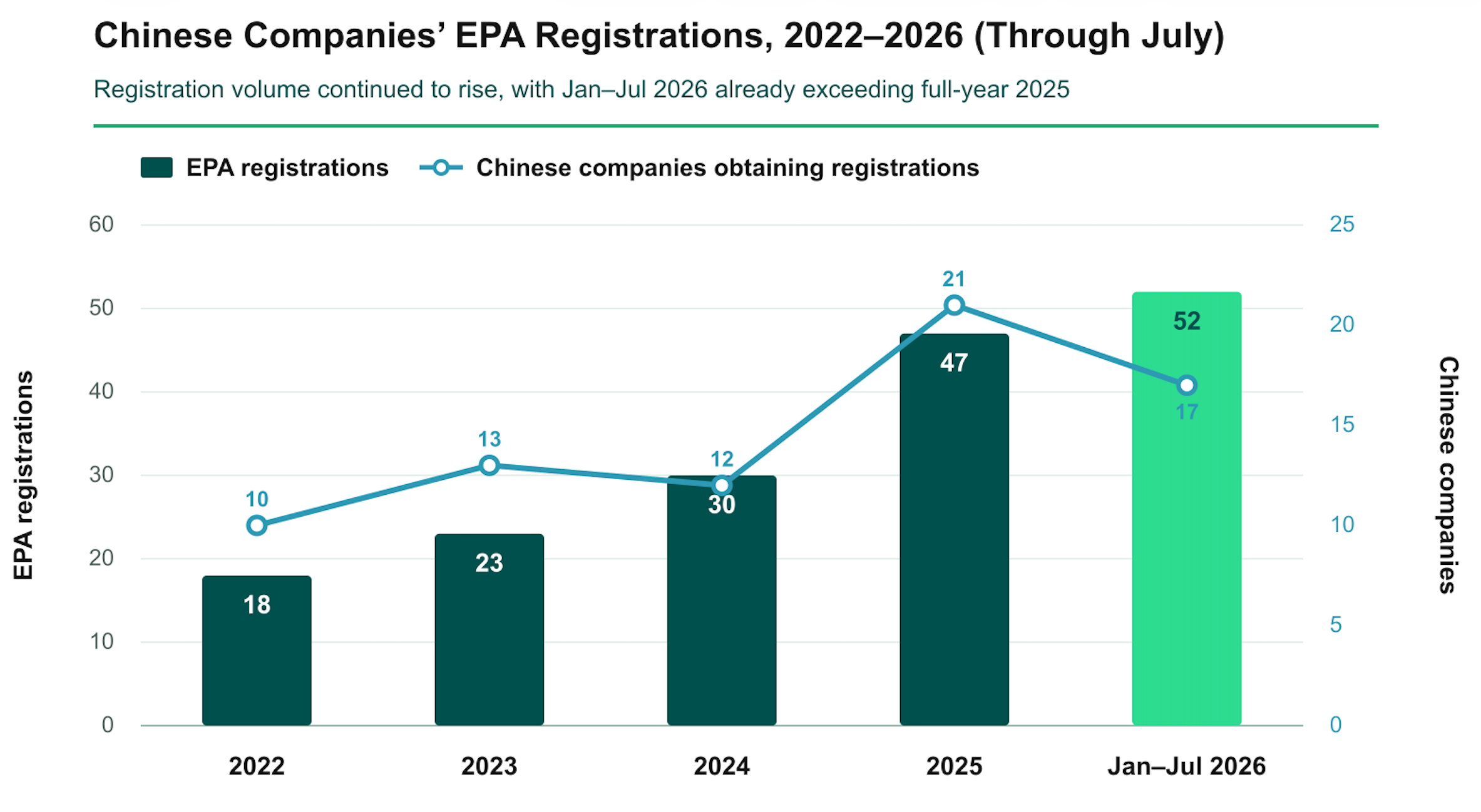
Conventional pesticides remained dominant, accounting for 44 of these registrations, alongside six biochemical pesticide registrations and two antimicrobial pesticide registrations. Notably, 33 were end-use products and 19 were manufacturing-use products, including technical products and concentrates.
This suggests that Chinese companies are increasingly pursuing end-use product registrations alongside manufacturing-use products, rather than focusing primarily on upstream technical products. At the same time, considerable room remains to build proprietary formulation expertise and more differentiated product portfolios.
REACH24H Insights: Seizing the Growth and Innovation Window
Through July 2026, U.S. EPA pesticide registration activity was characterized by strong conventional pesticide registration volumes, steady development in biopesticides and faster commercialization of innovative technologies. For companies planning to expand in North America, the opportunity is not simply a matter of higher registration volumes; product portfolio design, end-use positioning and launch timing are equally important.
REACH24H recommends that Chinese crop protection companies plan the following areas in parallel when seeking deeper market penetration and stronger brand recognition in North America:
Advance end-use product registrations in parallel: When registering technical or manufacturing-use products, companies should plan end-use formulations at an early stage to strengthen brand control and connect more directly with U.S. market demand.
Coordinate closely with state registration requirements: After obtaining federal EPA registration, companies should advance state registrations according to target sales regions and launch windows, completing the final step required for market entry. See REACH24H's U.S. state pesticide registration guidance.
Build a differentiated product portfolio: Established active ingredients remain the core of the market, but microbial pesticides, biochemical pesticides and gene-edited PIPs are creating new opportunities. Companies can leverage their technology and supply-chain strengths to develop distinctive active ingredients, formulations and use scenarios.
How REACH24H Can Support U.S. EPA Pesticide Registration
REACH24H supports companies across key stages of U.S. pesticide market access, from federal registration planning to state-level implementation. Depending on the product and registration pathway, support may include:
U.S. EPA federal pesticide registration and registration strategy;
new active ingredient registration and data requirement assessment;
data gap analysis, waiver analysis and testing coordination;
U.S. state pesticide registration and launch coordination;
U.S. agent and post-registration compliance support.
Planning a U.S. pesticide registration project?
Submit your product type, active ingredient, intended uses and current registration status. REACH24H can help assess the applicable EPA pathway, data requirements, state registration needs and next steps.
Recommended Reading
Pesticide Registration in the U.S.: Navigating New Active Ingredient Registration with the EPA
State Pesticide Registration in the U.S.: Key Requirements and Compliance Challenges
PRIA 6 Outlook: Potential Changes to U.S. EPA Pesticide Registration Fees and Review Timelines