Is your product facing any of these compliance challenges?
A natural essential-oil mosquito-repellent wristband is removed from an e-commerce platform as an unregistered pesticide.
A pet pest-control collar encounters import issues because of labeling.
A product made with naturally derived ingredients still receives a compliance notice.
Product listings are repeatedly suspended or removed, affecting U.S. market access.
You are unsure whether your product should follow conventional U.S. EPA pesticide registration or the FIFRA 25(b) minimum risk pesticide exemption pathway.
For pest repellents, pest-control products and other pesticides intended for the U.S. market, identifying the correct regulatory pathway is a critical first step. Certain products that meet the applicable requirements may qualify as Minimum Risk Pesticides under FIFRA Section 25(b) and be exempt from U.S. EPA federal product registration. However, the formulation, labeling, claims and applicable state requirements must still be addressed.
REACH24H supports companies with regulatory pathway assessment, formulation review, label and marketing-material review, efficacy-data strategy, U.S. state registration and ongoing compliance management.
What Is a FIFRA 25(b) Minimum Risk Pesticide?
Unless an exemption applies, pesticide products generally must be registered with the U.S. Environmental Protection Agency (EPA) under the Federal Insecticide, Fungicide, and Rodenticide Act (FIFRA) before they are sold or distributed in the United States.
In accordance with FIFRA Section 25(b) and relevant regulations, certain pesticide products that meet specified ingredient, labeling and claim conditions may qualify for the minimum risk pesticide exemption. A qualifying product does not need U.S. EPA federal product registration or an EPA Registration Number for the product.
Why Consider the FIFRA 25(b) Exemption Pathway?
For products that qualify, the 25(b) pathway does not involve the conventional EPA federal product-registration review process. This can reduce the federal regulatory burden and support a more efficient market-entry strategy compared with conventional pesticide registration.
However, companies should clearly distinguish between federal exemption and overall market access:
Federal registration exemption ≠ state-level registration exemption ≠ no regulation.
Each U.S. state has its own pesticide laws and may impose registration, filing or other requirements even when a product qualifies for the federal 25(b) exemption. Based on REACH24H's U.S. state compliance experience, more than 40 states require registration, filing or other applicable state-level compliance for minimum risk pesticide products. Requirements vary by state and product.
Companies should therefore assess the target sales states, product formulation, labeling and claims before placing a product on the U.S. market.
What Types of Products May Qualify as Minimum Risk Pesticides?
Subject to the applicable FIFRA 25(b) requirements, products that may potentially follow the minimum risk pesticide pathway include:
Product Category | Typical Use | Examples |
|---|---|---|
Personal repellent products | Repelling mosquitoes, ticks and other pests | Natural mosquito-repellent sprays, repellent patches, repellent wristbands |
Pet pest-control products | Repelling or controlling pests affecting pets | Pet pest-control collars, repellent sprays |
Household and garden pest-control products | Controlling common household or plant pests | Ant-control products, cockroach-control products, garden pest sprays |
Certain non-public-health microbial-control and odor-control products | Controlling microorganisms or odor sources not associated with public-health threats | Odor-control sprays, certain surface-treatment products |
Product category alone does not determine 25(b) eligibility. The complete formulation, intended use, ingredient functions, label and marketing claims should be assessed together before relying on the exemption.
Core Requirements for the FIFRA 25(b) Minimum Risk Pesticide Exemption
To qualify for the minimum risk pesticide exemption, the product formulation, labeling, and marketing materials must meet all of the following requirements:
1. Active Ingredient Requirements
Only active ingredients included on the U.S. EPA's list of active ingredients eligible for minimum risk pesticide products may be used. The list includes more than 40 active ingredients, mainly certain plant-derived essential oils, organic acids, and other substances, such as peppermint oil, clove oil, citric acid, and thyme oil.
2. Inert Ingredient Requirements
Only inert ingredients eligible for use in minimum risk pesticide products under U.S. EPA requirements, or inert ingredients that meet the applicable pesticide residue tolerance exemption requirements, may be used.
3. Ingredient Declaration Requirements
The product label should comply with the relevant U.S. EPA ingredient declaration requirements. Formulation information should be accurate and complete, with the relevant ingredients and their amounts identified in the required format.
4. Restrictions on Product Use and Efficacy Claims
Efficacy claims on product labels and promotional materials should comply with U.S. EPA requirements. Companies should avoid claims involving pathogen control, disease prevention, or other claims that may subject the product to more stringent regulatory requirements.
5. Company Contact Information Requirements
The product label should include accurate and complete company contact information, including the company name and valid contact details.
6. Consistency of Labels and Promotional Materials
Product labels and related promotional materials must not contain any false or misleading statements. Product descriptions should be truthful and accurate and comply with applicable U.S. EPA requirements.
What Are the Risks if a Product Does Not Meet the 25(b) Requirements?
If a product does not meet all applicable minimum risk pesticide exemption conditions and is sold or distributed without another applicable exemption or EPA product registration, federal or state enforcement action may follow.
Potential business impacts may include:
Import Issues
Pesticide products that do not meet applicable U.S. requirements may be refused admission or face other import-related enforcement measures.
E-Commerce Listing Restrictions
Non-compliant product identity, labels or marketing claims may result in listing restrictions, removal or additional compliance review on e-commerce platforms.
Regulatory Enforcement
A product marketed as an exempt pesticide without meeting the applicable exemption requirements may be subject to federal or state enforcement action.
Market and Brand Disruption
Repeated product corrections, listing suspensions or sales interruptions can increase compliance costs and disrupt longer-term U.S. market plans.
Compliance Enforcement Cases and Risk Alerts
Case 1: Amazon Fined Nearly $5 Million by California Department of Pesticide Regulation (CDPR) for Selling Unregistered Pesticides in California
Case Facts: Amazon was fined nearly $5 million after reaching an agreement with California authorities for selling pesticide products to California consumers that had not completed required California registration, including Minimum Risk Pesticide products that were not properly registered in California.
Key Compliance Alert: California maintains an independent pesticide regulatory system. Exemption from registration under U.S. EPA FIFRA Section 25(b) does not automatically qualify a product for exemption in California. Companies must independently evaluate whether their products meet CDPR exemption requirements based on factors such as product formulation, labeling, and pesticidal claims. If a product does not qualify for a California exemption, it must complete CDPR registration before being marketed or sold in California. Otherwise, companies may face enforcement actions, product delisting, sales restrictions, or other regulatory penalties.
Case 2: U.S. EPA and Customs and Border Protection (CBP) Strengthen Import Enforcement, Blocking Nearly 1.4 Million Pounds of Illegal Pesticides from Entering the United States
Case Facts:During Fiscal Year 2025, the U.S. EPA, together with U.S. CBP, strengthened border enforcement of imported pesticides and products regulated under FIFRA. Through import refusal actions, nearly 1.4 million pounds of illegal pesticide products were prevented from entering the U.S. market, and 469 Notices of Refusal of Admission were issued.The intercepted products primarily involved unregistered pesticides, improperly labeled products, and pesticide products that failed to meet FIFRA requirements.
Key Compliance Alert: Before shipment, companies should determine the product's regulatory status, applicable EPA registration or exemption pathway, label compliance and relevant state requirements. Failure to meet these requirements may result in products being refused entry, returned to origin, detained, or subject to other enforcement actions.
FIFRA 25(b) Minimum Risk Pesticide Compliance Process
The compliance process for a FIFRA 25(b) minimum risk pesticide generally involves four key stages: product formulation review, label and marketing material review, U.S. state registration, and post-market compliance maintenance.
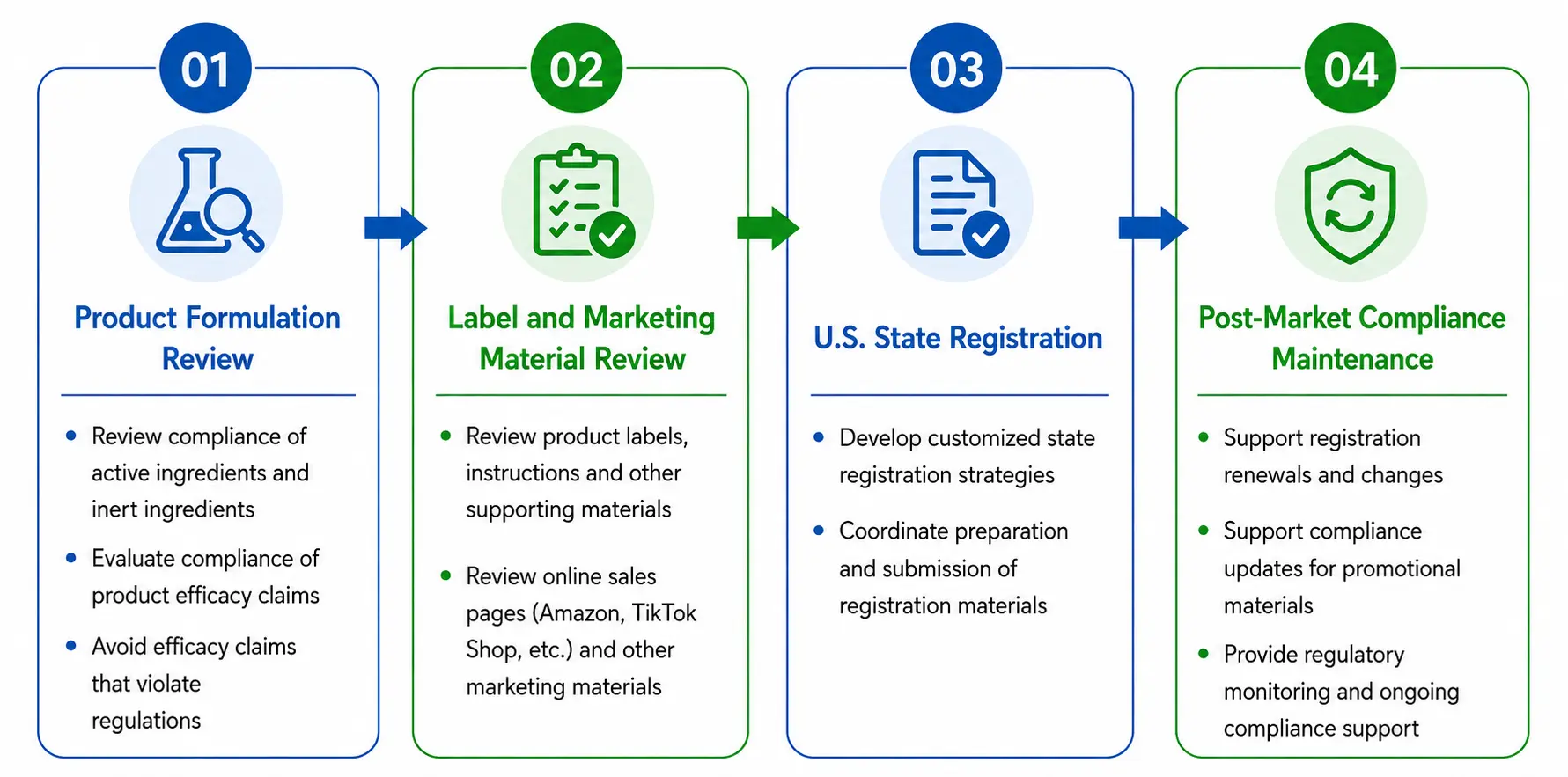
The specific requirements may vary depending on the product formulation, intended use, claims, and target sales states. For broader state-level pesticide requirements, see REACH24H's State Pesticide Registration in the U.S. service.
REACH24H FIFRA 25(b) Minimum Risk Pesticide Services
Core 25(b) Compliance Services
Minimum Risk Pesticide Formulation Compliance Assessment
Product Label, Instructions and E-Commerce Marketing Content Review
Efficacy Study Strategy and Study Monitoring
U.S. State Registration and Ongoing Compliance Support
Other U.S. EPA Pesticide Compliance Services
Where a company also has conventional EPA registration, pesticide-production establishment, inert ingredient or other U.S. pesticide regulatory needs, REACH24H can provide support including:
EPA company and establishment-related registration
Initial and annual pesticide-production reporting
New pesticide product and identical/similar product registration
Pesticide data-compensation assessment
Pesticide inert ingredient compliance support
Pesticide inert ingredient trade-name filing support
Product compliance and data-gap analysis
Annual U.S. agent services, where applicable
Data-compensation strategy and data-holder negotiation
Regulatory consulting and customized training
For conventional pesticide products that do not qualify for the 25(b) exemption, see REACH24H's U.S. EPA Pesticide Registration service.
These related services are not automatically required for every FIFRA 25(b) product and should be determined according to the actual product and business model.
Selected REACH24H Minimum Risk Pesticide Project Cases
Natural Pest-Repellent Product Restored to Amazon Sales
Challenge: A natural pest-repellent product was removed from Amazon after a pesticide compliance review identified issues involving the active ingredient display name and state registration information.
REACH24H Support: REACH24H reviewed the formulation, label and product claims, supported correction of the applicable EPA label display name and marketing content, and advanced the required target-state compliance work.
Outcome: After the corrective materials and appeal were submitted, the product was successfully restored for sale on Amazon.
Essential-Oil Mosquito Repellent Supported Through Multi-State Compliance
Challenge: A natural essential oil mosquito repellent brand faced potential compliance challenges due to the high proportion of essential oils in its formulation and insufficient assessment of California’s Minimum Risk Pesticide exemption requirements. As a result, the product might not qualify for the California exemption and could be subject to CDPR registration requirements. In addition, differences in pesticide registration requirements among U.S. states created challenges for product commercialization and Amazon channel sales.
REACH24H Support: REACH24H conducted a comprehensive compliance review of the product formulation and label claims based on EPA FIFRA Section 25(b) and CDPR requirements, and provided compliance optimization solutions.
We assisted the company in: Optimizing the formulation to meet California exemption requirements;Revising labels to comply with federal and state requirements;Coordinating efficacy testing to support regulatory compliance.
Outcome: The product met the applicable California compliance requirements, and REACH24H supported registration, filing or other applicable compliance work in more than 40 states, supporting broader U.S. market access and reducing e-commerce compliance risks.
Why Work with REACH24H?
15+ Years | 3,000+ | 50 States + Washington, D.C. |
|---|---|---|
U.S. Pesticide Project Experience | Federal & State Registration Certificates Supported | U.S. State-Level Project Coverage |
U.S.-Based Regulatory and Project Coordination
REACH24H's U.S. team works with its international regulatory teams to coordinate product information, regulatory communications, laboratory activities and ongoing project management. This helps global companies manage U.S. pesticide compliance across different teams, locations and time zones.
REACH24H USA Inc. is included in the U.S. EPA's public List of Pesticide Regulatory Consultants.
Multidisciplinary Regulatory Expertise
REACH24H's team includes professionals with backgrounds in analytical chemistry, chemical engineering, biology, pharmacology, environmental science, toxicology and risk assessment, supporting integrated assessment of formulation, efficacy and regulatory requirements.
Testing and Efficacy Support
Based on the product's intended use, target pests and applicable state requirements, REACH24H can support efficacy-study planning, third-party laboratory coordination, study monitoring and data-compliance review.
Ongoing Federal and State Regulatory Support
REACH24H monitors developments from U.S. EPA, state pesticide authorities, AAPCO and other relevant regulatory bodies to support registration maintenance, label changes and ongoing compliance management.
FIFRA 25(b) Minimum Risk Pesticide FAQ
Incorrect inert ingredient names or active ingredient percentages on the label;
Efficacy or target-pest claims that exceed the permitted scope;
Failure to meet applicable target-state requirements;
Inconsistencies between product labels and e-commerce or advertising content;
Statements that imply EPA approval, recommendation or endorsement.
Planning to Market a Minimum Risk Pesticide in the United States?
If your product involves personal repellents, pet pest control, household or garden pest control, or another pesticide use, assessing FIFRA 25(b) eligibility and target-state requirements before market entry can help establish the appropriate compliance pathway.
REACH24H can assess whether your product may qualify for the FIFRA 25(b) minimum risk pesticide exemption and support formulation, labeling, efficacy-data strategy, state registration and ongoing compliance.