As Indonesia approaches the mandatory halal certification deadline on October 17, 2026, the Halal Product Assurance Organizing Agency (Badan Penyelenggara Jaminan Produk Halal – BPJPH) has issued BPJPH Regulation No. 2 of 2026 on the Imposition of Administrative Sanctions for Violations of Halal Product Assurance, establishing a more comprehensive framework for enforcing Indonesia's halal requirements.
The regulation was issued on May 11, 2026 and entered into force on June 5, 2026, marking Indonesia's transition from the implementation phase of mandatory halal certification to a more active enforcement phase.
Rather than introducing new substantive compliance obligations, the regulation clarifies how administrative sanctions will be imposed, identifies the parties that may be subject to sanctions, and sets out the applicable enforcement procedures, timelines, and appeal mechanism. Its issuance is particularly significant as Indonesia transitions from the implementation phase of mandatory halal certification to a more active enforcement phase.
Key Points of the Regulation
1. Enforcement now covers the entire halal compliance ecosystem
One of the key developments under BPJPH Regulation No. 2 of 2026 is the expansion of parties that may be subject to administrative sanctions.
Under Government Regulation No. 42 of 2024, administrative sanctions primarily applied to business actors (Pelaku Usaha), Halal Inspection Bodies (LPH), and Halal Product Process Assistance Institutions (Lembaga Pendamping PPH).
The new regulation expands the enforcement framework by bringing Halal Auditors and Halal Product Process Assistants (Pendamping PPH) within the scope of direct administrative sanctions. This reflects BPJPH's intention to strengthen supervision across the entire halal assurance ecosystem rather than focusing solely on certificate holders. Since halal compliance involves multiple stakeholders, including manufacturers, importers, LPHs, halal auditors, consultants, and internal halal supervisors, the regulation reinforces that responsibility extends throughout the certification chain.
2. Clearer mapping between violations, sanctions, and compliance obligations
The regulation does not introduce entirely new categories of sanctions. Instead, it provides more detailed guidance on which sanctions apply to specific types of non-compliance.
Depending on the nature and severity of the violation, BPJPH may impose one or more of the following administrative sanctions:
Written warning;
Administrative fine;
Revocation of Halal Certificate;
Product recall from the market;
Suspension of operational activities or registration; or
Revocation of accreditation or official status for relevant institutions.
The table below summarizes several key compliance issues that may trigger administrative sanctions.
| Violation | Potential Sanction(s) | Practical Implications |
|---|---|---|
| Failure to obtain mandatory halal certification after the applicable implementation period | Written warning and/or product recall | Businesses have 30 business days after receiving a written warning to complete the required follow-up. Failure to do so may result in product recall. |
| Administrative fine and/or revocation of Halal Certificate, followed by mandatory product recall | BPJPH may issue a written warning before imposing administrative fines. Businesses generally have 14 business days to respond. Where the Halal Certificate is revoked, product recall will automatically follow. |
| Gradual imposition of written warning → Administrative fine → Halal certificate revocation and mandatory product recall | Business actors have 14 business days after receiving a written warning to take follow-up action. If the composition change affects a product's halal status, sanctions will escalate directly to revocation of halal certificate and/or product recall. Where the halal certificate is revoked, product recall is automatically imposed. |
| Failure to display non-halal information for products containing non-halal materials | Written warning | Business actors have 14 business days after receiving a written warning to take follow-up action. Business actor must recall product from circulation until non-halal information is affixed. For F&B outlets or direct service businesses, product recall means temporary closing of the relevant outlet/premises and putting up clear notices, such as stickers and/or banners. |
| For medium/large businesses: Administrative fine; and/or product recall For micro/small businesses: Gradual imposition of written warning → administrative fine → product recall | Different sanction mechanisms apply depending on business scale. |
3. Administrative sanctions follow a structured enforcement procedure
The regulation also establishes a clearer enforcement procedure, providing greater transparency on how administrative sanctions are imposed following BPJPH supervision.
The process generally follows the sequence below:
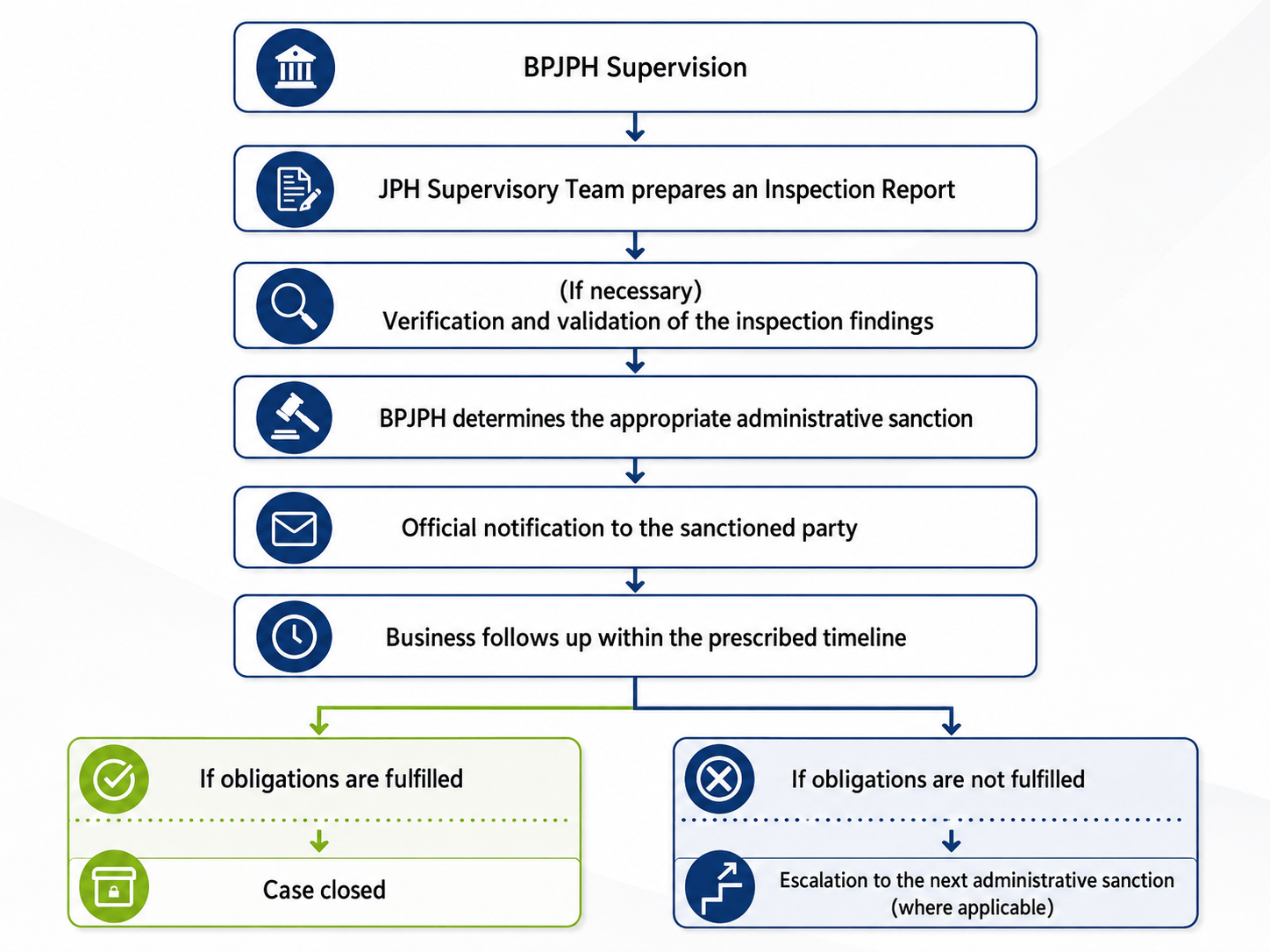
This structured process provides businesses with greater clarity regarding how inspection findings progress into administrative enforcement and the importance of responding promptly once a sanction is issued.
Procedural timeline
The regulation also introduces clear timelines for several key enforcement procedures.
| Enforcement Step | Timeline |
|---|---|
| Follow-up to written warning (general violations) | 14 business days |
| Follow-up to written warning for failure to obtain mandatory halal certification | 30 business days |
| Completion of product recall | 60 business days |
| Submission of objection against administrative sanctions | 5 business days |
These relatively short deadlines mean businesses should establish internal procedures to ensure that BPJPH notices are reviewed promptly and appropriate corrective actions can be taken without delay.
4. Public disclosure may increase reputational risks
In addition to administrative sanctions, the regulation expands BPJPH's authority to publicly disclose instances of non-compliance.
Where a business fails to comply with a written warning within the prescribed period, BPJPH may announce the violation through electronic media, print media, social media, or notices placed at business premises.
Compared with previous regulations, public disclosure is no longer limited to violations involving non-halal labeling. It may now be used more broadly as an enforcement measure where businesses fail to remedy violations following a written warning. As a result, regulatory non-compliance may not only lead to financial or operational consequences but also expose companies to reputational risks that could affect consumer confidence and commercial relationships.
5. Appeal mechanism for administrative sanctions
BPJPH Regulation No. 2 of 2026 also provides businesses with a formal mechanism to challenge certain administrative sanctions.
Business operators may submit an objection to the Head of BPJPH against the following sanctions:
Administrative fines;
Revocation of a Halal Certificate; and/or
Product recall from the market.
An objection must be submitted within 5 business days from the date the administrative sanction is imposed. Upon receiving the objection, the Head of BPJPH will establish an independent appeal team (Tim Banding) consisting of up to 5 members with no conflict of interest. The appeal team is responsible for reviewing the application and providing a recommendation to the Head of BPJPH, who will then issue the final decision.
Under the regulation, the appeal process follows a relatively short timeline:
| Appeal Process | Timeline |
|---|---|
| Submission of objection | Within 5 business days after the sanction is imposed |
| Appeal team review | Within 2 business days after the objection is received |
| Recommendation submitted to the Head of BPJPH | Within 1 business day after the review is completed |
| BPJPH decision issued | Within 1 business day after receiving the recommendation |
Given these relatively short deadlines, businesses should be prepared to respond promptly to any administrative sanctions and gather the necessary supporting documents if they intend to challenge BPJPH's decision.
What Should Businesses Do?
With Indonesia entering a more active enforcement phase ahead of the October 17, 2026 mandatory halal certification deadline, businesses should look beyond obtaining a Halal Certificate and ensure they are prepared for ongoing regulatory compliance.
Companies exporting or marketing products in Indonesia are advised to:
Assess whether their products are subject to mandatory halal certification and ensure certification is obtained before the applicable deadline;
Verify that foreign halal certificates have been properly registered with BPJPH, ensure the registration remains valid, and display the foreign registration number in accordance with Indonesian requirements;
Strengthen internal halal compliance management, including maintaining the Halal Product Assurance System (SJPH), appointing a Halal Supervisor where required, and promptly reporting changes to product composition or halal production processes;
Establish internal procedures for responding to BPJPH inspections and administrative notices, given the relatively short timelines for corrective actions and appeals; and
Monitor regulatory developments continuously, as Indonesia continues to strengthen the implementation and enforcement of its Halal Product Assurance framework.
By taking these proactive steps, businesses can reduce the risk of administrative sanctions, product recalls, and disruptions to market access in Indonesia.
Conclusion
BPJPH Regulation No. 2 of 2026 marks an important milestone in Indonesia's transition from establishing mandatory halal certification requirements to actively enforcing compliance. While the regulation does not introduce new substantive obligations, it provides greater clarity on how BPJPH will supervise compliance, impose administrative sanctions, and handle objections from regulated parties.
For overseas manufacturers, importers, and other business operators, the regulation serves as a reminder that halal compliance is no longer limited to obtaining certification. Maintaining valid foreign halal certificate registration, implementing an effective Halal Product Assurance System, and responding promptly to regulatory requirements will be equally important as Indonesia moves into a more active enforcement phase after October 17, 2026.
Businesses that review their compliance readiness early will be better positioned to minimize regulatory risks and ensure uninterrupted access to the Indonesian market. Need professional support? Our regulatory experts are ready to help you navigate Indonesia's halal certification and enforcement requirements.
Email: customer@reach24h.com