CHINA COSMETIC INGREDIENT REGULATORY UPDATE
On November 23, 2026, China's National Medical Products Administration (NMPA) approved the registration of Dihydroxyindole as a new cosmetic ingredient (NCI) for hair dyeing. It is the first new hair dye ingredient approved under the Cosmetic Supervision and Administration Regulation (CSAR), which took effect in 2021. The registrant is Beijing Fuluodi Technology Co., Ltd. (北京芙洛迪科技有限公司), and the registration certificate number is 国妆原注字20260002.
The approved technical requirements set a maximum concentration of 0.5% in cosmetics and state that the ingredient does not require use with strong oxidizing agents. Ingredient suppliers and hair care brands should assess the approved use conditions, sensitization evidence and separate requirements for finished hair dye products when planning a China launch.
Quick Navigation
What the Dihydroxyindole approval covers
Dihydroxyindole gradually oxidizes and darkens on exposure to air, offering a formulation option that does not require a strong oxidizing developer. Skin sensitization remains a safety consideration, as reflected in both the Chinese technical requirements and the historical European assessments discussed below.
China requires pre-market registration of new ingredients with hair-dyeing functions. NCIs outside the registration categories follow the filing pathway. The technical requirements published for this registration specify the ingredient's identity, manufacturing process and approved conditions of use.
| Item | Approved information |
|---|---|
| INCI name | Dihydroxyindole |
| Chemical name | 5,6-Dihydroxyindole |
| CAS number | 3131-52-0 |
| Chemical structure |
|
| Intended function | Hair dye |
| Use conditions | Does not require combination with strong oxidizing agents |
| Maximum use concentration | 0.5% in cosmetics |
| Ingredient assay | At least 96.0% on a dried basis |
| Appearance | Odorless, off-white to gray solid powder |
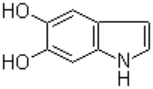
The disclosed synthesis comprises three stages. First, 1-methyl-2-nitro-4,5-bis(benzyloxy)benzene reacts with N,N-dimethylformamide dimethyl acetal and pyrrolidine in dimethylformamide to form intermediate 1. Intermediate 1 is then reduced in methanol using Raney nickel as catalyst and hydrazine hydrate as reducing agent to obtain intermediate 2. Finally, catalytic hydrogenation with palladium on carbon in ethyl acetate removes the protecting groups to yield 5,6-dihydroxyindole.
The technical requirements also specify frozen storage, protection from light and sealing under inert gas, with a 12-month shelf life for the ingredient. These conditions should inform procurement, handling and formulation-development planning.
Skin sensitization remains a formulation concern
The Chinese technical requirements identify potential skin sensitization. They also specify avoiding eye contact, restricting use to hair, and avoiding wounds, swelling, eczema or other abnormal skin areas. The raw ingredient is not intended for direct consumer use.
European scientific assessments provide historical safety context. On March 28, 2006, the Scientific Committee on Consumer Products (SCCP), a predecessor of the Scientific Committee on Consumer Safety (SCCS), adopted opinion SCCP/0952/05 on Dihydroxyindole. Based on the submitted evidence, it concluded that the ingredient itself at up to 0.50% in the finished cosmetic product did not pose a consumer health risk apart from its sensitizing potential. The opinion is a scientific assessment, rather than a marketing authorization.
The SCCS subsequently adopted its Memorandum on Hair Dye Chemical Sensitisation, SCCS/1509/13, on February 26, 2013. It placed Dihydroxyindole in the extreme sensitizing potency category based on local lymph node assay (LLNA) results. This category describes sensitizing potency in that assessment; it is separate from the Chinese registration decision.
Formulators should therefore assess the intended exposure, finished formulation and appropriate precautions. Neither air oxidation nor the absence of a strong oxidizing developer, by itself, supports an allergy-free claim.
Innovation guidance preceded registration
Beijing Fuluodi's project appeared as research code FLD2021, entry No. 2, in the first list of cosmetic ingredient projects proposed for innovation guidance. The National Institutes for Food and Drug Control (NIFDC) published the selection notice on October 20, 2025, covering 16 projects. FLD2021 was identified for hair-dyeing use, with Beijing Fuluodi as the applicant and the Beijing Medical Products Administration as the submitting provincial authority.
NIFDC expressly stated that inclusion in innovation guidance did not constitute acceptance of an ingredient's quality or safety. The applicable research and registration or filing requirements still had to be completed.
International assessments and China market access
Item 24 of NMPA's November 2025 cosmetics regulatory reform opinions calls for dynamic updates to permitted-ingredient standards for preservatives, sunscreens, colorants and hair dyes. It supports timely inclusion in China's permitted lists of ingredients assessed by authoritative international bodies and with a history of safe use overseas.
The policy provides context for considering international safety evidence in China's ingredient framework. It does not provide automatic recognition of an overseas assessment, and the published approval information does not establish that this policy measure was the basis for Dihydroxyindole's registration.
What ingredient suppliers and hair care brands should prepare
For businesses developing a new ingredient or evaluating a product containing one, the practical priorities are:
Confirm the ingredient and intended use. Review identity, manufacturing process, quality specifications and intended function against the applicable China pathway. A matching INCI name or CAS number alone is insufficient to establish that another supplier's material falls within this registration.
Assess the suitability of existing data. Map toxicological studies, international assessments and formulation data against China's dossier requirements. Check that the evidence applies to the proposed ingredient, specifications and use conditions before commissioning additional studies.
Plan finished-product registration separately. Hair dyes are special cosmetics in China and require product registration approval before production or import. Ingredient approval does not replace the finished-product registration process.
Coordinate use confirmation and safety monitoring. Under the registration and filing provisions, during the NCI safety monitoring period, the finished-product registration application or filing must be linked to the NCI and confirmed by the NCI registrant or filing person through the information platform. The three-year monitoring period starts when the first cosmetic containing the NCI is registered or filed, rather than on the ingredient approval date.
How REACH24H can support your ingredient project
REACH24H supports ingredient developers and cosmetic brands with China registration and filing strategy, toxicological data-gap analysis, ingredient safety assessment reports, and dossier preparation and submission support. These services help teams align their intended use, available evidence and market-entry plan before committing to a submission.
Plan Your China New Cosmetic Ingredient Submission
Share your ingredient's intended use and available safety data with REACH24H to assess the China submission pathway and evidence gaps.
Recommended Reading
Official References
NMPA technical requirements for Dihydroxyindole — 国妆原注字20260002
SCCP opinion on Dihydroxyindole adopted March 28, 2006 — SCCP/0952/05
SCCS Memorandum on Hair Dye Chemical Sensitisation — SCCS/1509/13
NIFDC selection notice for ingredient innovation guidance — October 20, 2025
NMPA Provisions for Registration and Filing of Cosmetics — Articles 13 and 19 to 23