PESTICIDE R&D AND GLOBAL REGISTRATION
As China's agrochemical industry accelerates its transition towards innovation-driven development, an increasing number of companies are investing in the development of new compounds and expanding into global markets. Unlike the traditional export of existing products, bringing innovative pesticides to international markets involves not only overcoming technical challenges in R&D, but also navigating diverse regulatory requirements across multiple countries, complex testing frameworks, and the coordination of global GLP laboratory resources. Therefore, how to plan R&D pathways strategically, select suitable Contract Research Organizations (CROs), and coordinate global registration activities has become an important consideration for agrochemical companies pursuing innovation and international expansion.
Expert Insights from CRAC China 2026
From October 21 to 23, 2026, REACH24H Consulting Group successfully hosted the 18th Chemical Regulatory Annual Conference (CRAC China 2026) in Wuyi Mountain, Fujian, China.
To help Chinese agrochemical companies better address the challenges associated with innovative pesticide development and global registration, REACH24H invited Dr. Sun Xinyou from CropLife China to deliver an in-depth presentation on CRO selection and collaboration in global pesticide innovation and R&D. His presentation explored the global distribution of GLP laboratory resources, key considerations for CRO selection and management, and how companies can support the global registration of innovative products through scientific R&D planning and optimized laboratory collaboration.
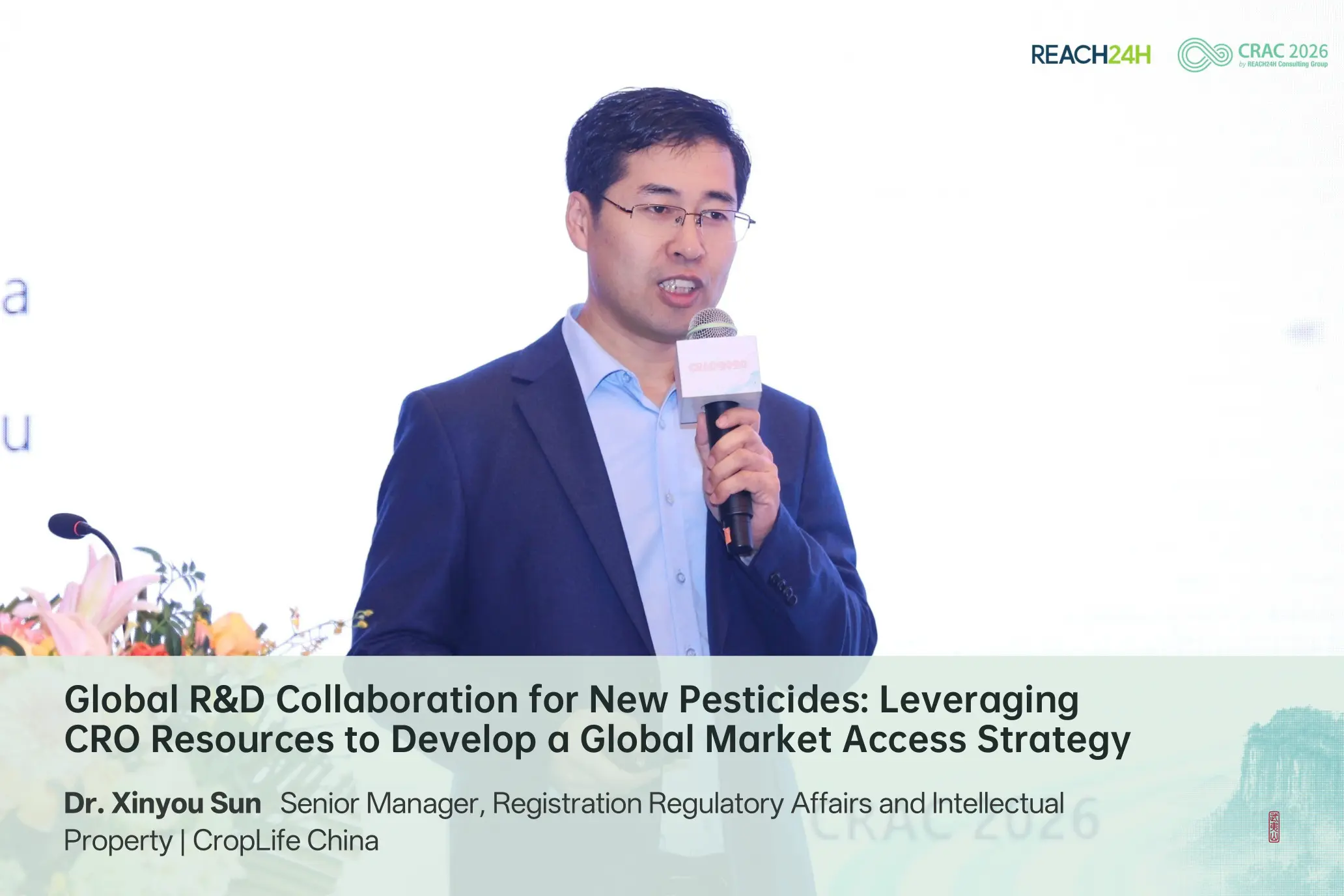
Global Pesticide Innovation: High Investment, Long Development Cycles and Complex Registration Challenges
Developing an innovative pesticide from initial research to market launch requires long-term investment and systematic R&D planning. Dr. Sun Xinyou pointed out that the average development cycle for a new chemical active ingredient is approximately 11.4 years, while the estimated average R&D cost for the period 2020–2025 was approximately USD 307 million. Faced with high investment requirements and lengthy development cycles, companies need to plan registration strategies for target markets at an early stage and coordinate testing arrangements and resource allocation to reduce the risk of additional testing and project rework at later stages.
The development of innovative pesticides involves multiple disciplines, including toxicology, ecotoxicology, residues and metabolism, environmental fate, product chemistry, and efficacy. Studies in these areas typically require coordination among laboratories with different areas of expertise. Therefore, incorporating regulatory requirements into the early stages of R&D is an important step towards improving development efficiency.
The Global GLP Laboratory Landscape: International Collaboration as a Key Support
According to the statistics presented at the conference, the global distribution of GLP laboratories varies significantly by region. Among the 36 countries included in the statistics, the United States and Europe accounted for 58.3% and 30.3% of the laboratories, respectively, making them the major centers of global GLP laboratory resources.
In addition, laboratories differ in their technical capabilities and research expertise. Companies should therefore select suitable CROs based on the type of study, technical requirements, and target markets, while coordinating collaboration among different laboratories to better align R&D needs with project timelines.
For background on study quality systems, see the OECD guidance on Good Laboratory Practice and compliance monitoring.
CRO Collaboration: How to Balance Quality, Timelines and Costs
When selecting a CRO, companies should comprehensively assess its technical expertise, work quality, and project management capabilities. Dr. Sun Xinyou recommended considering the following key factors:
Technical Expertise and Work Quality: Evaluate the laboratory's technical capabilities, relevant study experience, and quality management standards.
Animal Welfare: For studies involving laboratory animals, attention should be paid to the laboratory's animal welfare management practices.
Communication and Delivery: Assess communication efficiency, project scheduling, and delivery capabilities to ensure that study timelines align with the overall R&D plan.
Cost: Control testing budgets appropriately while ensuring that technical and quality requirements are met.
Historical Control Data: For certain areas, such as long-term toxicological studies, historical control data are also an important factor in evaluating laboratory capabilities.
Strengthening CRO Management to Improve Global Registration Efficiency
Selecting the right CRO is only the first step. Companies also need to establish a management mechanism covering the entire project lifecycle. Before commencing collaboration, they should conduct qualification assessments and clarify the responsibilities of both parties, confidentiality obligations, and intellectual property arrangements through formal agreements. During the study, companies should monitor progress, address deviations in a timely manner, and ensure proper review of study reports.
Furthermore, when selecting CROs and planning studies, companies should take the regulatory requirements of their target markets into account and confirm the applicability of laboratory qualifications and study data to avoid delays in subsequent registration caused by insufficient upfront planning.
REACH24H's GLP study monitoring services support laboratory selection, study coordination and report review for pesticide registration projects.
From R&D to Global Expansion: Strategic Planning for Global Agrochemical Registration
Dr. Sun Xinyou noted that, as of September 2026, 41 laboratories in China had obtained OECD GLP-related recognition. For Chinese agrochemical companies planning to pursue global registration, the rational integration of domestic and international testing resources, the establishment of stable CRO partnership networks, and the incorporation of regulatory compliance requirements into the early stages of R&D can help improve project management efficiency and support the introduction of innovative products to international markets.
As technological developments continue to advance in areas such as biopesticides, RNA interference (RNAi), peptide- and protein-based products, and AI-assisted discovery, companies also need to continuously optimize their R&D planning and global registration strategies in line with the characteristics of their products and the requirements of target markets.
Looking Ahead
The global development of innovative pesticides is not merely a technical R&D challenge; it also requires comprehensive capabilities in testing resource integration, project management, and global regulatory planning. By selecting CROs strategically, establishing stable laboratory partnership networks, and coordinating registration requirements for target markets from the early stages of R&D, companies can better manage development risks and lay a solid foundation for bringing innovative products to international markets.
How REACH24H Can Help
REACH24H supports agrochemical companies in coordinating testing resources and monitoring studies against the requirements of their target markets. Support includes:
Selecting laboratories based on technical capabilities and project budgets.
Coordinating study guidelines, plans, timelines and costs with laboratories.
Following study progress and reviewing draft study reports.
Plan Your Pesticide Studies for Global Registration
Discuss your target markets, study needs and laboratory coordination requirements with REACH24H.
Recommended Reading
Official References
The following resource provides background on GLP principles and compliance monitoring. The conference figures quoted above are attributed to the presentation and are not sourced from this OECD page.