U.S. EPA PESTICIDE REGISTRATION INSIGHT
For companies planning to enter the U.S. pesticide market, compensation for citing protected data can represent a substantial upfront investment in EPA registration. However, this cost does not depend solely on how many compensable studies exist for an active ingredient.
For the same active ingredient, different citation strategies can result in a difference of millions of dollars in the value of compensable data involved. What accounts for this difference?
Quick Navigation
Cite-All vs. Selective Citation Dossier Example Selective Citation Challenges Investment Decision Compliance Services Why REACH24HCite-All or Selective Citation?
For existing active ingredients, applicants entering the market can generally cite data previously submitted to EPA to support registration, without repeating all active ingredient studies. However, citation requirements differ depending on the protection status of the data:
Exclusive-use data: Data submitted to support the initial registration of a new active ingredient or a new combination of active ingredients, or an amendment adding a new use to the original registration. These data receive ten years of exclusive-use protection from the date of initial registration approval. Other applicants generally cannot cite them without authorization. The protection period may be extended in qualifying circumstances.
Compensable data: Data submitted to support an application that are no longer covered by exclusive-use protection. These data have a fifteen-year compensation period beginning on the date they were originally submitted to EPA. Applicants may cite them but must meet the applicable data compensation obligations.
Non-compensable data: These include public literature, government-funded studies, and data for which all exclusive-use and compensation periods have expired. Applicants may cite these data directly.
In U.S. EPA pesticide registration, therefore, identifying the data required and deciding which specific studies to cite are two separate questions.
EPA provides two principal approaches: cite-all and selective citation.
| Comparison | Cite-All | Selective Citation |
|---|---|---|
| Basic approach | Cites all data in EPA's files that are relevant to the application requirements. | Selects the studies to be cited based on specific data requirements. |
| Key characteristics | Straightforward to implement. | Requires endpoint-by-endpoint analysis and professional judgment. |
| Impact on data compensation | May bring more compensable data into the potential compensation scope. | May help avoid unnecessary data compensation costs. |
| Suitable scenarios | When overall data compensation costs are low, or the cost difference compared with selective citation is small. | When overall data compensation costs are high and there is a substantial cost difference compared with cite-all. |
Both approaches can be used for EPA registration, and each has its appropriate applications. For active ingredients with extensive compensable data and potentially high compensation costs, the choice of citation strategy can make a substantial financial difference.
In a previous EPA registration project, REACH24H systematically reviewed the potentially compensable data for an active ingredient. More than one hundred compensable studies were identified, with multiple companies having submitted studies for many of the same endpoints. Under the cite-all approach, the combined value of the compensable data involved was approximately USD 3.94 million.
Following an endpoint-by-endpoint analysis, and taking account of EPA's existing data and regulatory assessments, REACH24H excluded more than eighty compensable studies that did not need to be cited. The compensable data included in the selective citation strategy had a combined value of approximately USD 960,000.
The difference becomes clearer under a simplified scenario in which two existing technical-grade registrants and the new applicant share the relevant data costs equally:
| Comparison | Cite-All | Selective Citation | Difference |
|---|---|---|---|
| Value of compensable data involved | Approximately USD 3.94 million | Approximately USD 960,000 | Approximately USD 2.98 million |
| Simplified estimate assuming costs are shared among three registrants* | Approximately USD 1.31 million | Approximately USD 320,000 | Approximately USD 990,000 |
These are simplified calculations for a specific project stage and set of conditions, presented solely to illustrate the potential cost difference between citation strategies. Actual compensation amounts also depend on study valuation, cost-sharing arrangements and subsequent negotiations.
What Can Cite-All Mean in an Actual Registration Dossier?
In a recent review of several publicly available EPA registration dossiers, REACH24H found that some applicants had adopted cite-all strategies for active ingredients with high potential data compensation costs, even where non-compensable data were available to satisfy certain requirements.
Some dossiers used cite-all across extensive generic data requirements, ranging from acute, subchronic and chronic toxicity to ecotoxicology, environmental fate and residues.
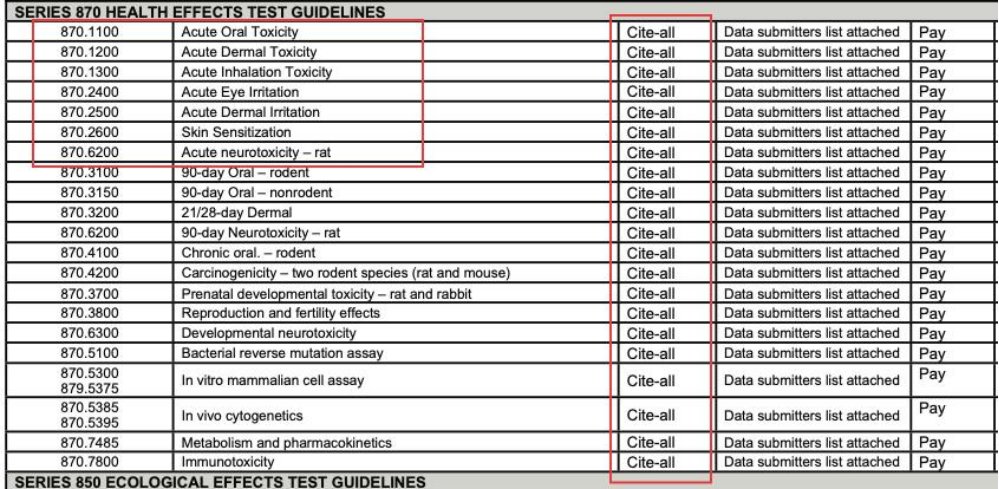
Cite-all is an EPA-permitted approach. However, further examination of the above example showed that it had been used even though available non-compensable acute toxicity studies could satisfy EPA's requirements.
As several additional technical-grade registrants had entered the market for that active ingredient in recent years, the approach brought the relevant compensable acute toxicity data from six registrants into the citation scope. This potentially added hundreds of thousands of dollars in data compensation costs.
Acute toxicity is a relatively straightforward example. For more complex active ingredient data, including long-term toxicity, ecotoxicology, environmental fate and residues, the relationships between studies and EPA's assessments require closer examination.
Companies that already have an EPA registration data plan—particularly for an active ingredient associated with high compensation costs—may therefore wish to check:
Does the plan rely extensively on cite-all? Are compensable studies still being cited for endpoints that can already be supported by suitable non-compensable data?
What Makes Selective Citation Challenging?
Selective citation involves more than removing a few studies from a data list.
For an active ingredient with a long registration history, EPA's files may contain extensive toxicological, ecotoxicological, environmental fate and residue data. A single endpoint may be supported by several studies submitted at different times and under different regulatory circumstances.
Reviewing these studies individually takes time and depends heavily on project experience. In addition to examining the studies themselves, the assessment needs to trace EPA's previous reviews and consider the specific registration project to determine how each study has been used in regulatory assessments and whether it is needed for the current application.
This generally involves considering:
Data requirements: Whether available non-compensable studies can satisfy the relevant EPA endpoint.
Regulatory assessments: Which studies EPA has used and accepted in its previous reviews.
Relevance to the registration: The relationships between studies and their relevance to the proposed product and uses.
Data status: The applicable protection periods and potential compensation obligations.
Where detailed screening requires substantial time, or the regulatory necessity of certain studies is difficult to establish with sufficient confidence, cite-all—or selective citation of a broader range of studies—can provide a more conservative and direct approach to reducing the risk of insufficient data support. This helps explain why some registration dossiers adopt relatively conservative citation strategies.
However, that conservatism can also bring compensable studies that are unnecessary for the particular registration into the potential compensation scope.
The challenge in selective citation is determining which studies need to be cited, based on sufficient regulatory evidence and project experience.
Data Strategy Is Part of the EPA Registration Investment Decision
Selective citation requires time and a detailed understanding of EPA's historical assessments and review practices. Long-term project experience therefore plays a central role in developing a data strategy.
REACH24H has more than sixteen years of experience in U.S. EPA pesticide registration services and has obtained more than 3,000 federal and state registrations in total. Through these projects, REACH24H has accumulated experience with EPA data requirements, active ingredient regulatory histories and specific assessments, applying this knowledge to the development of data citation strategies.
After submission of a registration dossier, data compensation work may also involve negotiations with data owners. Through its ongoing involvement in EPA registration and data compensation projects, REACH24H has gained experience in compensation discussions and negotiations with multinational companies and data consortia.
From initial data screening and citation strategy development to subsequent compensation discussions, REACH24H considers both whether the data package can support registration and the compensation costs it may create for the applicant.
For active ingredients with extensive compensable data or high potential data values, the choice of citation strategy can mean a difference of hundreds of thousands or even millions of dollars. Data strategy should form part of the overall EPA registration investment assessment and receive sufficient attention before an application is submitted.
Identifying the data genuinely needed and recognizing unnecessary compensation exposure before registration are part of the value a well-developed EPA registration strategy should provide.
REACH24H's U.S. EPA Pesticide Compliance Services
Based on product type, formulation, intended uses, label claims and target markets, REACH24H provides U.S. pesticide regulatory and technical support covering initial assessment, federal registration, state market access and post-registration maintenance.
Product Assessment and Registration Strategy
Assessment of FIFRA applicability and product classification.
Evaluation of pathways for conventional pesticides, antimicrobial pesticides, biopesticides, pesticidal devices and FIFRA Section 25(b) minimum-risk pesticides.
Assessment of registration pathways for new active ingredients, new uses, new products, and identical or substantially similar products.
Assessment of PRIA categories, fees, timelines, and federal and state market-access plans.
Federal Registration and U.S. Agent Services
Support with EPA Company Numbers and establishment registration.
U.S. agent services for applicants based outside the United States.
Applications for new active ingredients, new products and related amendments.
Preparation and review of application materials, labels and dossiers.
Tracking EPA review questions and supporting technical responses.
Data and Technical Strategy
Data gap analysis covering product chemistry, toxicology, ecotoxicology, environmental fate, residues and efficacy.
Assessment of existing data citation, the Formulator's Exemption, bridging and data waiver strategies.
Assessment of data rights and compensation strategies.
Testing and technical coordination support according to project needs.
Compliance for Specialized Products
Registration of biopesticides and antimicrobial/disinfectant products.
Compliance support for pesticidal devices and FIFRA Section 25(b) minimum-risk pesticides.
Assessment of pesticide adjuvants, inert ingredients and related state requirements.
Review of product labels, marketing materials and claims.
State Registration and Post-Registration Maintenance
Pesticide product registrations, renewals and amendments across U.S. states.
California and multistate market-access support.
Annual maintenance fees, production reporting and registration information maintenance.
Support with Data Call-Ins, Registration Review and other post-registration regulatory matters.
Why Choose REACH24H?
15+ Years U.S. EPA pesticide registration project experience | 3,000+ Federal and state registrations supported | 50 States + Washington, D.C. U.S. state market coverage |
Listed in EPA's Consultant Directory
REACH24H USA Inc. is listed in the U.S. EPA public directory of pesticide regulatory consultants.
U.S.-Based Project Coordination
REACH24H's U.S.-based and international teams support cross-border projects, including applicant coordination, documentation, U.S. agent arrangements, EPA correspondence and long-term project management.
Data Strategy and Project Feasibility
REACH24H assesses data gaps, citation options, compensation, bridging and waiver strategies early in the project to help identify technical, timing and budget risks before submission.
Federal-to-State Market Access
Support covers federal registration strategy, California and multistate registration, renewals and post-registration maintenance across different pesticide product categories.
Learn more about REACH24H's U.S. EPA Pesticide Registration Services.
Review Your EPA Data Citation Strategy
Preparing a U.S. pesticide registration or reviewing an existing data plan? Discuss data requirements, citation options and potential compensation exposure with REACH24H.
Discuss Your Data Strategy Explore EPA Registration Services