
SOUTH KOREA MSDS AND GHS REGULATORY UPDATE
South Korea's Ministry of Employment and Labor (MoEL) issued Notice No. 2025-50 on August 6, 2025, with effect from August 7, 2025. The notice revised technical classification criteria, a transport-label pictogram and MSDS Section 15 requirements. The standards were subsequently amended by Notice No. 2026-26, effective April 24, 2026. This article explains the changes introduced in 2025-50 and their current compliance significance. Companies supplying chemicals to South Korea should review their documentation under the latest official text and, where needed, update their Korean MSDS and labels.
Quick Navigation
Jump to the key changes, deadlines and recommended compliance actions.
Korea MSDS Changes at a Glance
| Compliance Point | What Companies Need to Know |
|---|---|
| Notice No. 2025-50 | Issued on August 6, 2025 and effective from August 7, 2025. |
| Main changes | Revised technical classification criteria, an updated flammable-liquid transport pictogram and new MSDS Section 15 information requirements. |
| Transition status | The temporary arrangement for adding specified information to Section 15 “Others” of an old-format MSDS ended on June 30, 2026. Full compliance was required from July 1, 2026. |
| Current regulatory text | The same standards were subsequently amended by MoEL Notice No. 2026-26, effective April 24, 2026. Companies should use the latest consolidated text for current compliance decisions. |
Regulatory status update — July 2026: This article explains the changes introduced by Notice No. 2025-50. Because MoEL later issued Notice No. 2026-26, companies should consult that current official text before finalizing an MSDS, label or submission strategy.
Technical Classification Standards Updated
Notice No. 2025-50 refined several test conditions and mixture-classification criteria in Annex 1. Companies should determine whether existing test data and product classifications remain suitable under the revised rules.
Self-Heating Substances and Mixtures
For Category 1 self-heating substances and mixtures, a positive result is determined when a cubic sample with a side length of 25 mm is tested at 140°C.
Oxidizing Solids
For Test Method 3, when a substance or mixture is tested with cellulose at a ratio of 4:1 or 1:1, the burning rate must be calculated against the average burning rate of a calcium peroxide and cellulose mixture at a 3:1 ratio.
Serious Eye Damage and Eye Irritation
Mixtures are classified as Category 1 when either of the following thresholds is met:
The total concentration of components classified for serious eye damage (H318) or skin corrosion (H314) is 3% or higher; or
The combined concentration of skin-corrosive components (H314) and serious-eye-damage components (H318) is 3% or higher.
Double counting is not permitted: if one component meets both H314 and H318 criteria, its concentration is counted only once.
GHS and Transport Labeling Update
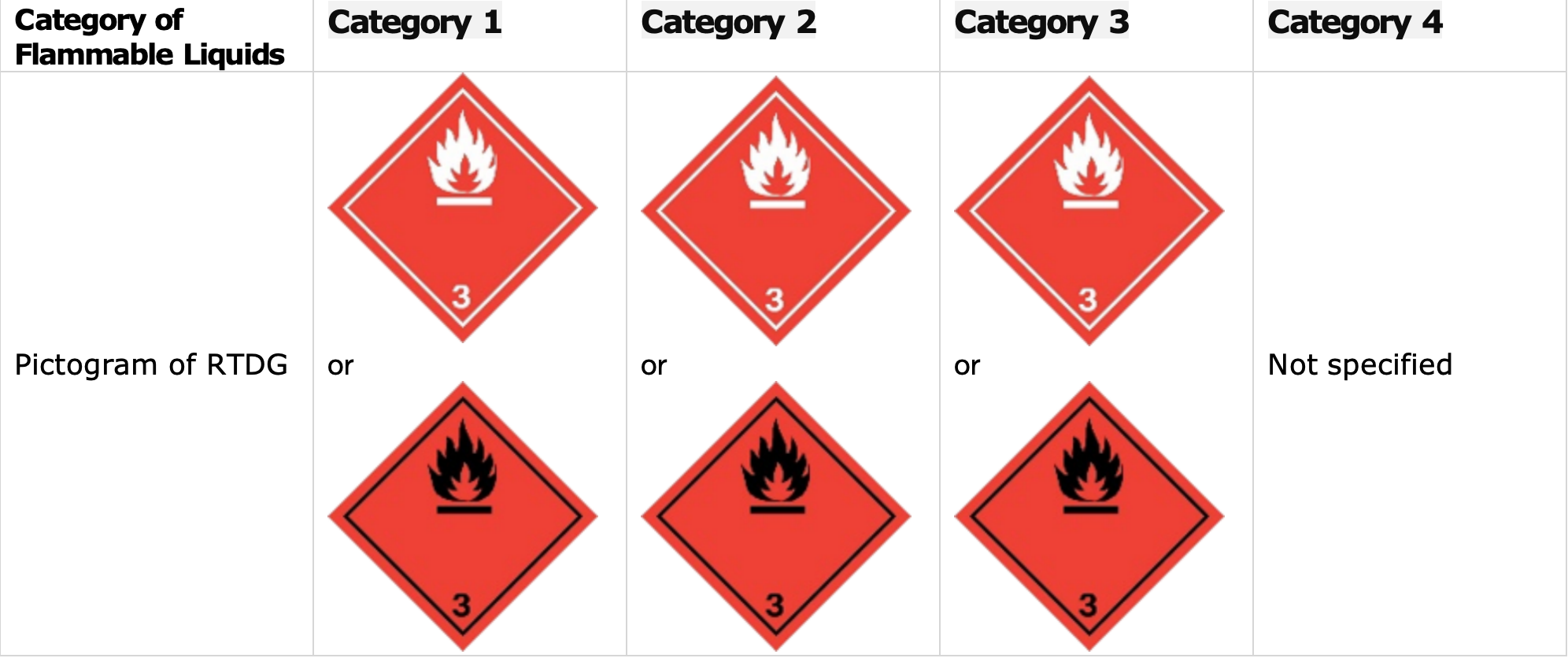
Shipping labels must use the updated pictogram for flammable liquids under the Recommendations on the Transport of Dangerous Goods (RTDG). The revision places the number “3” in the bottom corner of the pictogram.
Mandatory Korea MSDS Updates
The amendment introduced new MSDS preparation requirements for substances with unconfirmed hazards and for toxic substances affected by reclassification. These changes are especially relevant to Section 15: Regulatory Information.
MSDS for Substances with Unconfirmed Hazards
The requirement applies to substances or mixtures identified as having unconfirmed hazards under the Act on the Registration and Evaluation of Chemicals (K-REACH). Section 15 of the MSDS must include:
Identification: “Substance with Unconfirmed Hazards” followed by the specific substance name;
Hazard details: the specific unconfirmed hazard items, such as acute oral toxicity or chromosomal aberration; and
Safe handling: an appropriate safe-handling statement.
If the substance name is not disclosed, it must be provided separately using the Annex 25 format under the Enforcement Rules of K-REACH.
The transition period has ended. Until June 30, 2026, the information could be added to Section 15 “Others” of an old-format MSDS. From July 1, 2026, the MSDS should fully reflect the applicable updated requirements.
Reclassification of Toxic Substances
The former “toxic substances” category was subdivided into:
Substances with acute human-health hazards;
Substances with chronic human-health hazards; and
Ecologically hazardous substances.
Related MSDS updates were required by July 1, 2026. For the changes described in Notice No. 2025-50, revisions limited to Section 15 did not require MSDS resubmission, but the updated MSDS had to be communicated to downstream users.
What Chemical Companies Should Do Now
Check the current legal text: compare the MSDS and labels against MoEL Notice No. 2026-26, which is the latest official version identified in this review.
Reassess classification: verify whether the revised test conditions or mixture thresholds change any existing hazard classification.
Review MSDS Section 15: confirm that information on substances with unconfirmed hazards and reclassified toxic substances is complete and current.
Update labels and packaging: verify GHS elements and the Class 3 flammable-liquid transport pictogram.
Communicate revisions: provide updated MSDS documents to downstream users where required and retain evidence of the update process.
Korea MSDS Update FAQ
Is MoEL Notice No. 2025-50 still the latest version?
No. The standards were amended again by MoEL Notice No. 2026-26, effective April 24, 2026. Notice No. 2025-50 remains important for understanding the 2025 changes, but current decisions should be checked against the latest consolidated standard.
When did Notice No. 2025-50 take effect?
August 7, 2025. MoEL issued the notice on August 6, 2025, and it became effective the following day, as confirmed by the official MoEL notice.
Has the June 30, 2026 MSDS transition period ended?
Yes. The temporary placement option for specified information in Section 15 “Others” of an old-format MSDS ended on June 30, 2026. From July 1, 2026, affected MSDS documents should meet the applicable updated requirements.
Does a Section 15 update always require MSDS resubmission?
Not for the Section 15-only revisions described in Notice No. 2025-50. The updated MSDS still had to be provided to downstream users. Companies should separately assess whether other changes trigger submission or update obligations under the current standard and the KOSHA MSDS system.
How REACH24H Can Help
REACH24H can support manufacturers, importers and chemical suppliers with practical Korean MSDS submission and CBI compliance, including:
Regulatory gap review: checking existing Korean MSDS documents and labels against applicable requirements;
MSDS preparation and update: revising classification information and Section 15 content;
Label review: checking GHS and transport-label elements; and
Submission and CBI support: assisting with Korean MSDS submission, domestic-agent arrangements and confidential business information applications.
Need to review or update a Korean MSDS?
Share your substance, mixture and supply-chain information with REACH24H to assess the applicable MSDS, labeling, submission and CBI requirements.


