On August 10, 2026, the U.S. Food and Drug Administration (FDA) announced a proposed rule on substances Generally Recognized as Safe (GRAS)that would make GRAS notification mandatory for certain substances used in human and animal food. The proposal would amend 21 CFR Parts 170 and 570 and is not yet in effect. If finalized as proposed, the final rule would take effect 60 days after publication, while the mandatory notification requirements would have an 18-month compliance period after the effective date. Companies currently relying on independent or “self-affirmed” GRAS conclusions should begin reviewing their U.S. ingredient portfolios and supporting safety documentation.
What Would Change Under the FDA GRAS Proposed Rule?
Under the current framework, companies may independently conclude that a substance is Generally Recognized as Safe (GRAS) under its intended conditions of use without notifying FDA.
The proposed rule would generally require companies introducing substances into U.S. interstate commerce under the GRAS provision to submit a GRAS notice to FDA, unless a specified exception applies.
Importantly, mandatory notification would not turn GRAS into a premarket approval system. A GRAS notice would inform FDA of the company's conclusion and supporting basis; it would not constitute an application for “GRAS approval.”
The proposal also provides several circumstances where a new GRAS notice may not be required, including certain uses already covered by:
an FDA no questions letter;
applicable GRAS listings or affirmations in 21 CFR;
an effective Food Contact Notification (FCN);
a Threshold of Regulation (TOR) exemption; or
other qualifying FDA review pathways.
Whether an exception applies depends on the specific substance and conditions of use, not simply the ingredient name.
What About Existing Self-Affirmed GRAS Substances?
The proposal includes an important transition mechanism for substances already marketed based on an independent GRAS conclusion.
Eligible substances introduced into interstate commerce before the effective date of a future final rule could use a time-limited streamlined submission pathway instead of immediately submitting a complete GRAS notice.
Companies would generally need to provide information on:
the substance;
its intended conditions of use;
use levels and purpose; and
evidence that the relevant use was already in interstate commerce before the final rule took effect.
The streamlined submission would need to be made within one year after the final rule's effective date. Inclusion on FDA's public list would not mean that FDA has determined the substance to be GRAS, and FDA could later require a full GRAS notice or food additive petition.
This one-year transition window is separate from the proposed 18-month compliance period for mandatory GRAS notification.
Key Timing to Watch
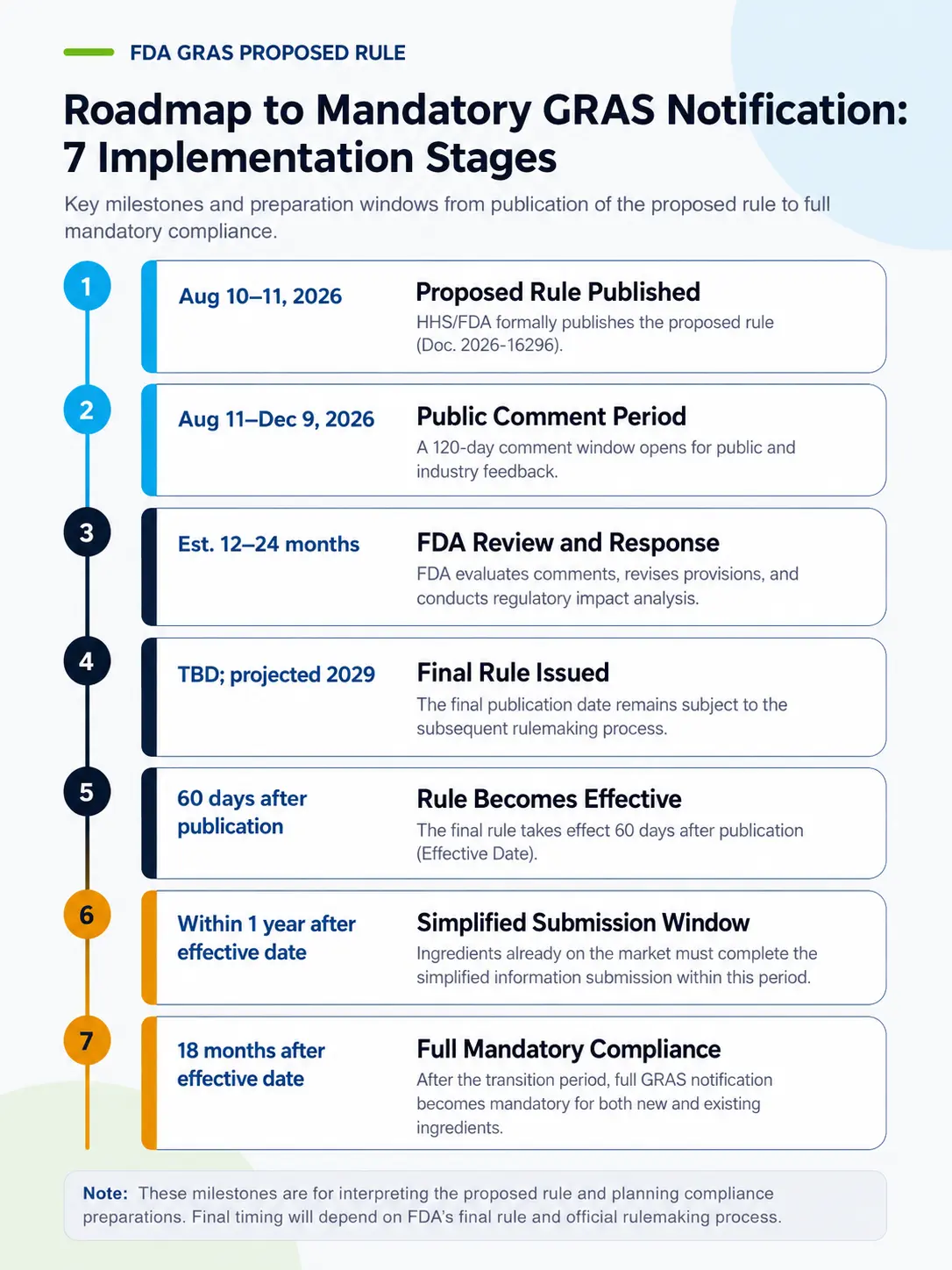
The proposed rule provides for a 120-day public comment period.
If FDA later publishes a final rule as proposed:
the final rule would become effective 60 days after publication;
eligible existing GRAS uses would have one year after the effective date to use the streamlined submission pathway; and
the mandatory GRAS notification requirements would have an 18-month compliance period after the effective date.
The final compliance dates therefore cannot yet be determined.
What Should Food and Ingredient Companies Do Now?
The proposal could affect food ingredient manufacturers, food and beverage companies, animal food businesses, food-contact material suppliers and overseas companies supplying the U.S. market.
Companies relying on independent GRAS conclusions should prioritize four actions:
1. Inventory GRAS-based uses
Identify substances used in U.S.-market products and document their actual food categories, use levels, specifications and technical functions.
2. Confirm the regulatory basis
Determine whether each use is supported by an existing GRAS notice, GRAS regulation, FCN, TOR exemption, another FDA pathway or an independent GRAS conclusion.
3. Review scientific support
For self-affirmed GRAS uses, reassess key supporting information such as:
identity and specifications;
purity and impurities;
manufacturing process;
use levels and dietary exposure; and
toxicological and other safety data.
4. Preserve evidence of existing U.S. market use
Companies that may wish to use the proposed streamlined pathway should retain evidence showing that the relevant substance and conditions of use were already in interstate commerce before the future final rule's effective date.
The source materials similarly identify ingredient inventories, pathway assessment, safety documentation and supplier information as priority preparation areas.
How REACH24H Can Help
REACH24H provides U.S. FDA GRAS regulatory and notification support for companies assessing how the proposed changes may affect existing and planned food ingredients.
U.S. regulatory pathway assessment;
review of existing self-affirmed GRAS uses;
GRAS data-gap and safety assessment;
dietary exposure evaluation;
GRAS notice preparation and submission support; and
assessment of potential eligibility for the proposed streamlined pathway.
For companies planning market entry in multiple jurisdictions, REACH24H can also help coordinate regulatory strategies and improve the reuse of existing technical and safety data across markets.
Currently relying on a self-affirmed GRAS conclusion or planning to introduce a new food ingredient into the U.S.?