
TURKEY KKDIK REGULATORY UPDATE
Turkey's KKDIK interim registration window is approaching a key checkpoint. Companies with relevant substances that have not completed full registration should confirm by September 30, 2026 whether their supply is covered by a valid interim or full registration arrangement. After that date, pre-registration alone should not be treated as a substitute for an interim or full registration number, and uncovered substances may face market-access and supply-chain disruption risks in Turkey.
Where no Lead Registrant (LR) has been established, joint submission has stalled, or Letter of Access (LoA) arrangements remain unresolved, companies may consider an individual interim registration through Turkey's Chemical Registration System (KKS). This transitional route can provide time to prepare the data and dossier required for full registration, but it does not complete the company's full KKDIK obligations or replace the applicable final registration deadline.
This guide answers 16 practical questions on registration routes, data preparation, importer information, registrant eligibility, costs and the transition to full registration. For the complete commercial scope, see REACH24H's KKDIK Turkey REACH registration and Only Representative services.
Quick answer
Individual interim registration is a conditional transitional route for companies affected by an unavailable LR, stalled joint submission or unresolved LoA arrangements. Companies should still verify the registrant, substance identity, tonnage band, uses, Turkish importer coverage and the applicable full registration deadline.
Quick Navigation
Jump to the key sections of this article.
Why Individual Interim Registration May Be the Priority Now
Q1. The LR is progressing slowly or an LoA quotation is not available. How can the company move forward?
The company may submit an individual interim registration. Under Turkey's 2026 implementation arrangements, a registrant that cannot progress through joint submission because an LR is difficult to identify or similar coordination obstacles remain may submit an individual interim dossier through KKS. The route does not depend on the LR first completing a joint submission and generally does not require the company to purchase an LoA at the interim stage. The prescribed basic information and applicable administrative fee are still required.
Q2. How does individual interim registration differ from joint full registration?
| Route | When it is more suitable | Immediate focus | Key consideration |
|---|---|---|---|
| Joint interim / full registration | An LR has been identified and can provide a workable joint-submission arrangement | Confirm submission status, data sharing and LoA terms with the LR | Timing and cost depend on joint-submission coordination |
| Individual interim registration | No LR is available, joint submission is blocked, or LoA arrangements remain unresolved | Submit the prescribed interim dossier and obtain an interim registration number | It is transitional; full registration is still required later |
As the September checkpoint approaches, securing a valid registration number may be the immediate priority. The decision should still be aligned with the company's longer-term plan for the Turkish market.
Q3. Will the administrative fee be charged again when an interim registration is upgraded to full registration?
Where the tonnage band does not increase and the registrant and dossier continuity remain unchanged, the administrative fee paid at the interim-registration stage may generally be carried forward to the subsequent full registration rather than charged again. This staged approach can help companies protect near-term market access while completing the data package. Fee treatment should be reconfirmed if the tonnage band, registrant or submission details change.
Q4. Should an intermediate use individual interim registration or individual full registration?
The current KKS administrative-fee setting for individual interim registration does not distinguish between intermediate and general uses. If the company already has the information required for intermediate registration, individual full registration may offer more favorable administrative-fee treatment. However, the intermediate status, relevant use and any strictly controlled conditions should be verified separately; the route should not be selected on fee alone.
What Information Is Needed for Individual Interim Registration?
Q5. What core information should be prepared?
| Information category | Recommended content |
|---|---|
| Substance information | Substance name, CAS/EC information, composition, typical concentration, spectra or other identity evidence |
| Classification and labelling | Existing SDS, hazard classification, label elements and supporting basis |
| Uses and exposure | Intended uses in Turkey, use scenarios and available exposure information |
| Tonnage and trade | Estimated annual import/manufacture tonnage and known or potential importers |
| Registrant and supply chain | Registrant details, OR appointment information and importer Firma ÇKN details |
Q6. Can existing EU REACH information or analytical spectra be used directly for KKDIK?
They should first undergo a reuse assessment. The company should confirm that substance identity, composition, analytical methods and data applicability are consistent. If spectra or other information are temporarily unavailable, the company may assess whether a justified temporary omission or later-supplementation approach is available for the interim dossier; the required information must still be completed for full registration. Companies with EU REACH dossiers may also review how EU REACH data can support a KKDIK registration strategy.
Q7. Can the dossier be submitted before all Turkish importer information has been collected?
A company may organize and enter the importer information already known, but this should not be understood as permission to leave the importer record incomplete indefinitely. When a new customer or distributor is added, or a trade route changes, the importer list in the dossier should be updated promptly. Incomplete information can affect the assessment of supply-chain coverage and later regulatory or customs checks.
Q8. What is a Firma ÇKN, and what should be checked before it is entered?
Firma ÇKN (Firma Çevre Kimlik Numarası) is the environmental identity number used to identify a Turkish company in the environmental information system. When an OR links an importer in KKS, the number should match the actual importing legal entity and its system account. Turkish importers should confirm the number, legal name and account contact details in advance to avoid an incorrect linkage.
Q9. How can a Turkish importer confirm that it is covered by the registration?
The importer may log in to the relevant environmental information system to view summary information about the registrant linked to the company. Where an OR has registered on behalf of an overseas entity, the system will normally show summary information associated with the OR. The overseas supplier and OR should also maintain a process for transmitting registration numbers, updating importer lists and tracking tonnage rather than relying on a one-time system check.
Who Can Register, and How Should the 2026–2030 Deadlines Be Read?
Q10. How can a company established outside Turkey meet its KKDIK registration obligations?
A non-Turkish manufacturer, mixture formulator or article producer cannot submit a KKDIK registration directly as a foreign legal entity. Subject to eligibility, it may appoint an Only Representative (OR) established in Turkey to perform the relevant KKS registration obligations and cover the Turkish importers identified under the arrangement.
Q11. Can a trader appoint an OR and complete the registration directly?
A company acting solely as a trader will generally not qualify to appoint an OR. Eligibility depends on whether the company also performs a role recognized under the regulation, such as manufacturing the substance or producing the article. If a trading or resale entity uses an OR route without an eligible underlying role, the registrant status may be challenged and the registration number may be at risk. The supply-chain role should therefore be mapped before deciding whether an upstream manufacturer should appoint the OR or a Turkish importer should hold the obligation.
Q12. Can a pre-registration number still be used as the basis for market access after September 30, 2026?
No. Pre-registration supports the earlier information-exchange and registration-preparation process; it is not equivalent to interim or full registration. Under the current implementation arrangements, relevant substances placed on the Turkish market after the checkpoint should be covered by a valid interim or full registration number. Companies should not treat pre-registered as meaning registration completed.
Q13. What is the latest deadline for completing full registration after interim registration?
| Full registration deadline | Applicable substances |
|---|---|
| December 31, 2026 | ≥1,000 tonnes/year; CMR Category 1A/1B substances at ≥1 tonne/year; Aquatic Acute 1 or Aquatic Chronic 1 substances (H400/H410) at ≥100 tonnes/year |
| December 31, 2028 | Other substances manufactured or imported at ≥100 tonnes/year |
| December 31, 2030 | Other substances manufactured or imported at ≥1 tonne/year |
If required data cannot be obtained by the applicable deadline for justifiable reasons, the company may submit the reasons and apply under the relevant procedure for an extension. Approval is determined by Turkey's competent authority and is not automatic. Where granted, the extension may be up to two years beyond the applicable full-registration deadline. The phased deadlines are confirmed in the Ministry's KKDIK amendment announcement.
What Does the Route Cost, and How Can Companies Control Long-Term Risk?
Q14. What are the main cost components of individual interim registration?
For the individual interim-registration route discussed here, the core project cost normally consists of the authority's administrative fee and the OR service fee. The company generally does not need to pay the LoA cost associated with joint submission at the interim stage. Full registration will still require the company to address data-use rights and the complete data requirements.
Q15. Should the company apply for the Turkish SME administrative-fee reduction?
It is often not commercially worthwhile. KKDIK administrative fees are comparatively limited, so the saving from SME status may be modest, while the authority applies a strict review of SME eligibility and the supporting materials can create translation, certification and administrative costs. The decision should be based on the expected fee saving compared with the full evidence burden for the applicant.
Q16. What can a company do if the LoA price exceeds the full-registration budget?
A company may first assess whether its circumstances support an application for an extension because required data cannot be obtained for justifiable reasons. An extension is not automatic, and a high LoA price alone should not be treated as a guaranteed basis for approval. If the Turkish market no longer justifies the cost of full registration, the company may decide not to maintain the registration route. Authority fees already paid are generally non-refundable, although a valid interim registration may have supported continued trade during the transitional period.
Six Actions Companies Should Prioritize Now
Build a Turkey substance inventory and verify substance identity, use, annual tonnage and applicable exemptions.
Confirm the status of the LR, joint submission, LoA and any existing interim or full registration for each substance.
Compare individual interim registration with direct full registration and document the reason for the route selected for each substance.
Organize spectra, composition, SDS, use, exposure and available EU REACH information into a clear evidence list.
Confirm the OR appointment and importer Firma ÇKN details, and establish a process for importer additions, changes and tonnage maintenance.
Work backward from September 30, 2026, while preparing the data needed for the applicable 2026, 2028 or 2030 full-registration deadline.
How REACH24H Can Support KKDIK Registration
REACH24H can assess the substance, tonnage, supply-chain role and Turkish market plan and support the following workstreams:
Registration obligation and route assessment: evaluate the suitability of individual interim registration or direct full registration.
Turkish Only Representative and importer coverage: coordinate the registrant arrangement and importer linkage.
Interim and full registration dossier support: support data-gap assessment, Turkish-language documentation and KKS submission.
SIEF and data-sharing support: follow LR status, LoA and data-sharing arrangements and plan the transition from interim to full registration.
Need to assess an individual substance before the September checkpoint?
Submit the substance identity, annual tonnage, uses, available EU REACH information and Turkish importer details. REACH24H can help assess the registration route and initial information gaps.
Continue the Discussion at CRAC China 2026
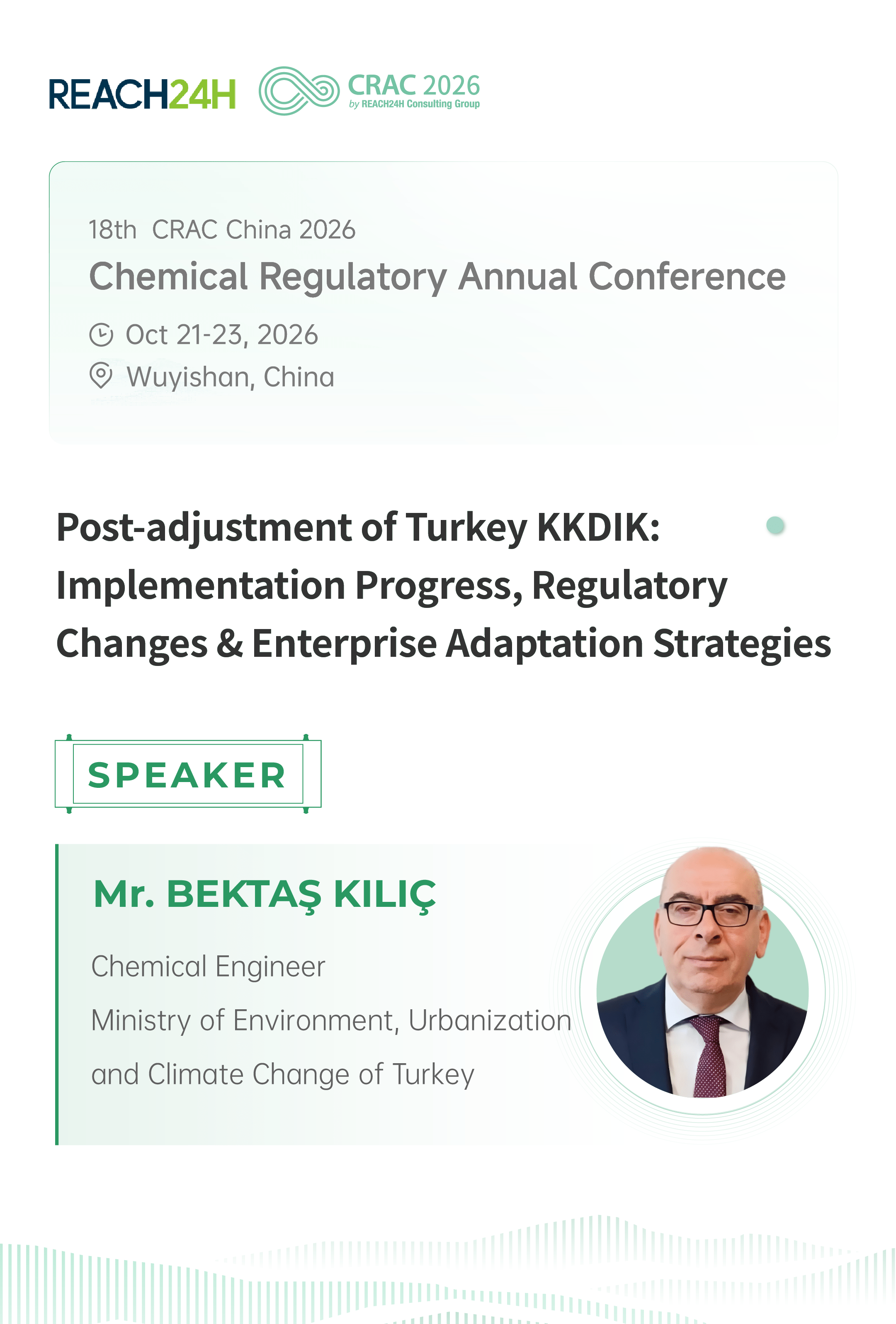
REACH24H uses the CRAC global forum series to support professional dialogue between regulatory authorities and industry. Following KKDIK discussions with representatives of Turkey's Ministry of Environment, Urbanization and Climate Change at CRAC China 2025 and CRAC Italy 2026, the Ministry is scheduled to participate again at CRAC China 2026.
Mr. Bektaş KILIÇ, Chemical Engineer, are listed for the October 21 session on KKDIK implementation progress, regulatory changes and enterprise adaptation strategies. Companies working on interim registration, full registration, data sharing or Turkey market access can review the CRAC China 2026 agenda. Topics and speakers remain subject to change.
Recommended Reading
KKDIK vs EU REACH: Data Reuse Strategy for Turkey REACH Registration
KKDIK Temporary Registration Activated: A Guide for Turkey REACH Compliance


