COMPANY & EVENT NEWS
Hosted by REACH24H Consulting Group and supported by the Singapore Chemical Industry Council (SCIC), CRAC Singapore 2025 convened more than 70 representatives from regulatory bodies, government-related institutions, industry organizations and companies. The two-day forum connected regulatory and industry perspectives across China, Japan, South Korea and ASEAN, with sessions spanning chemical management, GHS, EPR, Halal certification, green chemistry and decarbonisation.
Quick Navigation
Jump to the key sections of this event recap.
A Regional Forum Built on Regulatory and Industry Collaboration
Singapore, October 16, 2025 – The 17th Chemical Regulatory Annual Conference (CRAC 2025) concluded its Singapore stop after two days of discussion on Asia-Pacific chemical compliance and sustainable development. Organized by REACH24H and supported by SCIC, the conference brought together more than 70 representatives from regulatory bodies, government-related institutes, industry associations, academia and businesses.
The breadth of participation reflected REACH24H's long-standing communication network across the region. Speakers and contributors represented organizations including the Nanjing Institute of Environmental Sciences under China's Ministry of Ecology and Environment, the National Registration Center for Chemicals under China's Ministry of Emergency Management, the Philippine Department of Environment and Natural Resources–Environmental Management Bureau, Indonesia's Halal Product Assurance Organizing Agency (BPJPH), SCIC, the Japan Chemical Industry Association, the Korea Petroleum Association, the Vietnam Responsible Care Council, the Nickel Institute and Nanyang Technological University.
This participation should be understood as substantive regulatory and industry dialogue rather than institutional endorsement. It demonstrates REACH24H's ability to convene authoritative perspectives and translate high-level policy discussion into practical questions for manufacturers, importers and supply-chain teams.
Opening remarks: strengthening Singapore's role as a regional compliance hub
Mr. Fangwei Hong, Chairman and General Manager of REACH24H Consulting Group, highlighted Singapore's strategic position in the Asian chemical industry. Since establishing its Southeast Asia headquarters in Singapore in 2023, REACH24H has continued to strengthen regional service capacity and connections across global supply chains. He described CRAC Singapore as a platform where government, industry and academia can work together on chemical safety, sustainability and responsible innovation.
 Mr. Fangwei Hong delivers the opening remarks at CRAC Singapore 2025.
Ms. Cissie Yeung of SCIC called for closer cooperation among policymakers, enterprises and trade bodies during the region's green transition. She emphasized the value of regulatory coordination, technological progress and circular-economy principles in building a more resilient and inclusive regional compliance ecosystem.
 Ms. Cissie Yeung of SCIC addresses delegates at the opening session.
Direct Dialogue Across Major Asian Chemical Regulatory Systems
A central theme of CRAC Singapore 2025 was the shift from reactive control toward risk-based, preventive and life-cycle chemical management. Regulatory, research and industry experts compared how China, Taiwan, Japan and South Korea are adapting registration, hazard communication, workplace safety and supply-chain controls.
China: new chemical substances and hazardous chemical safety
Dr. Lei Wang, Director of the Chemicals Research Laboratory at the Nanjing Institute of Environmental Sciences, Ministry of Ecology and Environment, discussed the role of MEE Order No. 12 in China's increasingly risk-based approach to new chemical substance management. Her presentation examined differentiated controls based on factors such as volume, use and hazard profile, together with the broader “screening–evaluation–control” framework for life-cycle management.
 Dr. Lei Wang presents on China's new chemical substance management framework.
Mr. Jinhe Chen, an expert from the National Registration Center for Chemicals under the Ministry of Emergency Management of China, addressed hazardous chemical registration, hazard identification, SDS and GHS label compliance, and the role of regulatory data in accident prevention and emergency response.
 Mr. Jinhe Chen discusses hazardous chemical safety management in China.
Taiwan: classification-based management and dual-track registration
Ms. YaHui Ni, General Manager of Environmental Resource & Information Co., Ltd., introduced Taiwan's classification-based chemical management framework under the Toxic and Concerned Chemical Substances Control Act, including permits, registrations, notifications, labels, SDS and personnel training. Mr. Ray Huang, General Manager of REACH24H Taiwan, then outlined developments in the dual-track registration system for new and existing chemicals and the growing importance of hazard and exposure data.
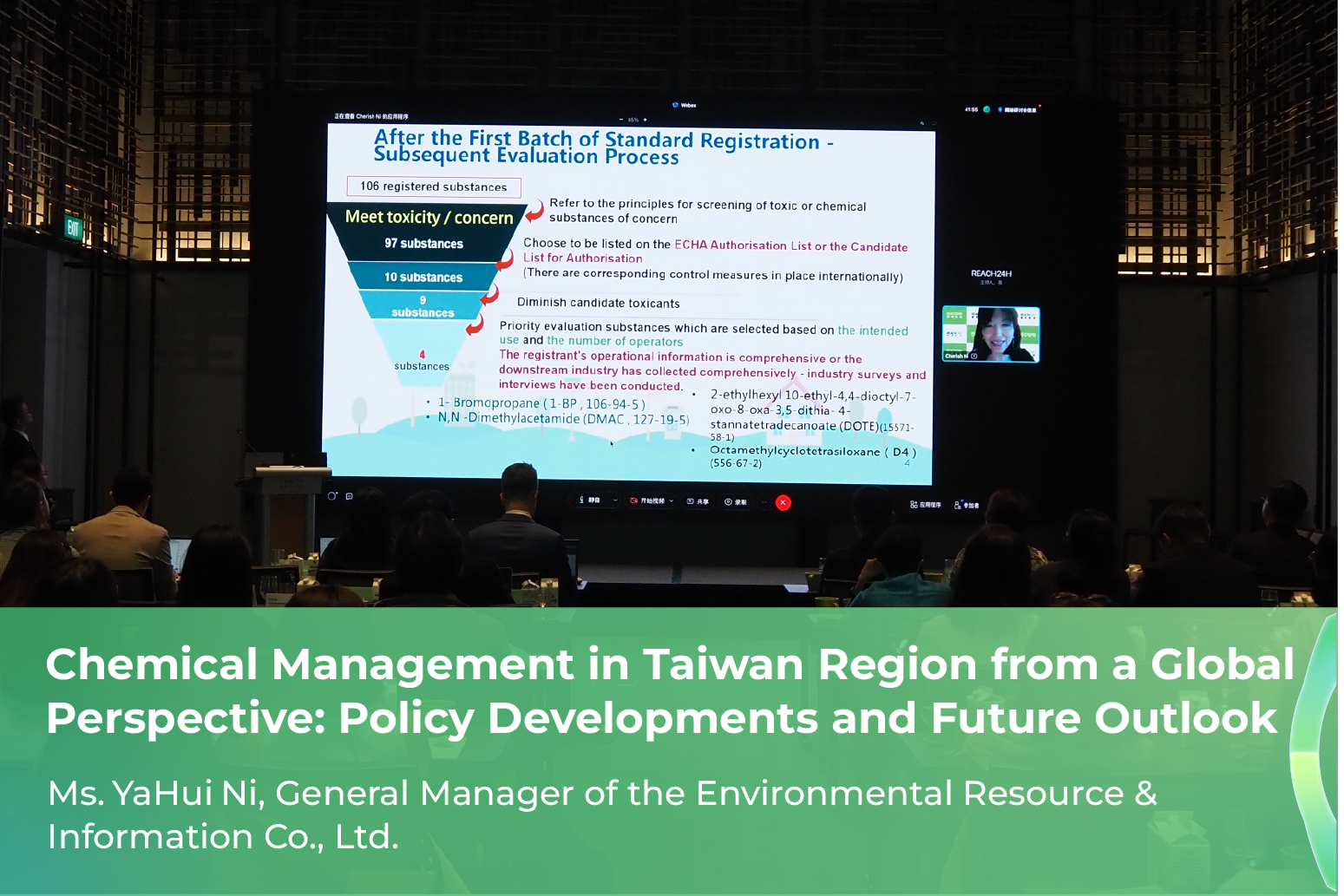 Ms. YaHui Ni presents on Taiwan's chemical management framework.
 Mr. Ray Huang discusses new and existing chemical registration in Taiwan.
Japan and South Korea: stronger data, SDS and enterprise-led risk management
Mr. Sugio Nishimura, General Manager of the Japan Chemical Industry Association, reviewed Japan's chemical control framework under CSCL, ISHL and PRTR requirements. He highlighted the expanding role of corporate risk assessment, exposure control, SDS and labeling obligations in workplace safety management.
 Mr. Sugio Nishimura presents on Japan's chemical control and workplace safety framework.
Mr. Ire Kim, Senior Manager at the Korea Petroleum Association, discussed reforms to K-REACH and the Chemical Control Act. His presentation focused on notification pathways, the use of broader data sources and more differentiated controls based on acute, chronic and ecological hazards.
 Mr. Ire Kim discusses reforms to K-REACH and the Chemical Control Act.
Southeast Asia Market Access and Certification in Focus
The conference also gave businesses direct access to regulatory and industry perspectives from fast-changing Asian markets. Sessions covered chemical notification and inventory systems, digital permitting, product certification and the documentation needed to maintain compliance after market entry.
Vietnam: evolving chemical controls and local compliance capacity
Mr. Do Thanh Bai, President of the Vietnam Responsible Care Council, discussed the development of Vietnam's chemical management framework and the need for companies to track requirements covering classification, labeling and risk assessment. He also emphasized supply-chain planning and local technical capacity as important foundations for long-term market participation.
 Mr. Do Thanh Bai discusses Vietnam's evolving chemical management framework.
India: BIS certification and post-certification continuity
Mr. Aman Sharma, Global Regulatory Affairs Consultant at REACH24H, examined India's mandatory BIS certification framework for chemicals. He advised companies to confirm the applicable certification route, prepare technical documentation systematically, maintain laboratory calibration validity and plan for ongoing obligations after certification.
 Mr. Aman Sharma presents practical considerations for India BIS chemical certification.
Philippines: lifecycle regulation and digital permitting
Engr. Roland Omar C. Tamani of the Environmental Management Bureau, Department of Environment and Natural Resources, introduced the Philippines' lifecycle-based framework under R.A. 6969, including PICCS, the Priority Chemicals List and Chemical Control Orders. He also highlighted the importance of the Online Permitting and Monitoring System, compliant test data, SDS preparation and sustainable internal compliance processes.
 Engr. Roland Omar C. Tamani presents on chemical regulation and digital permitting in the Philippines.
Indonesia: first-hand perspectives on BPJPH Halal certification
Mr. Muhammad Wahyu Arif of the Halal Certification Directorate at BPJPH discussed Indonesia's Halal Product Assurance framework and the need to plan certification pathways around product composition and technical documentation. His participation gave international companies direct access to an authority perspective on Indonesia's developing Halal certification system.
 Mr. Muhammad Wahyu Arif of BPJPH discusses Indonesia's Halal certification framework.
Mr. Ade Suherman, Halal Auditor Management Manager at LPPOM, added an operational perspective covering preparation, application, audit readiness and post-certification continuity. He emphasized complete documentation, an aligned Halal assurance system, management support, training and ongoing policy monitoring.
 Mr. Ade Suherman of LPPOM shares practical insights into Halal audit and certification.
Sustainability, GHS and EPR: Connecting Policy with Implementation
Moderated by Mr. Fabien Henry, Regulatory Affairs Manager for South-East Asia at the Nickel Institute, the sustainability session examined how companies can align chemical compliance with decarbonisation, circularity and value-chain risk management.
 Mr. Fabien Henry moderates the sustainability and compliance session.
Decarbonisation: moving from policy risk to business response
Dr. Daniel Lee, Associate Professor at Nanyang Technological University, encouraged businesses to use internal carbon pricing and scenario analysis in investment and risk planning. He also emphasized supplier engagement, joint emission-reduction targets, procurement optimization and the development of lower-carbon products across the value chain.
 Dr. Daniel Lee presents on decarbonisation policy and corporate response.
GHS: managing regional differences in hazard communication
The forum reviewed developments linked to the UN GHS framework and implementation trends across China, Singapore, Japan, South Korea and Vietnam. Ms. Qiyi Zhang, Senior Regulatory Consultant at REACH24H, recommended a systematic approach combining regulatory monitoring, differentiated CBI strategies and transparent hazard-information exchange across supply chains.
 Ms. Qiyi Zhang discusses GHS implementation and supply-chain hazard communication.
EPR: advancing circularity through regional cooperation
Ms. Cissie Yeung of SCIC examined Extended Producer Responsibility as a policy mechanism for improving lifecycle accountability and recycling outcomes. She called for greater regional alignment on definitions, scope and standards, together with investment in recycling systems, technology and capacity building.
 Ms. Cissie Yeung discusses EPR and regional circular-economy cooperation.
From Conference Insights to Practical Compliance Action
CRAC Singapore 2025 did more than summarize policy developments. It demonstrated REACH24H's ability to bring regulators, government-related research institutes, industry associations, academic experts and companies into the same discussion, then connect those discussions with concrete market-access work.
For companies manufacturing, importing or supplying chemicals and related products across Asia-Pacific, REACH24H provides support in the areas highlighted at the conference:
China chemical compliance: MEE Order No. 12 new chemical substance registration, hazardous chemical registration, and China SDS and label compliance.
Northeast Asian market access: Taiwan TCCSCA and OSHA registration, Japan CSCL and ISHL compliance, K-REACH registration, Korean MSDS submission and CBI applications, and Korea CCA compliance.
Southeast Asian chemical compliance: Vietnam chemical registration and NCI compliance and Philippines PMPIN notification.
India market access: BIS FMCS certification for regulated chemical products and ongoing certification maintenance.
Indonesia Halal certification: BPJPH pathway assessment, documentation, SIHALAL support, SJPH preparation and audit readiness.
Global hazard communication and sustainability: GHS, SDS/MSDS and label compliance, regulatory monitoring, chemical lifecycle management and sustainability solutions.
CRAC's Global Conference Network and REACH24H's Convening Role
Since 2009, the Chemical Regulatory Annual Conference has developed into a recurring platform for dialogue among government bodies, international institutions, industry associations, technical experts and businesses. Across its history, CRAC has reported collaboration with organizations including the Helsinki Chemicals Forum, the United Nations Environment Programme, the European Commission and the Organisation for Economic Co-operation and Development. Speakers and participants at different editions have also come from bodies including China's Ministry of Ecology and Environment and Ministry of Emergency Management, the European Chemicals Agency, the U.S. Environmental Protection Agency and South Korea's National Institute of Environmental Research.
The successful Singapore conference completed CRAC 2025's three-city program after Hangzhou and Tokyo. Across the three stops, more than 600 industry leaders and experts participated in discussions on chemical regulation, innovation, market access and sustainable development.
As the organizer of CRAC, REACH24H combines this international dialogue network with technical teams and local operations across major markets. The Group supports more than 15,000 companies worldwide with regulatory strategy, product registration, hazard communication, market access and ongoing compliance.
Turn regulatory dialogue into practical market access action
REACH24H can help assess your obligations, define a market-specific compliance pathway and coordinate registration, documentation, SDS and labeling, certification, and ongoing compliance across Asia-Pacific.
Recommended Reading
CRAC Japan 2025: Global Compliance of Chemicals and Food Contact Materials
CRAC China 2025: Cosmetic Ingredient Innovation and Compliance
CRAC 2025 in Hangzhou: Pesticide Innovation, Collaboration and Sustainability
REACH24H at Helsinki Chemicals Forum 2026: Supporting Global Dialogue on Chemicals Management